Uncategorized

Concerned homeowner checking an empty propane tank gauge in winter — time to call for emergency propane delivery Newport PA
Uncategorized

Emergency Propane Refills: What to Do if You Run Out in Newport or Duncannon

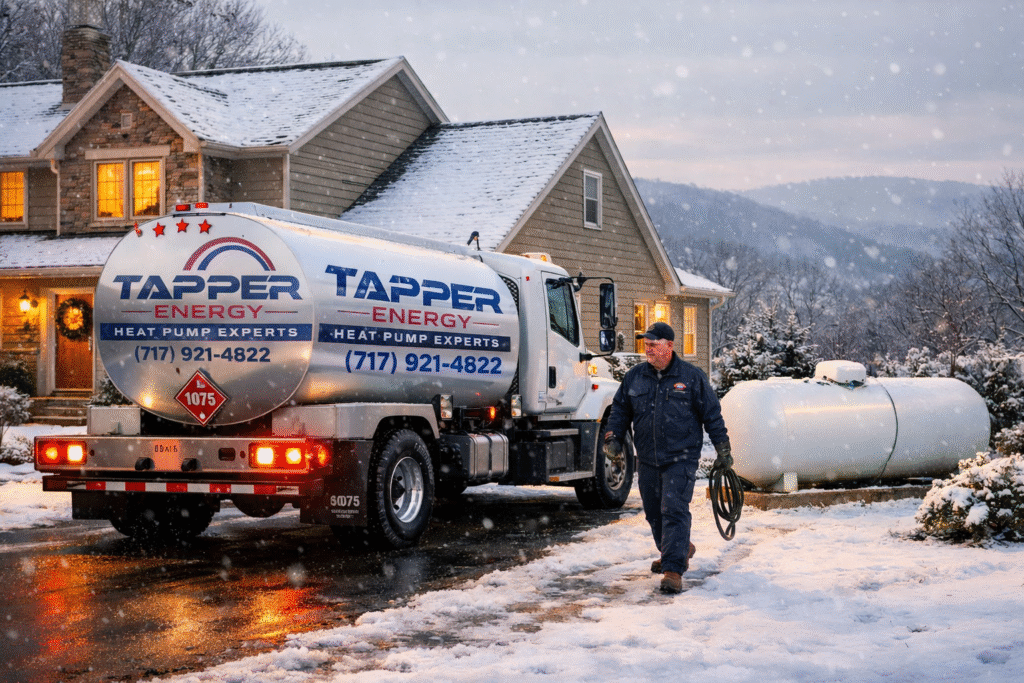
Emergency propane delivery Newport PA is not something you ever want to need — but when your tank runs dry during a bitter Perry County PA cold snap, knowing exactly what to do can protect your family, your pipes, and your peace of mind. You wake up to a freezing house. The thermostat reads 52°F and dropping. You stumble to the basement and check your tank gauge — the needle sits on empty. Panic sets in. What now? This situation happens to more Susquehanna River area homeowners than you might expect. Rural delivery routes, unpredictable weather, and aging equipment all contribute to unexpected propane outages. The good news? A fast response and the right local supplier can have your heat running again within hours, not days. This guide walks you through every critical step. You will learn exactly what to do the moment you realize you are out of propane. You will understand the safety protocols that protect your home. And you will discover how to prevent this emergency from ever happening again. For immediate assistance, the team at Tapper Energy offers 24/7 dispatch across Newport, Duncannon, and the entire Perry County PA region. Table of Contents Immediate Steps: What to Do the Moment Your Propane Tank Runs Dry The moment you realize your propane tank is empty, take a breath. Panic leads to mistakes. A calm, methodical response protects your home and speeds up the refill process. Your first action is critical. Walk outside to your propane tank and locate the main tank valve. Turn it clockwise until it stops completely. This tank valve closure prevents any residual gas from escaping and stops air from entering the system. Next, go back inside and turn off every propane appliance in your home. Your furnace, water heater, stove, dryer, and fireplace all need to be switched to the “off” position. Do not simply turn down thermostats — physically switch each appliance off at its control panel. Now check your pilot lights. Modern appliances often have electronic ignition, but older units may have standing pilot lights that have gone out. Do not attempt to relight any pilot until a certified technician inspects your system after the refill. Here is your quick-action checklist for an empty propane tank: Step Action Why It Matters 1 Close the main tank valve (turn clockwise) Prevents air and moisture from entering the system 2 Turn off all propane appliances Stops gas flow when service resumes 3 Do NOT relight pilot lights yourself Safety risk until leak test is completed 4 Open windows briefly if you smell gas Ventilates any trapped propane 5 Call your propane supplier immediately Gets you on the emergency dispatch schedule 6 Avoid using open flames near the tank Eliminates ignition risk during refill The stress of a cold house during a Perry County PA winter is overwhelming. Temperatures inside can drop below freezing within hours if your home lacks adequate insulation. Pipes freeze. Pets suffer. Every minute counts. That is why your next call matters so much. Reach out to a local supplier with true emergency response capability — not a national call center that routes you to a 48-hour waitlist. Fast Response: Why You Need Emergency Propane Delivery in Newport PA In rural areas like Newport, you cannot afford to wait. National propane companies often prioritize densely populated routes where one truck serves dozens of customers. Out here along Route 34 and Route 22/322, you might be the only delivery on a 20-mile stretch. Emergency propane delivery Newport PA homeowners can actually rely on requires a supplier who knows the backroads. Someone who understands that the quickest path to your property might be the unpaved fire road behind the old Miller farm, not the main highway that floods every spring. Tapper Energy is that kind of supplier. As a local family-owned energy company, they have spent decades building relationships throughout Perry County PA. Their drivers know which driveways get icy first. They know where cell service drops out. They know your road by name, not just by GPS coordinates. When you call Tapper’s 24/7 dispatch line, you reach a real person who lives in this community. They understand the urgency because they have been in your situation themselves. That personal connection translates into faster response times and better communication throughout the delivery process. National chains often quote “24 to 48 hours” for emergency calls. In a January cold snap with wind chills below zero, 48 hours means frozen pipes, burst water lines, and thousands of dollars in damage. A truly local provider like Tapper aims to reach you within hours — often the same day you call. The Safety Protocol: Why Running Out of Propane is a Risk Running out of propane is more than an inconvenience. It creates genuine safety hazards that every homeowner must understand. An empty system behaves differently than a full one, and those differences can lead to dangerous situations if not handled correctly. When your tank runs completely dry, the positive pressure that normally keeps air out disappears. Air and moisture can enter the tank, the propane regulator, and even the gas lines running into your home. That moisture causes internal rust over time. Rust flakes can clog regulators and burner orifices, leading to inefficient combustion or complete appliance failure. Even more concerning is the potential for leaks. Connections that held perfectly under pressure may loosen when that pressure drops to zero. When the tank refills and pressure returns, those compromised connections can allow gas to escape. Why You Must Shut Off Your Main Tank Valve Immediately Closing your tank valve the moment you realize the tank is empty is not optional. It is the single most important safety step you can take. An open valve on an empty tank allows outside air to flow backward into the system. Pennsylvania’s humid climate means that air carries moisture. That moisture condenses inside the tank, forming water droplets that sink to the bottom and promote rust. Rust inside
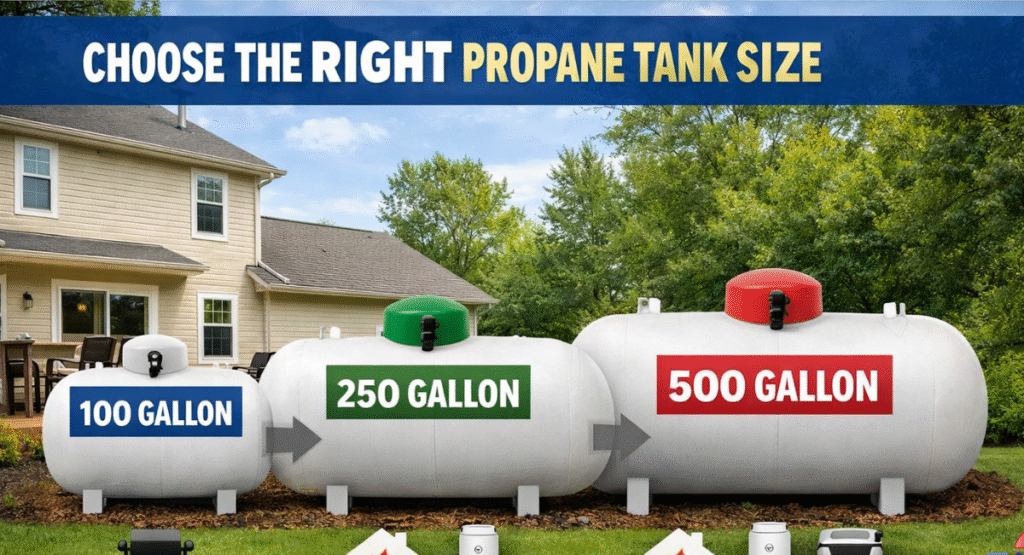
Propane tank installation Camp Hill — side-by-side size comparison of 120, 250, and 500-gallon residential tanks in a suburban yard
Uncategorized

Propane Tank Installation Camp Hill: 10 Best Expert Tips to Choose the Right Size

Propane tank installation Camp Hill homeowners trust starts with knowing your home’s actual energy needs. You are standing in your backyard near Market Street Camp Hill, staring at the space between the fence and the patio. Will a tank even fit here? Which size makes sense for your household? These questions come up for thousands of homeowners across the West Shore PA region every single year. Getting the answer right means cozy winters and lower fuel bills. Getting it wrong means overpaying for capacity you will never use — or worse, running dry during a bitter January cold snap. This guide covers everything you need. From 120-gallon “DOT” cylinders for modest setups to 1,000-gallon tanks for sprawling estates, each option serves a purpose. You will also learn about BTU load calculation, Cumberland County zoning, safety setbacks, and frost line depth requirements. Whether you are asking “what size propane tank for a 3-bedroom house?” or “do I need a permit for a propane tank in Camp Hill?”, every answer is right here. For personalized guidance, the experts at Tapper Energy are always ready to help. Table of Contents Planning Your Propane Tank Installation Camp Hill: Where to Start? The first step toward a successful propane tank installation Camp Hill project is not picking a tank. It is understanding your home inside and out. Walk through every room and count each appliance that runs on propane. Your furnace, water heater, stove, dryer, and fireplace all consume fuel at different rates. Write those numbers down. This simple inventory becomes the foundation of your entire sizing decision. Too many homeowners skip this step and default to the biggest tank they can afford. Bigger is not always better — especially on a compact Borough lot. Think about your property next. The Borough of Camp Hill features a mix of historic homes with narrow side yards and newer builds with more generous layouts. Your lot dimensions, existing landscaping, and proximity to property lines all dictate where a tank can go. A quick measurement of your available outdoor space narrows your options immediately. Combine that with your appliance inventory and you have already eliminated guesswork. That is exactly how the professionals at Tapper Energy approach every installation across the Capital City Region. Understanding Common Propane Tank Sizes for Central PA Homes Propane tanks come in four standard residential sizes. Each serves a different type of household and energy demand. The table below gives you a quick snapshot. Tank Size Best For Estimated Annual Usage 120 Gallon Cooking, fireplaces, grills Under 500 gallons/year 250 Gallon Furnace + 1–2 appliances 500–800 gallons/year 500 Gallon Whole-home heating 800–1,500 gallons/year 1,000 Gallon Large estates, pools, generators 1,500+ gallons/year Understanding these sizes helps you ask better questions when you call a provider. You will already know which category fits your lifestyle across the Susquehanna Valley. 120-Gallon Tanks: Ideal for Cooking and Fireplaces The smallest option is the 120-gallon “DOT” cylinder. DOT stands for Department of Transportation. These tanks meet federal standards for portable and semi-permanent use. They stand upright, making them a smart choice when considering vertical vs. horizontal tanks in tight spaces. If your home uses natural gas or electric heating but you want propane for a kitchen range or fireplace, this size handles it beautifully. However, a 120-gallon tank runs out quickly if you push it beyond its purpose. Think of it as a supplemental tank rather than a primary fuel source. Many homeowners near Hampden Township and Lower Allen pair these with an existing electric HVAC system. 250-Gallon Tanks: The Middle Ground for Moderate Energy Use Stepping up to a 250-gallon tank opens the door to moderate whole-home propane use. This size supports a furnace combined with a water heater or cooking range comfortably. It is the sweet spot for smaller Camp Hill homes, condominiums, and townhouses. If you have searched “what size propane tank for a 3-bedroom house?”, this is frequently the answer for homes under 1,800 square feet. The 250-gallon tank also introduces you to the tank gauge reading system. A dial on top shows the percentage of fuel remaining. The industry follows the 80% fill rule, meaning your tank only gets filled to 80% capacity. This leaves room for the propane to expand safely in warm weather. 500-Gallon Tanks: The Standard for Whole-Home Heating in Camp Hill The 500-gallon ASME tank is the undisputed residential standard across Camp Hill and the broader West Shore PA area. ASME stands for the American Society of Mechanical Engineers. This size handles everything a typical household throws at it. Central heating, hot water, cooking, clothes drying, and even a best propane tank for home backup generator setup — it manages all of it. It delivers reliable performance without excessive bulk. If you are pairing your new tank with an upgraded furnace, the team at Tapper Energy’s HVAC services in Camp Hill can coordinate both projects seamlessly. The vaporization rate performs optimally at this volume for average residential demand. During cold snaps, smaller tanks can struggle to convert liquid propane to gas fast enough. A 500-gallon tank maintains steady vaporization even when Susquehanna Valley temperatures plummet well below freezing. 1,000-Gallon Tanks: Maximum Capacity for Large Estates When a 500-gallon tank is not enough, the 1,000-gallon model steps in. This tank serves large estates, homes with heated pools, and properties with guest houses. It is common on larger lots in Hampden Township and Lower Allen. If you have wondered about the cost of underground propane tank installation for a large property, this is typically the size that gets buried. The advantage is straightforward. Fewer deliveries and better bulk pricing. A 1,000-gallon tank lets you purchase propane during summer when pre-season rates drop significantly. Factors That Determine Your Perfect Propane Tank Size Choosing correctly requires evaluating three interconnected factors. Ignoring any one of them leads to a misfit installation that costs more over time. A professional BTU load calculation quantifies your total energy demand. BTU stands for British Thermal Unit. Your furnace

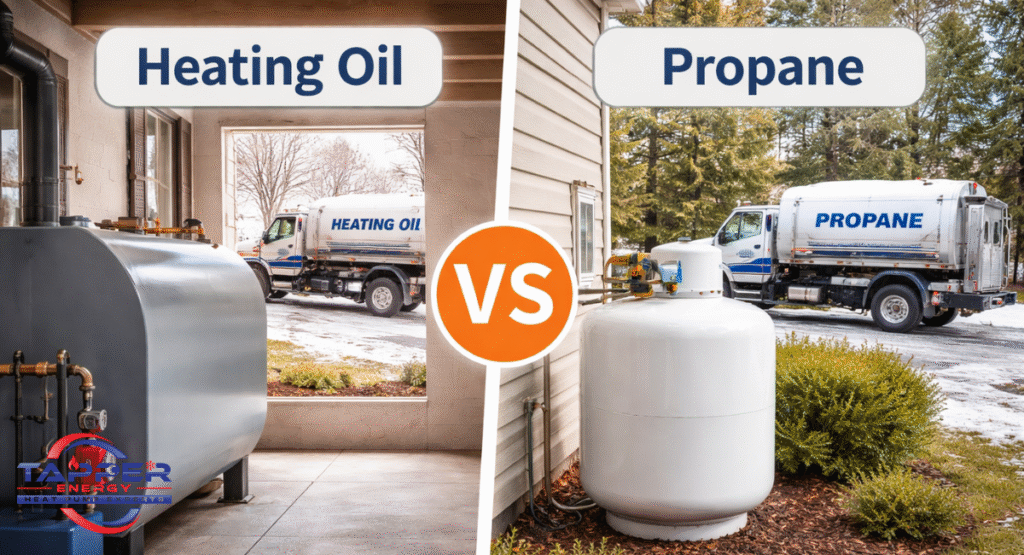
Side-by-side comparison of heating oil vs propane cost PA homeowners face showing an older oil tank system in a basement with an oil delivery truck outside on the left versus a modern propane tank setup with a clean propane delivery truck outside on the right for Central PA homes in Harrisburg and Mechanicsburg
Uncategorized

Is Heating Oil or Propane Better for Your Central PA Home? A 2026 Guide

Your complete 2026 resource for comparing heating oil vs propane cost PA homeowners actually face — covering efficiency, safety, delivery, and long-term value across the Susquehanna Valley. When heating oil vs propane cost PA homeowners pay every winter becomes the defining question of your annual energy budget, the answer matters enormously. Families across the Midstate — from the West Shore suburbs of Mechanicsburg to the rural Perry County routes near Newport and Duncannon — face this exact decision every single year. Some stick with Heating Oil #2 out of pure habit. Others are discovering that LP Gas delivers better efficiency, cleaner combustion, and more predictable pricing across a full Central PA winter season. This 2026 guide breaks down every factor that genuinely matters — cost per gallon, AFUE rating comparisons, equipment lifespan, delivery reliability, environmental impact, and real conversion costs — so you can make a fully informed energy decision for your specific Capital City region home before next heating season begins. Whether you live in Lower Paxton Township, Cumberland County suburbs, or along the Route 15 and I-81 corridors, this guide was built specifically for you. The Big Debate: Analyzing Heating Oil vs Propane Cost PA for Homeowners The heating oil vs propane cost PA debate isn’t settled by a single price-per-gallon comparison — it never has been. True cost analysis requires examining fuel efficiency, system performance, delivery reliability, price volatility patterns, and long-term equipment costs simultaneously. Homeowners across the Midstate who switch fuel sources based purely on today’s advertised gallon price frequently discover they missed critical cost factors that show up on their bills three months later without warning. The Capital City region energy market moves fast — and understanding all cost dimensions before committing to either fuel protects your household budget far more effectively than chasing the lowest quoted price available this week. According to the U.S. Energy Information Administration’s residential heating fuel data, both heating oil and propane prices fluctuate significantly with crude oil markets, seasonal demand cycles, and regional supply chain pressures. Central PA homeowners in Dauphin County and Cumberland County experience these fluctuations acutely every winter — making advance price protection strategies not merely convenient but genuinely financially critical for any household managing a fixed monthly budget through a Susquehanna Valley heating season. Comparing Price Per Gallon: Propane vs. Heating Oil in the Midstate Raw price-per-gallon comparisons between propane and Heating Oil #2 require important context to be genuinely meaningful for Midstate homeowners. Propane typically contains approximately 91,500 BTU per gallon. Heating Oil #2 delivers approximately 138,500 BTU per gallon — a higher raw energy content per unit volume. However, that BTU advantage doesn’t automatically translate into lower operating costs when system efficiency differences are factored into the real-world calculation. A modern high-efficiency propane condensing furnace running at 96% AFUE rating frequently delivers more usable heat per dollar spent than an older oil burner operating at 78–82% efficiency — even when oil’s raw price per gallon appears lower on the surface. The Pennsylvania Public Utility Commission’s energy comparison resources help Central PA homeowners evaluate fuel costs using equivalent heat unit calculations rather than misleading raw gallon price comparisons alone. Current heating oil prices in Harrisburg PA and surrounding Dauphin County communities fluctuate between $3.20 and $4.80 per gallon depending on market conditions and delivery timing. Propane prices across Mechanicsburg Borough and Cumberland County suburbs typically range between $2.50 and $3.90 per gallon through the same seasonal windows. The meaningful comparison requires converting both fuels to cost-per-million-BTU delivered to your living space — not cost per gallon sitting in your tank. Fuel Type BTU Per Gallon Typical PA Price Range Cost Per Million BTU (Est.) Propane LP Gas 91,500 BTU $2.50–$3.90/gal $27–$43 Heating Oil #2 138,500 BTU $3.20–$4.80/gal $23–$35 Natural Gas 100,000 BTU/therm $1.10–$1.80/therm $11–$18 Electric Resistance 3,412 BTU/kWh $0.14–$0.22/kWh $41–$64 How BTU Efficiency Affects Your Total Energy Bill Raw BTU comparison numbers tell only half the story that Central PA homeowners genuinely need to understand. The other half lives in your heating system’s AFUE rating — the percentage of fuel energy actually converted into usable household heat versus lost through exhaust and system inefficiency. An oil burner carrying a 78% AFUE rating loses 22 cents of every fuel dollar straight up the flue pipe as wasted exhaust heat. A modern propane condensing furnace operating at 96% AFUE rating loses only 4 cents per dollar — delivering 92 cents of usable warmth from every dollar of LP Gas consumed throughout the heating season. For a typical 2,000 square foot home in Lower Paxton Township or Susquehanna Township consuming 800 gallons of heating fuel annually, that efficiency gap translates into hundreds of real dollars saved per heating season — not theoretical savings on a marketing brochure but actual money remaining in your household budget every February. The U.S. Department of Energy’s heating system efficiency guidance recommends that Central PA homeowners evaluate new heating equipment using AFUE ratings as the primary comparison metric rather than fuel type or equipment price alone — because long-term operating efficiency consistently outweighs upfront equipment cost differences over any realistic ownership timeline. Price Protection: Locking in Rates to Avoid Winter Spikes Both propane and heating oil prices spike predictably during Central PA winter demand peaks — but the available price protection mechanisms differ meaningfully between the two fuels. Propane suppliers like Tapper Energy offer Price Cap Programs that set a firm per-gallon ceiling regardless of market movement above that ceiling — while still allowing customers to benefit automatically from any market price drops below the cap level. Budget Billing Plans spread estimated annual fuel costs across 12 equal monthly payments — eliminating the January billing shock that catches unprepared Susquehanna Valley families every single year without exception. Heating oil price protection programs exist but vary dramatically in structure, availability, and terms between suppliers across Dauphin County and Cumberland County. Fixed-price oil contracts lock your rate completely — eliminating downside market benefit entirely. Oil budget plans function similarly to propane budget billing

Propane Delivery in Harrisburg and Mechanicsburg
Uncategorized

The Ultimate Homeowner’s Guide to Reliable Propane Delivery in Harrisburg and Mechanicsburg

Your complete local resource for LP gas service, tank options, pricing plans, and finding the best Propane Delivery in Harrisburg and Mechanicsburg Running out of propane on a freezing January night in Central PA isn’t just uncomfortable — it’s a crisis. Whether you live on the East Shore near Lower Paxton Township or the West Shore closer to Mechanicsburg, finding truly reliable propane delivery changes everything about your winter experience. Not every supplier shows up when roads ice over along the Susquehanna Valley. The best propane supplier Central PA homeowners trust combines local knowledge, transparent pricing, and genuine emergency availability. This guide helps you navigate propane delivery Harrisburg PA options, compare propane companies Mechanicsburg PA residents actually rely on, and choose a partner who treats your home — and your family’s warmth — as a real priority. Propane Delivery in Harrisburg and Mechanicsburg has never been more important to understand fully before committing to any single supplier relationship. Finding the Best Propane Supplier in Central PA for Your Home Choosing a propane supplier feels simple until February hits and your tank reads 10%. Suddenly, “low price” means nothing if nobody picks up the phone. The best propane supplier in Central PA isn’t always the one with the biggest billboard on the I-81 Harrisburg exit — it’s the one with a bobtail delivery truck already heading your way before you even call. Local, family-owned suppliers operate with a completely different mindset than national chains. They know the Route 15 Corridor. They know which roads flood near the Susquehanna River after a sleet storm. They treat your account like a neighbor’s account — not a revenue number assigned to a zip code in a spreadsheet managed from another state entirely. Before signing any contract, ask yourself one honest question: will this company show up for me on the worst day of winter? National chains route calls through out-of-state dispatch centers that rely entirely on GPS navigation and automated scheduling systems. A local Tapper Energy driver already knows your driveway, your neighborhood’s seasonal quirks, and the fastest safe route to your door during a Dauphin County ice storm. According to the U.S. Energy Information Administration, propane heats approximately 5% of all U.S. homes — and in rural Central PA, that number climbs significantly higher. That difference between a faceless ticket number and a recognized local account is what separates genuinely reliable propane delivery from a company that simply collects payments in October and hopes for a mild winter that never comes. What to Evaluate Local Supplier Advantage National Chain Disadvantage Dispatch Location Local office, fast routing Out-of-state call center Storm Response Drivers know local roads GPS-only navigation Account Relationship Personal, long-term Rotating customer service reps Pricing Transparency Straightforward billing Common hidden fee structures Emergency Availability Direct local line 1-800 queue system Why Local Expertise Matters for Propane Delivery in Harrisburg PA Harrisburg PA isn’t one simple city. It’s a layered metro area — Lower Paxton Township sprawls east, Susquehanna Township sits north, and Swatara stretches south toward the state line. Each neighborhood carries its own road quirks, seasonal flooding patterns, and driveway access challenges that no national dispatch algorithm can fully replicate or anticipate. A driver who learned these streets through years of daily lived experience will always outperform a GPS signal routed from a call center operating three states away with no local context whatsoever. Propane Delivery in Harrisburg and Mechanicsburg demands that kind of earned, granular, hyperlocal knowledge — and homeowners who’ve survived a brutal Midstate winter understand exactly why it matters at 2 AM when their heat goes out. The East Shore vs. West Shore divide alone creates entirely distinct delivery dynamics across the Harrisburg metro area. Bridge access points, traffic patterns near the Susquehanna River, and neighborhood layouts differ significantly between the two sides of the water. When a bobtail delivery truck needs to reach a customer in a tight Harrisburg suburb during an ice storm at 6 AM, local expertise isn’t a bonus feature listed in marketing materials — it’s the entire service itself. The Pennsylvania Public Utility Commission regulates propane suppliers operating in Dauphin County and across the state, ensuring baseline service standards that local companies like Tapper Energy consistently exceed through genuine community investment and driver knowledge built over years. Comparing Propane Companies in Mechanicsburg PA: What to Look For Mechanicsburg PA homeowners — especially those in Silver Spring Township and Upper Allen — often manage larger properties with substantially higher seasonal heating demands. Bigger homes burn more residential heating fuel per month. Larger lots sometimes accommodate underground propane tanks buried well below Pennsylvania’s frost line for aesthetic and practical reasons. These homeowners need considerably more from their propane supplier than simply a competitive per-gallon price posted on a website. They need demonstrated technical expertise, genuinely reliable scheduling, and flexible financial tools that match the real scale of their energy consumption. Propane Delivery in Harrisburg and Mechanicsburg for larger Cumberland County properties requires suppliers with real installation credentials and multi-application experience. When comparing propane companies in Mechanicsburg PA, focus on five critical factors before price ever enters the conversation: tank gauge and monitoring technology, genuine 24/7 emergency response capability, flexible payment plan options, certified installation expertise, and proven local delivery reliability across varied Cumberland County terrain. A company that checks all five boxes confidently is worth a few extra cents per gallon without any hesitation. One that stumbles on even two of those criteria will cost you far more in compounded stress, missed delivery windows, and expensive emergency service calls than any per-gallon savings could ever offset across a full heating season in Central PA. Feature Why It Matters for Mechanicsburg Homeowners Tank Monitoring Technology Prevents run-outs on large-lot rural properties 24/7 Emergency Service Essential for families with no backup heating source Budget Billing Plans Smooths out unpredictable winter costs Underground Tank Expertise PA frost line knowledge protects your investment Local Dispatch Faster response across Cumberland County roads Automatic vs. Will-Call: Which Propane Delivery in

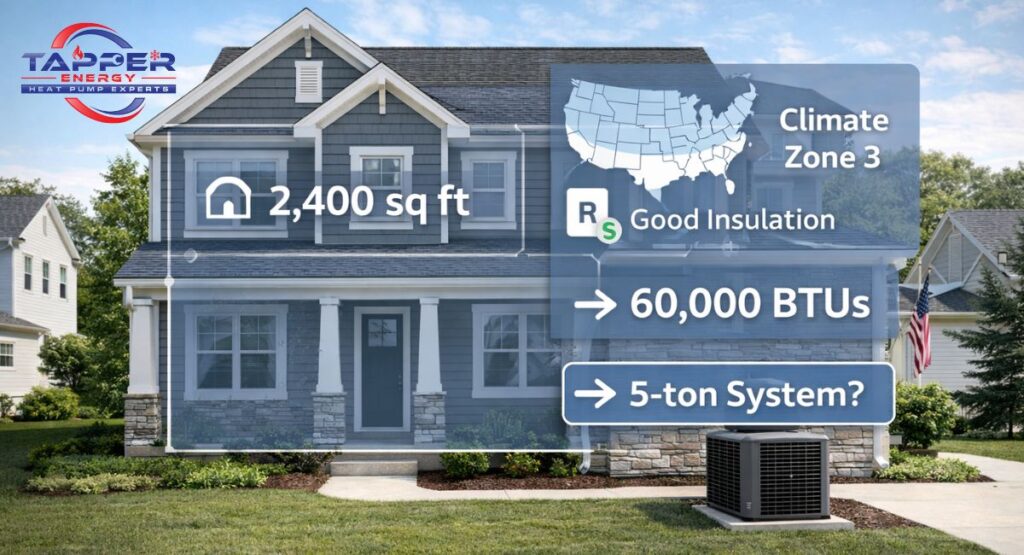
What size HVAC unit do I need — diagram of a 2,400 sq ft suburban home showing 5-ton system, 60,000 BTUs, insulation rating, and climate zone overlay
Uncategorized

What Size HVAC Unit Do I Need? 7 Proven Steps to Get It Right

Choosing the right HVAC system size is one of the most important decisions you will make as a homeowner. Buy the wrong size and you will pay for it every single month — in wasted energy, poor comfort, and early equipment failure. So, what size HVAC unit do you need? The answer depends on more than just your square footage. Your climate, your insulation, your windows, and your home’s layout all play a role. This guide covers everything you need to know — from BTU calculator for home basics to Manual J load calculation results — so you can make a smart, confident decision before you spend a dime. How HVAC Unit Size Is Measured (BTUs, Tons, and What They Mean) Before you can answer the question “what size HVAC unit do I need,” you need to understand how size is actually measured. HVAC professionals do not talk about physical dimensions. They talk about cooling capacity and heating capacity — how much heating or cooling a system can deliver per hour. What Is a BTU and Why Does It Matter for HVAC Sizing? BTU stands for British Thermal Unit (BTU). One BTU is the amount of energy it takes to raise one pound of water by one degree Fahrenheit. In the HVAC world, capacity is measured in BTUs per hour (BTU/hr). This tells you how many BTUs of heat a system can add or remove from your home every hour. The higher the BTU rating, the more powerful the system. When you are cooling your home, your AC removes heat. When you are heating, your furnace or heat pump adds it. Understanding British Thermal Units (BTUs) is the foundation of any HVAC load calculation. What Does “Tonnage” Mean in Air Conditioning? In the U.S., air conditioners and heat pumps are commonly sized in tons. This confuses a lot of homeowners. HVAC tonnage has nothing to do with physical weight. One ton of cooling capacity equals 12,000 BTUs per hour. So a 2-ton AC unit delivers 24,000 BTU/hr of cooling, and a 3-ton unit delivers 36,000 BTU/hr. Common residential AC sizes range from 1.5 tons to 5 tons. Most U.S. homes fall between 2 and 4 tons depending on size, location, and construction. The table below shows the BTU equivalent for each tonnage level: HVAC Tonnage BTUs Per Hour Typical Home Size 1.5 tons 18,000 BTU/hr Up to 900 sq ft 2 tons 24,000 BTU/hr 901–1,200 sq ft 2.5 tons 30,000 BTU/hr 1,201–1,500 sq ft 3 tons 36,000 BTU/hr 1,501–1,800 sq ft 3.5 tons 42,000 BTU/hr 1,801–2,100 sq ft 4 tons 48,000 BTU/hr 2,101–2,500 sq ft 5 tons 60,000 BTU/hr 2,501–3,000+ sq ft How Heating and Cooling Sizing Differ Your heating capacity and cooling capacity requirements are often different. A furnace is rated by BTU/hr output, while an air conditioner is rated in tons. Your home may need a 3-ton AC for cooling but only a 60,000 BTU/hr furnace for heating. That is completely normal. Heat pump sizing requirements are slightly different again. A heat pump handles both heating and cooling in one unit. Its heating capacity can drop significantly in very cold temperatures, which affects sizing decisions in northern U.S. climates. Want to understand how system type affects your sizing decision? Read our guide: How to Choose the Right HVAC System. How to Calculate the Right HVAC Size for Your Home’s Square Footage Now that you know what BTUs and tons mean, let’s look at how to use square footage to estimate what size HVAC unit you need. This is the most widely used first step in residential HVAC sizing. The Basic Square Footage Formula for HVAC Sizing The industry standard rule of thumb is 20 BTUs of cooling capacity per square foot of conditioned living space. This is the foundation of every HVAC unit size calculator and AC tonnage calculator you will find online. Here is a simple example. A 1,500 sq ft home × 20 = 30,000 BTUs per hour. Divide by 12,000 = 2.5 tons. That is your starting estimate — not your final answer. Step-by-Step: Estimating What Size HVAC Unit You Need Step 1: Measure only conditioned square footage. Exclude your garage, unfinished basement, and unconditioned attic. Step 2: Multiply your conditioned square footage by 20. This gives your baseline BTU requirement. Step 3: Divide that number by 12,000 to convert to tons. Step 4: Adjust based on climate zone, insulation quality, and ceiling height. Rooms taller than 8 feet need more capacity. Step 5: Use this estimate as a starting point when talking to your HVAC contractor — not as the final spec. Quick Reference — HVAC Sizing Chart by Home Size This HVAC sizing chart gives a quick snapshot for a typical U.S. home in a moderate climate: Home Size (Sq Ft) Estimated BTUs Needed Estimated HVAC Tonnage Up to 600 sq ft 12,000–18,000 BTU/hr 1–1.5 tons 600–1,000 sq ft 18,000–24,000 BTU/hr 1.5–2 tons 1,000–1,500 sq ft 24,000–30,000 BTU/hr 2–2.5 tons 1,500–2,000 sq ft 30,000–36,000 BTU/hr 2.5–3 tons 2,000–2,500 sq ft 36,000–42,000 BTU/hr 3–3.5 tons 2,500–3,000 sq ft 42,000–48,000 BTU/hr 3.5–4 tons 3,000+ sq ft 48,000–60,000 BTU/hr 4–5 tons Why Square Footage Alone Isn’t Enough: Climate, Insulation, and Load Factors Here is where many homeowners — and even some contractors — get it wrong. Square footage is just the beginning. The actual heat load and heat gain your home experiences depends on a complex set of variables. If you skip these factors, you risk buying the wrong size HVAC unit regardless of how accurate your square footage was. How U.S. Climate Zones Affect What Size HVAC Unit You Need The U.S. Department of Energy divides the country into eight climate zones. Your climate zone has a major impact on both your cooling capacity requirements in summer and your heating capacity requirements in winter. Homeowners in Miami, Houston, or Phoenix experience extreme summer heat and high solar heat gain. Homeowners in Minnesota, Maine, or Montana face seasonal temperature extremes that demand powerful heating systems.

choose the right HVAC system
Uncategorized

How to Choose the Right HVAC System: The Ultimate 2026 Guide for US Homeowners

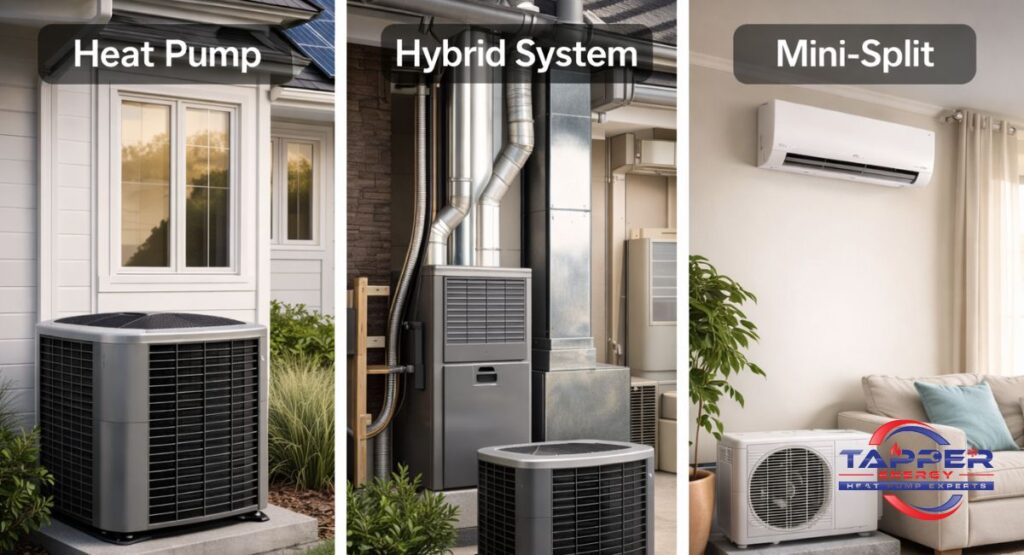
Choosing the right HVAC system is one of the most important financial decisions a homeowner will ever make. Get it wrong and you’ll spend years battling sky-high energy bills, uneven temperatures, and repair costs that never seem to stop. Get it right and your home stays perfectly comfortable through every season — efficiently, quietly, and affordably. Millions of American homeowners replace or install a new system every year without fully understanding what they’re buying or why. That’s an expensive mistake. Whether you’re weighing a central air conditioner replacement, comparing ducted vs ductless AC options, exploring the benefits of an air-source heat pump, or simply trying to decode SEER2 ratings and Manual J calculations, this guide covers everything. Choosing the right HVAC system doesn’t have to feel overwhelming. With the right knowledge — about system types, sizing, efficiency ratings, installation costs, top brands, and contractor red flags — you can make a confident, well-informed decision that protects your home and your wallet for the next 15 to 20 years. This is the only guide you’ll need in 2026. How Central Air Conditioning Works (and Why It Matters Before You Choose the Right HVAC System) Most homeowners try to choose the right HVAC system the same way they buy a refrigerator — pick a size and a price. That approach almost always backfires. Central AC pulls warm air from inside your home through return vents. That air passes over refrigerant circulation coils, which absorb the heat. The cooled air then pushes back through supply registers into every room. The heat absorbed by the refrigerant gets expelled outside through the outdoor condenser. It’s a continuous loop — and every single component must work in harmony for the system to perform efficiently. Understanding this cycle is the foundation of choosing the right HVAC system for your specific home. The key players in this process are the compressor unit, the air handler, the blower motor, and the thermostat control. The compressor pressurizes the refrigerant. The air handler distributes conditioned air throughout your home. The blower motor pushes that air through your ductwork. The thermostat tells the whole system when to start and stop. There’s also a condensate drain that removes moisture pulled from your indoor air — a component many homeowners completely overlook until it clogs and causes water damage. Knowing these parts helps you ask better questions, catch problems early, and make a smarter decision when it’s time to choose the right HVAC system. Why the Refrigerant Your System Uses Matters More Than Ever in 2026 The refrigerant inside your system isn’t just a technical detail — it’s a financial and environmental consideration. R-22 refrigerant, also known as Freon, was fully phased out due to its role in ozone depletion. If you own an older system still running on R-22 refrigerant, replacement parts and refrigerant are now extremely expensive. The industry shifted to R-410A refrigerant, but even that’s being phased down. The Environmental Protection Agency (EPA) now pushes the industry toward lower-GWP refrigerants like R-454B refrigerant and R-32 refrigerant. The HVAC refrigerant transition is well underway and refrigerant regulations 2026 requirements are already reflected in most new systems. Always ask your contractor which refrigerant your new system uses before choosing the right HVAC system and signing anything. Central AC vs. Ductless Mini-Split vs. Heat Pump: Choosing the Right HVAC System Type for Your Home This comparison is the heart of how to choose the right HVAC system. Each system type carries a distinct profile — different costs, different use cases, and different long-term implications. A ducted air conditioning system works through a network of ducts running through your walls, floors, and ceilings. It’s the most common setup in American homes built after the 1970s. However, a ducted vs ductless AC comparison reveals that ductless systems win clearly in homes without existing infrastructure. A ductless mini split installation typically costs less than adding new ductwork and delivers surprisingly powerful cooling performance for individual zones or rooms. Choosing the right HVAC system means honestly evaluating which setup your home can realistically support. Then there’s the heat pump — arguably the most versatile option for homeowners choosing the right HVAC system in 2026. An air-source heat pump doesn’t just cool your home. It reverses the refrigeration cycle in winter to extract heat from outdoor air and push it inside. That makes it a genuine hybrid heating and cooling system. In mild climates, a heat pump replaces both your furnace and your AC entirely. In colder northern states, a dual-fuel HVAC system pairs a heat pump with a gas furnace — the heat pump handles moderate temperatures while the furnace activates during deep freezes. This configuration is now one of the most energy-efficient setups available. When choosing the right HVAC system for a cold climate, this dual-fuel approach deserves serious consideration. System Type Best For Heating Capable Avg Install Cost Ductwork Needed Central AC Ducted homes No $3,500–$7,500 Yes Mini Split vs Central Air Ductless homes Yes $2,000–$5,500 No Air-Source Heat Pump Mild-to-moderate climates Yes $4,000–$8,000 Optional Dual-Fuel HVAC System Cold climates Yes $5,000–$10,000 Yes How Your Climate Zone Should Drive Your Final Decision The US Department of Energy divides the country into climate zones and your zone should heavily influence how you choose the right HVAC system. Homeowners in Florida, Texas, and the Gulf Coast states primarily need powerful energy-efficient cooling with strong humidity control — central AC or a high-SEER heat pump fits best. In the Midwest and Northeast where winters are brutal, a heat pump for cold climate only works reliably if it’s a cold-climate-rated model or paired with a gas furnace in a dual-fuel HVAC system configuration. The Pacific Northwest with its mild temperatures is arguably the best region for pure heat pump adoption. Always factor climate first when choosing the right HVAC system. The retrofit air conditioning system you choose today should still perform reliably fifteen winters from now. How to Choose the Right Size Central AC Unit (BTUs, Tonnage & Load

best heating and air conditioning system.
Uncategorized

What Is the Best Heating and Air Conditioning System for Your Home in 2026?

Picking the best heating and air conditioning system for your home is one of the biggest decisions you’ll make as a homeowner. Get it right and you enjoy year-round comfort, lower energy bills, and peace of mind for the next 15–20 years. Get it wrong and you’re stuck with skyrocketing cooling costs, uneven temperatures, and costly repairs. Every home is different. Your climate, square footage, and budget all shape the right choice. This guide walks you through everything — from top HVAC brands 2025 to sizing, efficiency ratings, and real installation costs — so you can make a confident, informed decision on the best heating and cooling system for your specific needs. What Is the Best Heating and Air Conditioning System? Not every home needs the same solution. The best heating and cooling system for a 4,000-square-foot home in Minnesota looks completely different from the right pick for a 1,200-square-foot apartment in Houston. Your climate, ductwork condition, insulation quality, and budget all play a role. The “best” system is the one that fits your specific situation — not the most expensive one on the shelf. That said, certain brands and models consistently rise to the top. The most reliable HVAC systems share common traits: high SEER rating, durable components, strong warranty coverage, and a proven track record. According to the U.S. Department of Energy, heating and cooling account for nearly 50% of a home’s total energy use. Choosing a high efficiency HVAC system isn’t just smart — it’s one of the best financial decisions you can make as a homeowner. How HVAC Systems Work and Why the Right Choice Matters for Your Home Your HVAC system does one job: move heat. In summer, it pulls heat out of your home and dumps it outside. In winter, it does the opposite — pulling heat from outside air or burning fuel to warm your living spaces. A central air conditioning system uses a network of ducts to distribute conditioned air throughout your home. A ductless mini split system skips the ductwork entirely and delivers air directly to individual rooms. A heat pump system for home use handles both heating and cooling with a single piece of equipment. Here’s why your choice matters so much. An undersized system runs constantly and never fully cools your home. An oversized one short-cycles — turning on and off rapidly — which destroys components and spikes your cooling costs. A system mismatched to your climate will struggle during extreme outdoor temperatures and leave you uncomfortable and frustrated. The right system, properly sized and installed by certified technicians, delivers year-round comfort, lower energy bills, and reliable performance for 15–20 years. The 6 Best HVAC Systems for Homes in 2026: Expert-Tested Picks After extensive research and side-by-side analysis, these six systems represent the absolute best the industry has to offer in 2026. Each one earned its spot based on efficiency, durability, indoor air quality performance, and real-world homeowner feedback. These are the top HVAC brands 2026 has to offer — and they’re all worth your serious consideration. We evaluated each system on SEER rating, variable-speed compressor performance, smart technology integration, and total value. These aren’t paid placements or sponsored recommendations. These are the systems that professional HVAC companies across the USA actually install and stand behind. Let’s break them down one by one. Trane XV20i TruComfort Variable Speed Air Conditioner The Trane XV20i review community is overwhelmingly positive — and for good reason. This unit features a variable-speed compressor that adjusts its output in tiny increments, delivering pinpoint temperature consistency throughout your home. It earns a SEER2 rating of up to 22, placing it firmly in high efficiency HVAC system territory. It also integrates seamlessly with smart thermostat integration systems like Trane’s own ComfortLink II. What sets the XV20i apart is its quiet operation — running as low as 55 decibels, which is roughly the sound level of a normal conversation. It’s one of the best HVAC system for large home applications, especially in the southern USA where hot summers and cold winters demand consistent performance. Pair it with proper home insulation and a zoning system, and this unit is virtually unbeatable. Carrier Infinity 26 Heat Pump with Greenspeed Intelligence The Carrier Infinity 21 AC line has long been respected, but the Infinity 26 Heat Pump takes things further. Its Greenspeed Intelligence technology combines variable-speed compressor operation with advanced diagnostics. It achieves a SEER2 rating of up to 24 and functions as a true air source heat pump — delivering efficient heating even when outdoor temperatures drop well below freezing. This makes it a standout pick for cold climate heat pump applications across the Midwest and Northeast. Trane vs Carrier is one of the most debated comparisons in the HVAC world. Carrier edges ahead here on heating efficiency in colder climates. The Infinity 26 also comes with Carrier’s impressive 10-year parts warranty coverage when registered — one of the strongest in the industry. For homeowners wanting a single system that handles both summer heat and brutal winters, this is the one. Lennox SL28XCV Variable-Capacity Air Conditioner The Lennox SL28XCV efficiency rating is jaw-dropping — up to 28 SEER2, making it one of the most energy-efficient residential air conditioners ever built. That number translates directly into serious energy savings on your monthly bill. Lennox achieves this through a variable-speed compressor that modulates between 35% and 100% capacity, always running at exactly the right speed for conditions. It’s ENERGY STAR certified and recognized by the Environmental Protection Agency (EPA) for outstanding efficiency. In the Lennox vs Rheem debate, Lennox wins on raw efficiency — but comes at a higher price point. The SL28XCV suits energy-conscious homeowners in warm climates who prioritize lower energy bills over upfront savings. It also performs remarkably well on humidity control, keeping your home comfortable even during peak summer humidity. If you’re doing an energy-efficient HVAC upgrade and want the best possible efficiency rating money can buy, Lennox is hard to beat. Rheem Prestige Series RA20

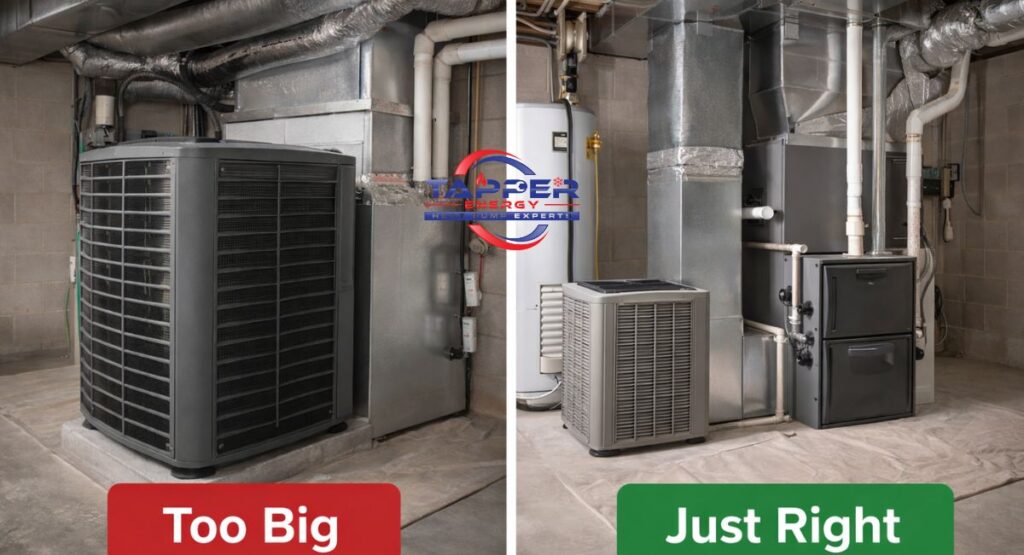
Side-by-side comparison of an oversized HVAC unit versus a properly sized system installed in a residential utility room
Uncategorized

Why HVAC System Size Matters More Than You Think

Getting your HVAC system size right is one of the most important decisions you’ll make as a homeowner. Too big? You’ll deal with short cycling AC and high humidity indoors. Too small? Your system runs constantly and still can’t keep up. Proper AC sizing affects your energy bills, your comfort, and your equipment’s lifespan. Here in South Central Pennsylvania, where summers get humid and winters bite hard, this decision really matters. At Tapper Energy, we see sizing mistakes every single week. Let’s fix that. The Hidden Cost of Getting It Wrong Homeowners often focus on brand or price. But HVAC system size is the real game-changer. A wrong-sized unit creates problems from day one. You pay more to operate it. It breaks down sooner. And your home never quite feels right. The stakes are higher than most people realize. Too Small: Your System Never Catches Up An undersized AC runs constantly trying to hit your target temperature. It burns through energy and wears out faster. During a hot Pennsylvania July, it simply can’t keep up. You’ll notice uneven cooling in house zones, frustrated family members, and a skyrocketing utility bill every single month. Too Large: More Problems Than You’d Expect Oversized air conditioner problems are surprisingly common. A unit that’s too big blasts cold air fast, then shuts off before completing a full cycle. This is called short cycling. It prevents proper dehumidification. Your home feels clammy even when the temperature reads correctly. Mold from humidity issues can follow quickly. How HVAC Sizing Is Actually Calculated Getting your HVAC system size right starts with real math, not guesswork. Most sizing errors happen when contractors skip the proper calculation process. They eyeball it. They go by what the old unit was. Neither approach works well. Accurate sizing requires evaluating your home as a complete system, not just counting square feet. A proper Manual J calculation is the gold standard. It’s a room-by-room heat load analysis developed by the Air Conditioning Contractors of America (ACCA). It accounts for dozens of variables unique to your specific home. Without it, your contractor is just estimating — and that estimate could cost you thousands over the system’s lifetime. What Manual J Actually Measures The load calculation method examines your home’s insulation quality, ceiling height, number of occupants, and even appliance heat output. It measures heat gain in summer and heat loss in winter. Every room gets evaluated separately. The result is a precise BTU assessment your installer uses to select the right equipment capacity. Why Square Footage Alone Misleads You Many online guides push a simple rule: 1 ton per 500–600 square feet. That’s a starting point, not a solution. Your ductwork condition, window type, sun exposure, and attic insulation all shift the number significantly. Two identical 2,000 sq ft homes can need very different systems depending on orientation, shade, and construction year. Key Factors That Determine the Right HVAC Size for Your Home Your home is unique. That’s not a sales pitch — it’s an engineering reality. Residential AC sizing depends on dozens of variables working together. Climate plays a huge role. So does how well your home holds conditioned air. Before any technician recommends a unit, they should walk your entire home and ask detailed questions about how you use each space. Here in Greater Harrisburg and South Central Pennsylvania, climate zone considerations are critical. We sit in a mixed-humid climate. That means your system needs strong indoor humidity control just as much as raw cooling or heating capacity. A system sized purely for temperature might still leave your home feeling uncomfortable all summer long. Home Characteristics That Change Everything Your square footage matters, but so does your layout. Open floor plans distribute air differently than compartmentalized rooms. Insulation quality in walls and the attic directly affects how fast your home gains or loses heat. Older Camp Hill homes, for example, often need a full home energy audit before sizing can begin accurately. Climate Zone and Local Weather Patterns South Central Pennsylvania experiences real seasonal extremes. Summers are hot and humid. Winters are cold and wet. Your HVAC system size must handle both ends comfortably. What works in coastal Virginia may underperform here. Local experience matters enormously when evaluating air conditioning capacity and heating output requirements together. HVAC Size by the Numbers: A Practical Reference Here’s a quick reference table to help you understand general sizing ranges. Remember, these are starting estimates only — not a substitute for a Manual J calculation. Home Size (Sq Ft) Estimated Tonnage Estimated BTUh 600–1,000 1.5 tons 18,000 BTUh 1,000–1,500 2 tons 24,000 BTUh 1,500–2,000 2.5 tons 30,000 BTUh 2,000–2,500 3 tons 36,000 BTUh 2,500–3,000 3.5–4 tons 42,000–48,000 BTUh 3,000–3,500 4–5 tons 48,000–60,000 BTUh Note: Actual requirements vary based on insulation, windows, climate zone, and ductwork. Always verify with a certified HVAC technician. The numbers above assume average insulation quality and standard construction. Homes with poor insulation, large window areas, or significant sun exposure on southern or western walls will need more capacity. Homes with superior insulation and shade may need less. Use this table to start a conversation — not to make a final decision. Choosing the Right HVAC System Type Before You Size It HVAC system size and system type are two different decisions — but they’re deeply connected. Before calculating tonnage, you need to know what kind of system fits your home. Each system type has different sizing considerations, efficiency profiles, and installation requirements. Choosing the wrong type first means you may end up sizing a system that was never right for your space to begin with. The four main residential options are the central air conditioning system, the split-system air conditioner, the ductless mini split system, and the packaged HVAC unit. Homes with existing ductwork typically use central systems. Homes without ducts — like older Marysville or New Cumberland properties — often benefit more from a ductless mini split or a heat pump system with dedicated air handlers in each zone. Central

Duct cleaning specials in Enola PA – Tapper Energy HVAC services for the Greater Harrisburg area
Uncategorized

Duct Cleaning Specials in Enola PA: Why They Matter

Your home’s air ducts quietly work every single day. They push heated and cooled air through every room. But over time, dust and debris buildup, mold growth in air ducts, and other nasties collect inside. The result? Poor air quality and a struggling HVAC system. If you’re in Enola, PA, duct cleaning doesn’t have to break the bank. Tapper Energy offers local specials designed to keep your system running clean. Indoor air pollutants and biological contaminants are more common than most homeowners realize. Let’s talk about why this service matters — and when you truly need it. What Duct Cleaning Actually Does for Your Home Most people don’t think about their supply and return air ducts until something goes wrong. A proper duct cleaning reaches deep into your system — clearing out the blower motor and housing, plenums, and every connected passage. It’s not just about dust. It’s about restoring airflow and protecting your equipment. NADCA standards set the bar for how this work should be done. Certified professionals use HEPA vacuum equipment to capture fine particles without releasing them back into your living space. Corners get checked. Air registers and grilles get wiped down. When it’s done right, you’ll notice the difference immediately. Signs Your Ducts Might Need Attention Visible Mold or Musty Odors If you spot visible mold inside ducts or catch a musty smell every time your system kicks on, don’t wait. Microbial contamination spreads fast through forced air. That smell isn’t just unpleasant — it’s a warning. Call a professional before it gets worse. Excessive Dust Around Vents Are you wiping the same shelves every few days? Excessive dust from registers is one of the clearest signs your system needs service. Dust and debris buildup inside the ductwork gets blown out with every cycle. It lands on your furniture, your floors, and eventually your lungs. Rodents or Insects in the System A vermin infestation in ducts is every homeowner’s nightmare. Rodents in HVAC systems leave behind droppings, nesting material, and odors that contaminate every room. Insect infestation in air vents causes similar problems. If you hear scratching or notice droppings near vents, act fast. Recent Renovation or Construction Work Construction stirs up enormous amounts of fine particles. Without proper protection, those particles enter your duct system and settle in. Indoor air pollutants like drywall dust and fiberglass fibers don’t belong in your airflow. A post-renovation cleaning is often a smart investment. What the EPA Actually Says About Duct Cleaning The EPA recommendations on this topic are worth knowing. The EPA supports as-needed duct cleaning rather than routine scheduled cleanings every year. There’s no evidence duct cleaning prevents health problems unless contamination is actually present. That’s an honest, science-based position — and it’s one we respect. That said, the EPA does recommend cleaning when there’s confirmed mold growth in air ducts, a vermin infestation in ducts, or when ducts are so clogged they’re restricting airflow. HVAC system contamination is real. When it happens, cleaning isn’t optional — it’s necessary. Knowing the difference saves you money and protects your health. Key Facts About Duct Cleaning: A Quick Reference Table Topic Key Detail EPA Stance Cleaning recommended only when contamination is confirmed NADCA Standard Requires cleaning of all system components Mold in Ducts Requires professional remediation, not just cleaning Average Cost $300–$700 for a standard residential system Filter Replacement Every 1–3 months for HVAC preventive maintenance Best Cleaning Method HEPA vacuum cleaner with agitation devices Carbon Monoxide Risk Inspect fuel-burning furnace annually Duct Leakage Seal duct air leaks to improve HVAC efficiency improvement How Tapper Energy Approaches Duct Cleaning in Enola PA Tapper Energy follows proper duct cleaning procedures from start to finish. Our team inspects your air handling unit, heat exchangers, and cooling coils before touching anything. We want to know exactly what’s inside your system before we start. No guesswork. No shortcuts. We use professional-grade equipment that meets NADCA standards. Every condensate drain pan gets checked for standing water. Cooling coil maintenance is part of our process because dirty coils drive up energy use. When we leave, your system runs cleaner — and so does every breath you take indoors. Preventing Future Duct Contamination Change Your Filters on Schedule The single easiest thing you can do is change HVAC filters regularly. A clogged filter doesn’t protect your system — it starves it of airflow. Use a high-efficiency air filter rated for your specific unit. It traps more particles before they ever reach your ducts. Control Moisture Inside Your System Moisture control in HVAC is critical, especially in Central Pennsylvania summers. Humidity feeds mold. Prevent condensation in ducts by keeping your system properly maintained and your home’s relative humidity levels between 30–50%. A well-maintained system naturally resists biological growth prevention issues. Seal Leaks and Insulate Properly Duct air leak sealing does double duty. It keeps conditioned air in and unfiltered air out. Gaps in ductwork pull in attic dust, insulation fibers, and outside allergens. Energy conservation in HVAC improves when your system isn’t working overtime to compensate for lost airflow. Understanding Chemical Treatments: What You Should Know Some companies offer chemical biocides in air ducts as an add-on service. These products kill mold and bacteria, but they come with important caveats. The EPA only endorses the use of an EPA-registered biocide applied by trained professionals. Using the wrong product in fiberglass duct board contamination situations can cause additional harm. Ozone duct treatment is another option you’ll hear about — but the EPA has serious concerns about ozone at levels effective against contaminants. Encapsulation of duct surfaces is sometimes used instead of removal, but it’s not always the right call. Ask questions. Know what’s going into your system before you agree to any chemical application. Case Study: The Ramirez Family in Enola, PA The Ramirez family moved into a 1990s split-level home in Enola last spring. Within weeks, their daughter started having respiratory symptoms every morning. They assumed it was seasonal allergies. A Tapper Energy technician arrived for

Old Home Heating Solutions in Camp Hill, PA
Uncategorized

7 Old Home Heating Solutions in PA: Ductless vs. High-Velocity for Camp Hill & New Cumberland

Finding reliable old home heating solutions in PA is one of the biggest challenges facing owners of Victorian and mid-century homes in Camp Hill, New Cumberland, and Harrisburg. Your home wasn’t built for modern ductwork — and forcing a standard furnace system into it means tearing out walls, dropping ceilings, and blowing past your renovation budget. We’ve been inside hundreds of homes like yours across New Cumberland, Marysville, and the older neighborhoods of Harrisburg. The problem isn’t your home — it’s that it was never designed for a modern forced-air furnace system. The good news: there are proven old home heating systems built specifically for homes like yours. This guide breaks down the two best options — and helps you figure out which one is right for your situation. Why Old Home Heating in PA Is Different From the Rest of the Country Most Victorian and mid-century homes in Camp Hill and New Cumberland were built around boilers, radiators, or floor registers — none of which use the wide metal ductwork a modern gas furnace needs. To retrofit that ductwork today, you’d be opening up walls, dropping ceilings, and burning through a renovation budget that quickly hits five figures. We see this pattern constantly in the older homes along Market Street in New Cumberland, or in the Victorian two-stories near the Camp Hill borough center. The existing layout simply doesn’t leave room for a traditional duct system — not without major disruption. Beyond ductwork, there’s another Central PA reality: humidity from the Susquehanna River corridor. Old stone and brick foundations already fight moisture year-round. The last thing you want is a system that adds duct condensation to the equation. Old Home Heating Solutions: Ductless Mini-Splits vs. High-Velocity Systems When a traditional system isn’t an option, two technologies step in to do the job properly — without gutting your home: Both are excellent options. Homeowners searching for old home heating in PA often assume a full renovation is unavoidable — but with either of these systems, it isn’t. Which one wins for your home depends on your layout, your budget, and how much room-by-room control you want. Option 1: Ductless Mini-Split Heat Pumps How It Works A ductless mini-split has two parts: an outdoor compressor unit and one or more indoor air handlers mounted high on the wall. A small 3-inch conduit connecting them carries refrigerant, power, and a condensate drain. That’s it — no ductwork, no major construction. Instead of one big central system trying to heat every room equally — and usually failing in a 100-year-old floor plan — each mini-split unit serves its own zone. Your bedroom can be 68°F while the home office runs at 72°F. You set it. The unit remembers. Ductless Systems in Central PA: What You Need to Know Here’s the honest reality about heat pumps in Pennsylvania winters: standard models struggle when temperatures drop below 25–30°F. We regularly see lows in the mid-teens around Marysville and along the river towns in January and February — that’s when older heat pump technology would let you down. The solution is a cold-climate mini-split rated for operation down to -13°F or lower. Paired with a backup electric resistance strip heater or a small gas unit, these systems handle Central PA winters reliably. We never install a mini-split in this area without discussing backup heat strategy first — that’s just the right way to do this job. Best candidates for ductless mini-splits: 👉 Interested in a ductless installation estimate? Contact us Option 2: High-Velocity (Small-Duct) Systems How It Works A high-velocity system uses a central air handler — typically tucked in an attic, basement, or closet — and distributes conditioned air through narrow, insulated tubes about 2 inches in diameter. Those tubes flex and bend through wall cavities, floor joists, and tight spaces that would be impossible to route standard 12-inch ductwork through. Think of it this way: a garden hose moves a lot of water slowly through a big opening. A pressure washer nozzle moves water fast through a tiny opening. High-velocity systems work the same way — small, high-speed outlets create gentle whole-room circulation that eliminates hot and cold spots more effectively than traditional systems. The outlets are small — about the size of a hockey puck — and sit flush in ceilings, floors, or walls. In the old Victorians in Camp Hill we service, we’ve run high-velocity tubing from a basement air handler all the way to the third floor without opening a single wall. High-Velocity Systems: The Honest Pros and Cons The major advantage is that you get a whole-home solution — heating and cooling from a single central system, just like a traditional forced-air setup. It also handles humidity better than ductless-only solutions, which matters in our Susquehanna Valley summers. The trade-off: high-velocity systems cost more upfront than a single-zone ductless installation. Installation is also more involved — crews will need attic and basement access and some drilling between floors, though nothing close to a full renovation. Best candidates for high-velocity systems: Quick Comparison: Ductless vs. High-Velocity Factor Ductless Mini-Split High-Velocity System Ductwork Required? No No (uses small 2″ tubes) PA Winter Performance Excellent (cold-climate models) Excellent Whole-Home Coverage Multi-zone, not always central Yes — one system, all rooms Zone Control Excellent (per-unit) Good (zoning add-on available) Upfront Cost Lower for partial coverage Higher for whole-home Aesthetic Impact Wall-mounted unit visible Small 2.5″ flush outlets only Installation Time 1–2 days (typical) 2–5 days (whole home) So Which Old Home Heating Solution Is Right for You? The most effective old home heating approach depends on one key question: are you solving one problem room, or replacing your whole heating strategy? If your home already has a functional boiler or radiator system and you just can’t get the back bedroom or converted sunroom warm, a single-zone mini-split is often the fastest, cleanest fix. We can have it running in a day, and you’ll wonder why you suffered through three winters without it. If

Scroll to Top