Uncategorized

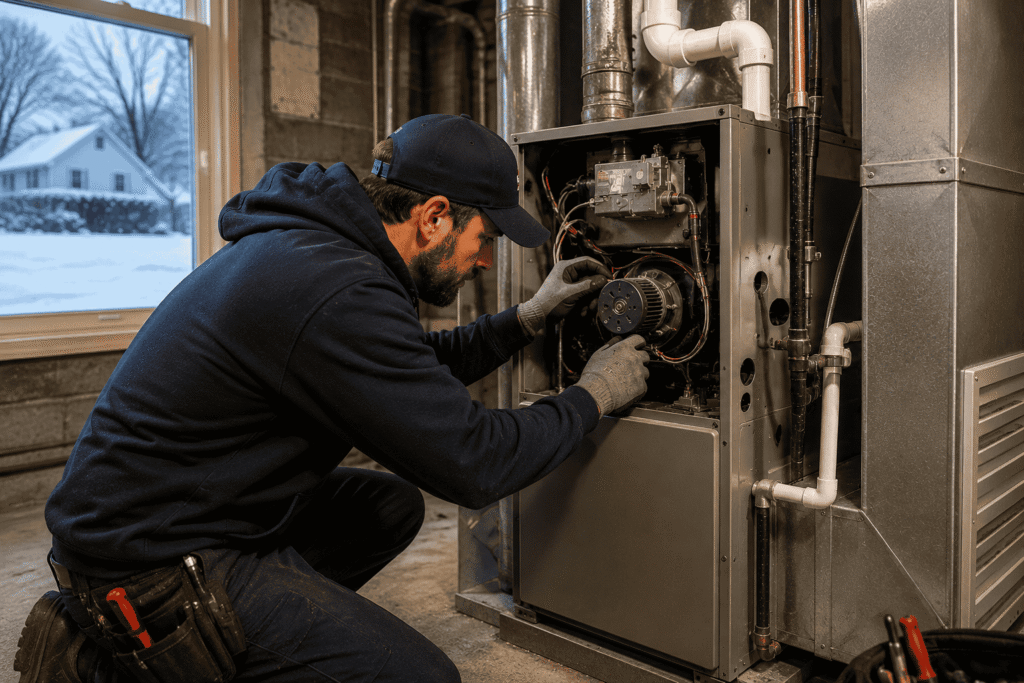
furnace blowing cold air Harrisburg PA
Uncategorized

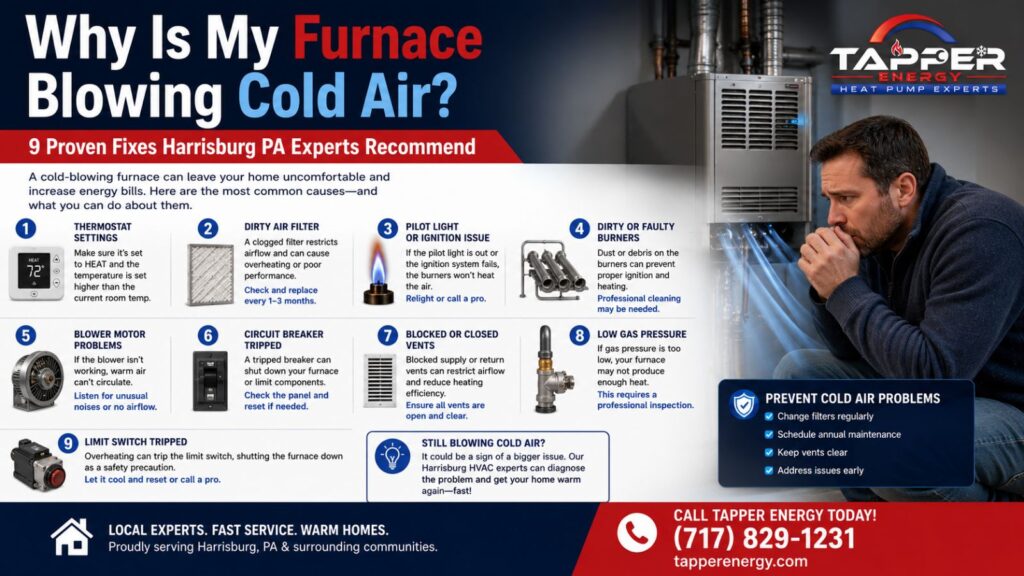
Why Is My Furnace Blowing Cold Air? 9 Proven Fixes Harrisburg PA Experts Recommend

Furnace blowing cold air Harrisburg PA homeowners search for this every winter — and the good news is the cause is usually a cheap, five-minute fix. TL;DR: Most of the time it’s a thermostat set to ON instead of AUTO, a clogged air filter, or a tripped breaker. The rest need a licensed technician — and one of them, a cracked heat exchanger, is a genuine safety emergency. If your house is getting colder while the system hums along, this guide covers all 9 fixes, what each costs, and how urgent it is. Table of Contents Check These 3 Things First (Before Calling for Repair) Before paying for a service call, rule out the three causes behind most “no heat” calls. These checks are safe, free, and take about five minutes. 1. Thermostat Set to ON Instead of AUTO This is the single most common reason for a furnace blowing cold air, and it isn’t a malfunction at all. When the fan is set to ON, the blower runs constantly — even between heating cycles. Air keeps moving through your vents while the burners are off, and that air feels cold. Switch the fan to AUTO. Now the blower only runs when the furnace is actively making heat. Also confirm the system is set to Heat, not Cool. 2. Dirty Air Filter Blocking Airflow A clogged filter chokes airflow across the heat exchanger. The furnace overheats, a high-limit safety switch shuts the burners down, and the blower keeps running — pushing cold air. Pull your filter. If you can’t see light through it, replace it. The U.S. Department of Energy home heating guidance recommends checking filters monthly in heavy-use seasons. In Harrisburg’s long heating season, swap 1-inch filters every 30–60 days. 3. Tripped Circuit Breaker or Power Switch Your furnace needs electricity even if it burns gas — the blower, ignition, and control board all run on power. Check your panel for a tripped breaker labeled furnace or HVAC. Flip it fully off, then on. Also check the furnace switch on the wall near the unit; it looks like a light switch and is easy to bump off. If the breaker trips again immediately, stop. A repeat trip signals an electrical fault that needs a professional. 6 Causes of a Furnace Blowing Cold Air Harrisburg PA Pros Must Fix If the three checks above didn’t restore heat, the cause is mechanical or fuel-related. These six need a licensed technician — and for gas work, proper safety training. 4. Pilot Light Is Out (Gas Furnaces) Older furnaces use a standing pilot light. If it goes out, the burners can’t ignite, so the blower pushes unheated air. Newer furnaces use electronic ignition, which can fail at the igniter or control board. Either way, diagnosis means working near the gas valve — leave it to a pro. 5. Dirty Flame Sensor The flame sensor is a thin metal rod that confirms a flame is present. When it gets coated in residue, it can’t “see” the flame, so the furnace shuts off the gas as a safety measure. The classic symptom: the furnace fires up, runs briefly, then blows cold. A technician cleans or replaces the sensor in one visit. 6. Gas Supply Interrupted No gas means no heat. Check whether your gas stove or water heater still works. If nothing gas-powered is functioning, the issue is your supply, not your furnace. If you ever smell gas, leave the house and call your utility immediately. 7. Condensate Drain Line Blocked High-efficiency furnaces produce water as a byproduct. That condensate drains through a line — and if it clogs, a float switch shuts the furnace down to prevent water damage. A technician clears the line and tests the switch quickly. 8. Blower Motor Failing If the motor driving your blower is failing, airflow becomes weak or stops. A struggling motor may overheat and cut out mid-cycle. Listen for humming, grinding, or squealing near the furnace. 9. Cracked Heat Exchanger (Safety Emergency) This is the one you cannot ignore. The heat exchanger separates combustion gases from the air you breathe. A crack lets carbon monoxide leak into your home. Many furnaces detect the fault and refuse to heat. If a technician confirms a cracked heat exchanger, shut the furnace off and do not run it until it’s repaired or replaced. Cause, Urgency & Cost at a Glance Cause DIY or Pro Urgency Estimated Fix Cost Thermostat on ON not AUTO DIY Can Wait $0 Dirty air filter DIY Can Wait $10–$40 Tripped breaker / switch DIY Can Wait $0 Pilot light / ignition fault Pro Call Today $80–$300 Dirty flame sensor Pro Call Today $80–$250 Gas supply interrupted Pro / Utility Call Today $0–$200 Blocked condensate drain Pro Call Today $75–$200 Failing blower motor Pro Call Today $300–$650 Cracked heat exchanger Pro Emergency $500–$2,500+ Not sure which cause you’re facing? Tapper Energy diagnoses the problem and quotes the price before any work starts. Book a furnace diagnostic → Quick Diagnosis Table: What’s Wrong with My Furnace? Match your exact symptom to the most likely cause. Symptom Most Likely Cause Fix Type Urgency Cold air runs constantly, even between cycles Fan set to ON DIY Can Wait Weak airflow from all vents Clogged filter or failing blower DIY then Pro Call Today Furnace dead, no lights or sound Tripped breaker or switch off DIY Can Wait Fires up, runs seconds, then cold Dirty flame sensor Pro Call Today No heat from any gas appliance Gas supply interrupted Pro / Utility Call Today Furnace clicks but won’t ignite Ignition failure Pro Call Today Furnace stops, water pooled near unit Blocked condensate drain Pro Call Today Soot or odd smell, no heat Possible cracked heat exchanger Pro Emergency Why a Furnace Blowing Cold Air Harrisburg PA Homeowners Face Is Dangerous A dead furnace isn’t just uncomfortable in Central PA — it creates two real hazards that turn a small repair into an expensive disaster. Frozen Pipe Risk in
hot water heater replacement Harrisburg PA
Uncategorized

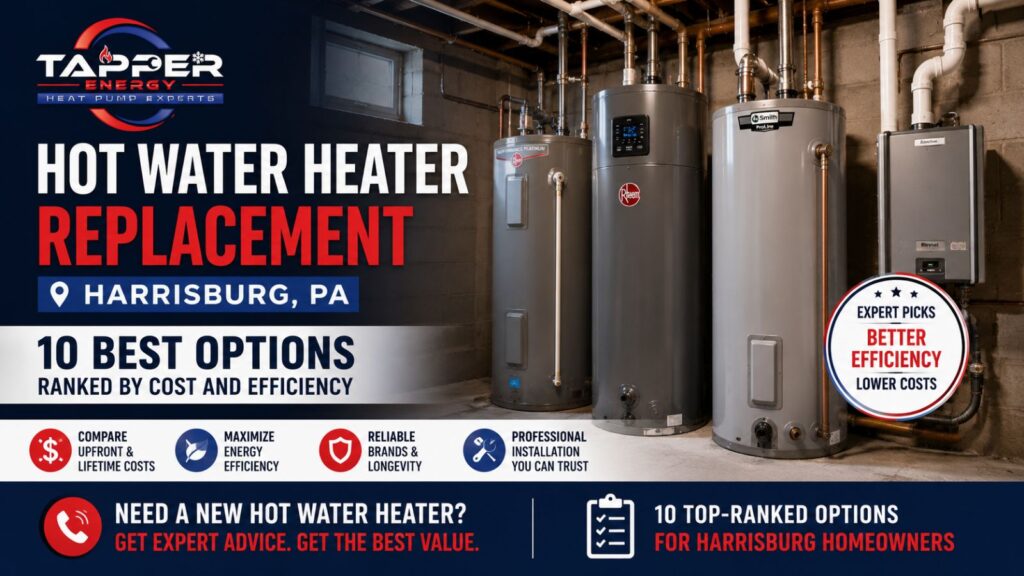
Hot Water Heater Replacement Harrisburg PA: 10 Best Options Ranked by Cost and Efficiency

Hot water heater replacement Harrisburg PA homeowners can finally understand without guesswork — that’s what this guide delivers. Here’s the short answer: most Harrisburg households spend $1,200–$3,500 on a standard tank swap and $3,000–$6,000 on a tankless upgrade. The right pick depends on your fuel type, household size, and how long you plan to stay. Below, we rank 10 options by real local cost and efficiency so you can choose with total confidence. Water heater leaking or out of hot water? Call Tapper Energy at (717) 921-4822 for a fast, free replacement estimate. Table of Contents How Much Does Hot Water Heater Replacement Cost in Harrisburg PA? The cost of a hot water heater replacement Harrisburg PA project depends on three things: the unit type, your home’s existing fuel and venting setup, and labor complexity. Below are realistic 2026 ranges for the Greater Harrisburg area, including parts, permits, and professional installation. Prices climb when an installer must upgrade gas lines, add venting, or relocate the unit. They drop when it’s a like-for-like swap in an accessible spot. A typical hot water heater replacement Harrisburg PA quote will spell out each of these line items clearly. Standard Tank Water Heater Installation Cost A standard 40–50 gallon tank is the most common choice for hot water heater replacement Harrisburg PA homeowners make. Expect $1,200–$2,200 installed for gas or electric. The unit itself runs $500–$900; the rest is labor, fittings, a permit, and disposal of the old tank. This is the budget-friendly path — and for many households, it’s perfectly adequate. Tankless Water Heater Installation Cost A tankless hot water heater replacement Harrisburg PA install costs more upfront: $3,000–$6,000, occasionally higher if your home needs a larger gas line or new stainless-steel venting. Tankless units cost $1,000–$2,500 alone, and labor is more involved. The payoff is endless hot water and lower monthly bills, which we break down in the case study below. Hybrid/Heat Pump Water Heater Installation Cost A hybrid heat pump unit runs $2,500–$4,500 installed. It’s pricier than a standard electric tank but uses roughly 60–70% less electricity. Pennsylvania rebates and the federal tax credit can shave $500–$2,000 off the cost of a hot water heater replacement Harrisburg PA homeowners choose in the heat pump category — see the rebate section below. Not sure which price range fits your home? Request a free estimate from Tapper Energy — honest local pricing, no pressure. 10 Water Heater Types Ranked for Harrisburg PA Homes Here are the 10 best options for a hot water heater replacement Harrisburg PA project, ranked by overall value — balancing upfront cost, efficiency, and fit for Central PA homes. 1. Standard Gas Tank (40–50 Gallon) — The default choice. Affordable, fast recovery, works during power outages. The best all-around pick for most Harrisburg homes on natural gas. 2. Standard Electric Tank — Reliable and cheap to install where gas isn’t available. Higher operating cost than gas, but a solid, simple option. 3. High-Efficiency Gas Tank — A condensing or ENERGY STAR gas tank costs slightly more but trims 10–15% off operating costs. A smart middle ground. 4. Tankless Gas (On-Demand) — Endless hot water, 20+ year lifespan, lowest gas operating cost. Higher upfront price, but the long-term winner for many families. 5. Tankless Electric — Good for smaller homes where gas venting is impractical. Needs significant electrical capacity. 6. Hybrid/Heat Pump Water Heater — The most efficient electric option by far. Best for homes with an unheated basement and access to PA rebates. 7. Propane Tank Water Heater — Ideal for Harrisburg-area homes off the natural gas grid. Pairs naturally with existing propane service. 8. Point-of-Use Tankless — A small unit for a single faucet far from the main heater. A supplement, not a primary system. 9. Indirect (Boiler-Connected) Water Heater — Uses your existing boiler to heat water. Extremely efficient if you already have a well-maintained boiler. 10. Solar-Assisted Water Heater — Highest upfront cost and longest payback, but the lowest operating cost over time for committed homeowners. When you compare these for a hot water heater replacement Harrisburg PA decision, the table below makes the trade-offs obvious. Water Heater Type Comparison Table Water Heater Type Upfront Cost (Installed) Annual Operating Cost Lifespan Best For Standard Gas Tank $1,200–$2,200 $250–$350 8–12 yrs Most gas-connected homes Standard Electric Tank $1,100–$2,000 $400–$550 8–12 yrs Homes without gas High-Efficiency Gas Tank $1,600–$2,800 $200–$300 10–13 yrs Cost-conscious upgraders Tankless Gas $3,000–$6,000 $150–$250 20+ yrs Larger families, long stays Tankless Electric $2,000–$3,500 $300–$450 15–18 yrs Small homes, no gas venting Hybrid/Heat Pump $2,500–$4,500 $110–$180 12–15 yrs Efficiency seekers w/ rebates Propane Tank $1,300–$2,400 $350–$500 8–12 yrs Off-grid / rural Harrisburg Point-of-Use Tankless $300–$700 $40–$90 10–15 yrs Single distant fixture Indirect (Boiler) $1,500–$3,000 $150–$300 15–20 yrs Homes with a strong boiler Solar-Assisted $5,000–$9,000 $80–$150 20+ yrs Long-term, eco-focused owners Figures are 2026 Greater Harrisburg estimates — confirm exact pricing with a local installer. Tank vs Tankless Water Heater: Which Is Right for Your Harrisburg Home? The tank-versus-tankless debate is the single biggest decision in any hot water heater replacement Harrisburg PA homeowners face. Neither wins universally — it depends on your priorities. Factor Tank Tankless Winner Upfront Cost $1,200–$2,200 $3,000–$6,000 Tank Operating Cost Higher Lower Tankless Lifespan 8–12 years 20+ years Tankless Hot Water Supply Limited by tank size Endless Tankless Space Required Large Compact Tankless Power-Outage Performance Gas tanks still work Needs electronics Tank Best Short-Term Value ✅ — Tank Best Long-Term Value — ✅ Tankless A tank wins on upfront price; a tankless wins on lifespan and running cost. Your hot water heater replacement Harrisburg PA budget and how long you’ll stay in the home should settle the tie. Household Size Sizing Guide Getting the size right prevents cold showers and wasted money. 2 people: A 40-gallon tank or a small 6–7 GPM tankless unit is plenty. 3–4 people: Choose a 50-gallon tank or a 7–9 GPM tankless. This is the Harrisburg sweet spot. 5+ people: Go with a 50–80 gallon

HVAC maintenance plan Harrisburg PA
Uncategorized

HVAC Maintenance Plans Harrisburg PA: 10 Powerful Benefits That Pay for Themselves (2026)

HVAC maintenance plan Harrisburg PA homeowners enroll in today can save $500 to $2,200 over just 2 years — and prevent the kind of January breakdown that leaves your family shivering at 3 a.m. With Central Pennsylvania winters dropping into the single digits and summer humidity pushing AC units past their limits, your heating and cooling system works harder here than in most parts of the country. This guide breaks down what an HVAC maintenance plan Harrisburg PA homeowners should expect, the 10 measurable benefits, and the real ROI math. TL;DR: A typical HVAC maintenance plan Harrisburg PA residents buy costs $150–$300/year, prevents $500+ emergency repairs, extends equipment life by 3–5 years, and cuts energy bills by 10–15%. For most homeowners, it pays for itself within the first year. Table of Contents What Is an HVAC Maintenance Plan Harrisburg PA Homeowners Should Buy? An HVAC maintenance plan Harrisburg PA contractors offer is a yearly service agreement. You pay a flat annual or monthly fee, and in return you get scheduled tune-ups, priority service, repair discounts, and equipment health monitoring. In Harrisburg, where homes range from century-old brick rowhouses in Midtown to newer builds in Hampden Township, HVAC systems face brutal seasonal swings. January lows hit 18°F on average, and July dew points often climb above 70°F. That’s a recipe for premature wear — and surprise breakdowns. https://tapperenergy.com/hvac-maintenance-checklist What’s Included in a Typical HVAC Maintenance Plan A solid HVAC maintenance plan Harrisburg PA contractors offer should include: How Often Your System Gets Serviced Most reputable plans schedule two visits per year — one in spring before AC season, one in fall before heating season. According to ENERGY STAR’s official HVAC maintenance guide this twice-yearly cadence is the gold standard for residential HVAC systems. 10 Benefits of an HVAC Maintenance Plan Harrisburg PA Homeowners Love Here are the 10 measurable benefits an HVAC maintenance plan Harrisburg PA homeowners get from a proper service agreement. 1. Priority 24-Hour Emergency Service When your furnace dies at 11 p.m. on a Saturday in February, non-members wait 24–72 hours. Plan members get bumped to the front of the queue — often same-day or next-morning service. In a Harrisburg cold snap, that’s not a luxury. It’s protection from frozen pipes. 2. Discounted Repair Rates (10–20% Off) Most plans include 10–20% off any repairs throughout the year. On a typical $800 compressor repair, that’s $80–$160 back — often more than the plan’s annual cost. 3. Annual Tune-Ups Prevent $500+ Emergency Repairs The U.S. Department of Energy’s maintenance guidance shows that regular maintenance prevents the majority of common HVAC breakdowns. Catching a worn capacitor at a $40 tune-up beats replacing a $1,200 motor it destroyed. 4. Extended Equipment Lifespan (3–5 Extra Years) A neglected furnace lasts 10–12 years. A maintained one lasts 15–20. For a $7,000 system, that’s roughly $2,000–$3,500 in deferred replacement cost. 5. Lower Monthly Energy Bills (10–15% Savings) Dirty coils, clogged filters, and miscalibrated thermostats force your system to run longer. Maintained systems use 10–15% less energy. For the average Harrisburg home spending $2,400/year on heating and cooling, that’s $240–$360 saved annually. 6. Maintained Manufacturer Warranty Compliance Most HVAC manufacturers — Carrier, Trane, Lennox — require documented annual maintenance to keep your warranty valid. Skip the tune-ups, and a $2,000 compressor failure comes out of your pocket. An HVAC maintenance plan Harrisburg PA homeowners enroll in keeps your paper trail bulletproof. 7. Improved Indoor Air Quality Pennsylvania ranks in the top 10 states for seasonal allergies. The EPA’s indoor air quality guidelines note that indoor air is often 2–5 times more polluted than outdoor air. Clean coils, fresh filters, and inspected ductwork mean fewer allergens. 8. Carbon Monoxide Safety Checks Every fall tune-up should include a CO test on your furnace’s heat exchanger. Cracked heat exchangers leak carbon monoxide — a colorless, odorless killer. This single check has saved lives across Dauphin and Cumberland counties. 9. No Surprise Breakdown During Extreme Weather Harrisburg sees 5–8 days per year below 10°F. That’s exactly when overworked, under-maintained furnaces fail. An HVAC maintenance plan Harrisburg PA residents enroll in dramatically reduces extreme-weather failures. 10. Locked-In Pricing Year Over Year Most plans guarantee no rate increases for 2–3 years. With HVAC labor costs rising 6–8% annually nationwide per Air Conditioning Contractors of America (ACCA) industry data, locking in today’s rate is real money. HVAC Maintenance Plan Harrisburg PA ROI: The Real Math Here’s the bottom line for an HVAC maintenance plan Harrisburg PA residents should run before deciding. Cost Category Without Plan (Annual) With Plan (Annual) Net Savings Maintenance Plan Fee $0 $199 -$199 Tune-Ups (2x retail) $300 Included +$300 Average Repair Cost $450 $360 (20% off) +$90 Energy Bill (HVAC portion) $2,400 $2,100 +$300 Emergency Service Fee $250 (1 in 3 years) $0 (priority) +$83 Equipment Replacement (amortized) $700/yr $467/yr +$233 TOTAL $4,100 $3,126 +$807/year Cost of Plan vs Average Emergency Repair Cost A typical HVAC maintenance plan Harrisburg PA homeowners buy runs $150–$300/year. The average emergency repair? $450–$1,200. One prevented breakdown pays for 2–4 years of plan membership. Furnace repair cost guide for Harrisburg PA → Energy Savings Over 5 Years At 10–15% energy savings on $2,400 annual HVAC costs, you save $1,200–$1,800 over 5 years just on utility bills. That alone covers the plan cost 4–6 times over. What to Look for in an HVAC Maintenance Plan Harrisburg PA Buyer’s Guide Not every plan is created equal. Here’s how to spot a quality HVAC maintenance plan Harrisburg PA homeowners can actually trust. Feature Good Plan ✅ Bad Plan ❌ Tune-ups per year 2 (spring + fall) 1 only Inspection checkpoints 25–40+ Under 15 Priority service Yes, 24/7 Business hours only Repair discount 10–20% 0–5% Warranty documentation Provided automatically You must request Carbon monoxide test Included Extra fee Locked pricing 2–3 years Annual increases Transferable to new owner Yes No Cancellation policy Flexible, prorated refund Locked, no refund Local technicians NATE-certified, Harrisburg-based Subcontracted Questions to Ask Before Signing Up Before you sign, ask the contractor: Case Study:

HVAC maintenance checklist Harrisburg
Uncategorized

HVAC Maintenance Checklist Harrisburg: 7 Proven Tasks to Avoid Costly Repairs

An HVAC maintenance checklist Harrisburg homeowners can actually follow is the single cheapest way to avoid a $4,000 emergency repair. This guide gives you the exact season-by-season routine our technicians use across Central PA — so your furnace, AC, and heat pump run longer, cost less, and don’t quit on the coldest night of January. If you own a home anywhere from Midtown to Mechanicsburg, this is built for your climate, your housing stock, and your bills. Short on time? Skip the guesswork and let us handle it — explore Tapper Energy maintenance plans. Table of Contents Why an HVAC Maintenance Checklist Matters in Harrisburg Harrisburg homeowners deal with it all — humid 90°F summers along the Susquehanna, freezing January nights, ice storms, and pollen-heavy springs. Your system works harder here than in milder climates. A neglected system can burn 15–25% more energy than a well-tuned one. According to the U.S. Department of Energy, routine maintenance is essential to keeping efficiency high and bills low. Here’s what a solid HVAC maintenance checklist Harrisburg residents follow actually protects against: The bottom line: two tune-ups a year cost far less than one furnace replacement. Monthly HVAC Maintenance Tasks (Year-Round) Some tasks are quick and should happen every month. Set a recurring reminder. These six habits form the backbone of any HVAC maintenance checklist Harrisburg homeowners use month to month. Spring & Summer HVAC Maintenance Checklist Spring is when you prep cooling equipment. Don’t wait for the first 85°F day — Harrisburg HVAC companies book solid once heat hits. Spring: Outdoor Condenser Unit Spring: Indoor Unit Summer Tasks (June–August) This portion of your seasonal HVAC maintenance checklist keeps cooling reliable through the worst heat waves. Fall & Winter HVAC Maintenance Checklist This is the most important seasonal stretch of the year. A properly prepped furnace is the difference between a comfortable winter and a $1,500 emergency on the coldest night. Fall: Furnace & Heat Pump Winter Tasks (December–February) Following this part of the HVAC maintenance checklist Harrisburg winters demand is non-negotiable for gas and oil systems. DIY vs. Professional HVAC Maintenance (Comparison Table) A homeowner checklist covers the basics. But several tasks legally and safely require a licensed technician. Here’s how the two compare. Factor DIY Maintenance Professional Tune-Up What it covers Filters, vents, debris, visual checks Combustion analysis, refrigerant, electrical, heat exchanger Frequency Monthly Twice a year (spring + fall) Typical cost ~$5–$30 (filters, supplies) ~$150–$200 per visit Catches CO / safety issues? No Yes — heat exchanger inspection Protects warranty? Partially Yes — documented service Best for Routine upkeep Safety, efficiency, peace of mind The smart approach: do the monthly items yourself and book two professional visits a year. Your complete HVAC maintenance checklist Harrisburg routine needs both halves to work. Want the professional half handled automatically? Schedule a tune-up with Tapper Energy or call (717) 921-4822. Case Study: What HVAC Neglect Cost One Harrisburg Family Problem: A family in an older Allison Hill home hadn’t serviced their 14-year-old gas furnace in over six years. Energy bills had crept up, and one January morning the furnace stopped igniting. Solution: Our technician found a clogged filter, a failing flame sensor, and early heat-exchanger corrosion. After an emergency repair, the family enrolled in a maintenance plan with twice-yearly inspections. Result: In the following 12 months, their winter heating bills dropped roughly 18%, and they avoided a projected $4,000 furnace replacement by catching the corrosion early. Their total maintenance cost for the year was under $350. The lesson: a consistent HVAC maintenance checklist Harrisburg homeowners stick to pays for itself many times over. Warning Signs You Need a Pro Immediately Call a Harrisburg HVAC repair company right away if you notice: The CDC notes that carbon monoxide is colorless and odorless — which is why a working detector and annual furnace inspection are essential. Older Harrisburg Homes: Special Considerations Homes in Midtown, Allison Hill, Bellevue Park, and Shipoke often predate modern HVAC. Watch for: If you own an older home, your HVAC maintenance checklist Harrisburg routine should include a contractor who genuinely understands historic housing. Frequently Asked Questions Final Word: Your HVAC Maintenance Checklist Harrisburg Homes Can Rely On Homeowners who follow a consistent HVAC maintenance checklist Harrisburg-wide spend a fraction of what their neighbors pay on emergency repairs and premature replacements. Their systems run quieter, last longer, and keep bills steady. If tracking all of this yourself sounds like a chore, that’s exactly what our maintenance plans are for — we handle scheduling, seasonal inspections, warranty documentation, and 24-hour emergency service. Ready for a professional tune-up? Request a free estimate or call Tapper Energy at (717) 921-4822. Family-owned, locally trusted, always on call. About the Author The Tapper Energy Service Team has kept Central PA homes comfortable for decades, providing furnace repair, AC service, heat pump maintenance, and complete HVAC care across Harrisburg, Camp Hill, Mechanicsburg, and surrounding communities. This checklist reflects the same process our licensed, EPA-certified technicians use in the field every day. Related Articles You May Find Helpful AC Freezing Up in Harrisburg, PA? 7 Critical Causes and What to Do Furnace Not Turning On? 9 Proven Fixes to Try First How Long Does a Furnace Last in PA? View All Tapper Energy HVAC Services

HVAC rebates Pennsylvania 2026
Uncategorized

HVAC Rebates Pennsylvania 2026: 10 Powerful Incentives Most Homeowners Miss Completely

HVAC rebates Pennsylvania 2026 look completely different than last year. Federal tax credits (Section 25C and 25D) expired December 31, 2025 — but PPL, PECO, FirstEnergy, Duquesne Light, and the pending Penn Energy Savers program can still save Pennsylvania homeowners between $200 and $9,950. Most HVAC rebates Pennsylvania 2026 utility programs expire May 31, 2026. Table of Contents Introduction HVAC rebates Pennsylvania 2026 are a moving target — and most homeowners are leaving thousands on the table. The federal tax credits that anchored every contractor’s sales pitch are gone. The state’s biggest rebate program is still waiting for federal sign-off. And every major utility has a hard deadline of May 31, 2026, before Act 129 Phase IV expires. Yet the savings from HVAC rebates Pennsylvania 2026 programs are still very real. Between utility rebates, low-interest state loans, manufacturer promotions, and the pending Penn Energy Savers program, a typical PA homeowner can still recover $1,500–$10,000 on a new heat pump system — if they know where to look. This guide breaks down every legitimate HVAC rebate Pennsylvania 2026 incentive available right now, how to stack them, and exactly which programs are worth chasing before the deadlines hit. What Changed: Federal HVAC Tax Credits That Expired in 2026 The biggest shift in HVAC rebates Pennsylvania 2026 is what’s no longer available federally. If you’re working off advice from 2024 or early 2025, almost half of it is now obsolete. Section 25C (Energy Efficient Home Improvement Credit) — Expired Dec 31, 2025 Section 25C used to give homeowners a 30% tax credit, capped at $2,000 per year, for qualifying heat pumps and heat pump water heaters. It also covered up to $600 for high-efficiency furnaces and central AC. That credit ended December 31, 2025. Equipment installed in 2026 does not qualify — even if you signed the contract or paid a deposit in late 2025. The IRS counts the placed-in-service date, not the purchase date. Section 25D (Residential Clean Energy Credit) — Expired Dec 31, 2025 Section 25D covered geothermal heat pumps, solar, and battery storage at 30% with no cap. For a typical $25,000 geothermal install, that meant a $7,500 federal credit. That option is also gone for 2026 installations, fundamentally reshaping HVAC rebates Pennsylvania 2026 strategy. What the One Big Beautiful Bill Act Changed The One Big Beautiful Bill Act (OBBBA), passed in mid-2025, accelerated the sunset of these residential energy tax credits. However, it did not rescind the IRA’s $258.9 million in HEAR/HOMES funding allocated to Pennsylvania. Those dollars remain authorized through September 30, 2031, or until depleted. So while PA HVAC tax credits 2026 at the federal level are essentially zero, the state-level pipeline of HVAC rebates Pennsylvania 2026 is still very much alive. IRS guidance on expired energy credits → IRS.gov Section 25C archive 10 HVAC Rebates Pennsylvania 2026 Programs Still Available Here are the ten HVAC rebates Pennsylvania 2026 programs homeowners should be checking right now. Each one is verified active as of April 2026. 1. PPL Electric Heat Pump Rebates ($350–$450) PPL Electric serves 1.4 million customers across 29 counties in central and eastern Pennsylvania. Under Act 129 Phase IV, PPL offers tiered HVAC rebates Pennsylvania 2026 customers can claim based on equipment efficiency. Applications must be submitted within 180 days of installation, or by June 15, 2026, whichever comes first. PPL Electric rebate portal → pplelectricsavings.com 2. PPL Central AC Rebates PPL also rebates standard high-efficiency central air conditioners — useful if you’re not ready to switch to a heat pump. Rebates range from $200–$300 for ENERGY STAR-certified systems meeting SEER2 ≥ 15.2. 3. Penn Energy Savers HEAR Program (Up to $8,000 — Pending Launch) The Home Electrification and Appliance Rebate (HEAR) program is the headline incentive for HVAC rebates Pennsylvania 2026. Funded by the Inflation Reduction Act, Pennsylvania received $129.2 million for HEAR specifically. Important caveat: As of April 2026, Penn Energy Savers is still awaiting final DOE approval. The administrator (EGIS BLN) was hired in December 2025, but no launch date is confirmed. Do not sign contracts contingent on HEAR funding until the program officially opens. Penn Energy Savers official site → pennenergysavers.com 4. Penn Energy Savers HER Program (Whole-Home Retrofits) The Home Efficiency Rebates (HER) program covers whole-home energy retrofits — insulation, air sealing, HVAC, and weatherization combined. PA received $130 million for HER, administered by Resource Innovations. Like HEAR, it’s still pending federal approval but will round out HVAC rebates Pennsylvania 2026 stacking when launched. 5. Act 129 Phase V Utility Rebates (Starting June 2026) The PA Public Utility Commission approved Act 129 Phase V on June 18, 2025. Phase V begins June 1, 2026, and runs through May 31, 2031. Phase V is expected to expand the next generation of HVAC rebates Pennsylvania 2026 households can access, but specific amounts haven’t been published yet. If you can wait until June 2026, you may qualify for higher rebates. If your system is failing now, don’t wait — the gap between Phase IV expiration and Phase V launch may create a 30-day enrollment lag. 6. Manufacturer Equipment Rebates Major HVAC manufacturers — Carrier, Trane, Lennox, Mitsubishi, Daikin — run their own seasonal rebates that complement HVAC rebates Pennsylvania 2026 utility programs. These typically range from $300 to $1,500 depending on the system, time of year, and dealer. Always ask your contractor about active manufacturer promotions before signing. 7. HVAC Financing at 0% Interest Many PA contractors partner with Synchrony, Wells Fargo, or GreenSky to offer 0% APR financing for 12–60 months on qualifying HVAC purchases. This isn’t technically a rebate, but it stacks cleanly with HVAC rebates Pennsylvania 2026 utility incentives and preserves cash flow. 8. PHFA Energy Efficiency Loan Program (1% for 10 Years) The Pennsylvania Housing Finance Agency (PHFA) runs the HEELP (Home Energy Loan Program). HEELP offers loans of $1,000–$10,000 at a fixed 1% APR for 10 years, with no prepayment penalty. The companion KEEP program covers $2,500–$25,000 at below-market rates for larger projects. Both PHFA loans stack

emergency furnace repair Harrisburg PA
Uncategorized

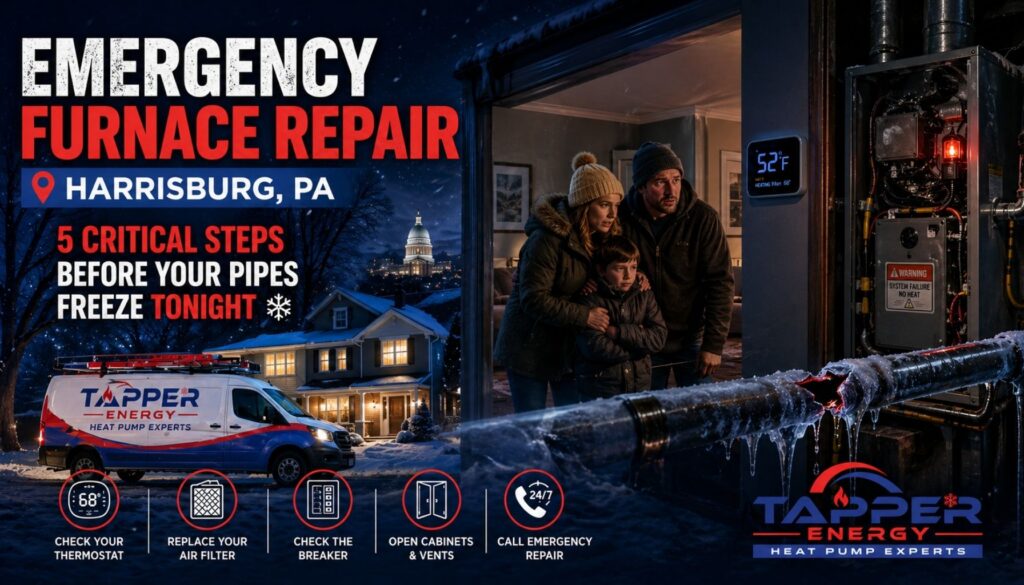
Emergency Furnace Repair Harrisburg PA: 5 Critical Steps Before Your Pipes Freeze Tonight

🚨 Emergency furnace repair in Harrisburg PA can’t wait — if you have no heat tonight, call Tapper Energy now at (717) 921-4822. Our certified technicians are on standby 24/7 across Harrisburg, Duncannon, and Central PA. Table of Contents Intro Emergency furnace repair Harrisburg PA homeowners need tonight starts with one decision: act fast or risk frozen pipes. When temperatures plunge into the teens and your furnace dies at 9 PM, every minute matters. Pipes can begin freezing in as little as 6 hours of zero heat — and a burst pipe can cause $5,000–$15,000 in water damage on top of your furnace bill. This guide walks you through the exact 5 steps to protect your home, what to check before you call, and what emergency repair really costs in Central PA. Read fast — then call. 3 Things to Check Before Calling for Emergency Furnace Repair Before you dial, spend two minutes on these checks. Roughly 1 in 4 emergency calls are fixable by the homeowner, which means no service fee and heat back in minutes. Check Your Thermostat Settings and Batteries Sounds obvious — but this is the #1 cause of “dead” furnaces in Harrisburg PA homes. If the thermostat screen is blank, batteries are almost always the cause. Check Your Circuit Breaker and Power Switch Furnaces have two power sources that can trip: Flip the breaker fully OFF, then back ON. Flip the service switch the same way. Wait 30 seconds — the furnace should fire up. Check Your Air Filter A clogged filter is the silent killer of furnaces in Central PA. When airflow chokes, the system overheats and trips the high-limit safety switch, shutting itself down. Pull your filter out. If you can’t see light through it, replace it. If your furnace restarts after a filter change, you just saved an emergency furnace repair Harrisburg PA service call. ✅ Still no heat after these 3 checks? Call Tapper Energy at (717) 921-4822 — we’ll dispatch a technician within the hour. 5 Steps to Protect Your Home While Waiting for Emergency Repair Even with a fast response, your home will keep losing heat. In a Harrisburg winter, indoor temperatures can drop 1°F every 45 minutes in a poorly insulated home. Here’s how to stop pipe damage and stay safe until the technician arrives. Step 1: Open Cabinet Doors Under Sinks (Prevent Pipe Freezing) Pipes under kitchen and bathroom sinks sit against exterior walls. Once cabinet doors are closed, those pipes lose access to whatever residual heat is in the room. Open every cabinet door that hides plumbing — kitchen, bathroom vanities, laundry room. This single step prevents the majority of frozen-pipe emergencies during furnace outages. Step 2: Set Faucets to a Slow Drip Moving water freezes much slower than still water. Open the faucet farthest from your main water shutoff to a slow, steady drip — both hot and cold sides. This relieves pressure buildup and keeps water moving through the line. According to the American Red Cross winter pipe protection guidelines, a continuous drip is one of the most effective freeze-prevention tactics. Step 3: Use Space Heaters Safely in One Room Pick one small, well-insulated room (usually a bedroom) and consolidate the family there. Use a space heater rated for indoor use with these rules: The U.S. Environmental Protection Agency recommends only EPA-certified or UL-listed heating equipment for indoor use. Step 4: Check If Your Furnace Is Leaking CO If your furnace was running before it failed — and especially if you smell something unusual — carbon monoxide is a real risk. CO is odorless, but a failing furnace often produces a faint “fishy” or “burning” smell from related components. Symptoms of CO exposure include headache, dizziness, nausea, and confusion. If anyone has these symptoms or your CO detector sounds: The Centers for Disease Control and Prevention reports over 400 unintentional CO deaths annually in the U.S., many tied to faulty heating equipment. Step 5: Call Tapper Energy’s Emergency Line Once your home is stabilized, call (717) 921-4822. Have this info ready to speed up dispatch: 🔥 Don’t wait for morning. Heat lost overnight = pipe damage by sunrise. Call (717) 921-4822 now. How Much Does Emergency Furnace Repair Cost in Harrisburg PA? Pricing transparency is something Central PA homeowners rarely get from HVAC companies. Here’s the honest breakdown for emergency furnace repair Harrisburg PA pricing in 2026. Emergency Furnace Repair Cost Comparison Table Time of Call Typical Service Fee Repair Cost Range Average Total Cost Regular Hours (Mon–Fri 8AM–5PM) $89–$129 $150–$650 $240–$780 After-Hours (Evenings, before 10PM) $149–$199 $150–$650 $300–$850 Late Night (10PM–6AM) $199–$299 $150–$700 $350–$1,000 Weekends & Holidays $179–$249 $150–$700 $330–$950 Maintenance Plan Member $0–$49 10–15% off repairs $135–$595 Pricing reflects average Central PA market rates as of 2026. Actual quotes vary by furnace model and parts required. Regular Hours vs After-Hours Pricing Why the surcharge? After-hours technicians are paid premium wages, parts suppliers are closed (meaning we stock more inventory on the truck), and we limit night calls to genuine emergencies — which keeps response times under 90 minutes for life-safety issues like no heat below 20°F. According to Angi’s national HVAC repair report, the U.S. average furnace repair runs $130–$1,200, with emergency surcharges adding 30–60% on top. Harrisburg pricing tracks closely with national norms. Why Maintenance Plan Members Save on Emergency Calls Tapper Energy’s maintenance plan members get: For most homeowners, the plan pays for itself with a single emergency call avoided. Learn more about Tapper Energy’s maintenance plan benefits → Case Study: How a Harrisburg Family Avoided $8,000 in Pipe Damage Problem: A family of four in the Camp Hill area woke up at 4:30 AM on a January night to a 48°F house. Outdoor temp was 9°F. Their 14-year-old furnace had failed silently overnight after the ignitor cracked. Solution: They called Tapper Energy’s emergency line at 4:42 AM. While waiting, they followed our phone-guided checklist: opened all sink cabinets, started a slow drip on the upstairs bathroom faucet, and

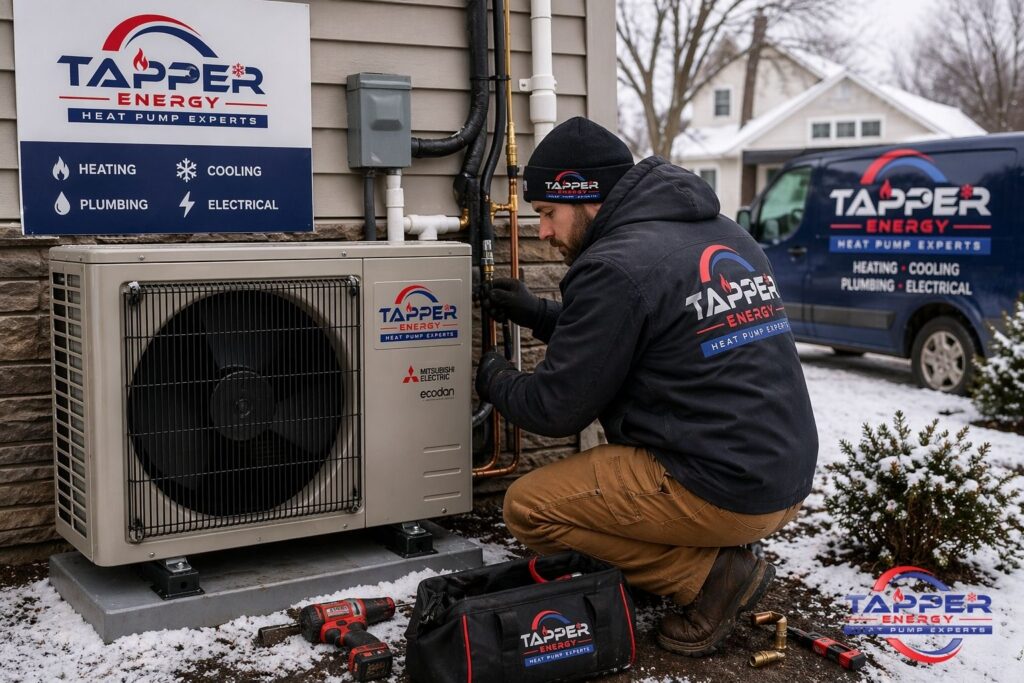
heat pump vs furnace Central PA installation by Tapper Energy technician at a suburban Harrisburg home in winter
Uncategorized

Heat Pump vs Furnace Central PA: 5 Essential Facts That Could Save You $2,000+ in 2026

Published by Tapper Energy | Family-owned HVAC experts serving Harrisburg, Mechanicsburg, Camp Hill & Greater Central PA 📑 Table of Contents Intro Choosing a heat pump vs furnace Central PA homeowners face isn’t just about comfort — it’s a decision that affects your energy bills for the next 15 to 20 years. Get it wrong and you’ll overpay thousands. Get it right, and you could save $2,000+ over the next decade, plus cash in on rebates still available through May 2026. Here’s the short answer: for most homes in Harrisburg, Mechanicsburg, and Camp Hill, a dual fuel system (heat pump + gas or propane furnace) delivers the lowest 10-year cost of ownership in our Zone 5A climate. But the right choice for your home depends on your current fuel, ductwork, and budget. At Tapper Energy, we’ve installed, repaired, and replaced heating systems across Central PA for decades. Below are the 5 essential facts every homeowner needs before spending $8,000–$15,000 on a new system in 2026. 📞 Need a free in-home assessment? Call Tapper Energy at (717) 921-4822 or request a free estimate. How Heat Pumps and Furnaces Work Differently in Central PA Winters Before comparing costs, you need to understand how each system heats — because that determines which one fits your home. How a Gas Furnace Heats Your Home A gas furnace burns fuel (natural gas, propane, or heating oil) inside a combustion chamber. The heat warms a metal heat exchanger, and a blower pushes warm air through your ducts. It’s the system most Central PA homes were built around. How a Heat Pump Heats (and Cools) Your Home A heat pump doesn’t burn anything. It moves heat using a refrigerant cycle — the same physics as your refrigerator, just reversed. In summer it pulls heat out of your home. In winter it pulls heat from the outside air (yes, even at 10°F) and moves it indoors. Why Central PA’s Climate Zone 5A Matters Central PA sits in IECC Climate Zone 5A — cold and humid, with winter design temperatures that dip into the single digits in Harrisburg and Mechanicsburg. According to the U.S. Department of Energy’s cold-climate heat pump data, modern cold-climate heat pumps maintain 75%–100% of their rated capacity at 5°F, which is a game-changer compared to heat pumps from a decade ago. This is exactly why the heat pump vs furnace Central PA debate has shifted dramatically in 2026. The old conventional wisdom — “heat pumps don’t work in PA winters” — is simply outdated. Heat Pump vs Furnace Cost Comparison for Harrisburg PA Homeowners Let’s talk real numbers — using live 2026 PPL Electric and UGI gas rates for the Harrisburg service area. Upfront Installation Cost Comparison Based on our field estimates across Central PA and 2026 pricing data from ENERGY STAR certified installers: Annual Operating Costs Using Local PPL and UGI Rates 10-Year Total Cost of Ownership Here’s the full heat pump vs furnace Central PA financial picture for a typical 2,000 sq ft Harrisburg home: Factor Gas Furnace + AC Heat Pump Only Dual Fuel System Upfront Install Cost $10,000 $13,000 $16,000 Annual Heating Cost $1,350 (UGI gas) $1,100 (PPL elec) $950 (blended) Annual Cooling Cost $600 $550 $550 2026 Rebates Available Minimal Up to $450 (PPL) Up to $450 + dual fuel adder Avg. Lifespan 15–20 yrs 12–15 yrs 15–20 yrs 10-Year Total Cost $29,500 $29,500 $31,000 Savings vs. Oil Heat $8,000+ $10,000+ $12,000+ 💡 Key insight: The sticker shock of a heat pump disappears once you factor in cooling (you need AC anyway in PA summers), rebates, and the efficiency curve in our Zone 5A climate. For a deeper dive into sizing, see our guide on what size HVAC unit do I need. The Dual Fuel Option: Why It’s the Best Choice for Most Central PA Homes Here’s what most HVAC salespeople won’t tell you: you don’t have to pick one. A dual fuel heat pump Harrisburg PA installation gives you the best of both worlds — and it’s what we recommend for the majority of our Central PA customers. How a Dual Fuel System Works A dual fuel system pairs a cold-climate heat pump with a gas or propane furnace into a single integrated system. A smart thermostat decides which one runs based on outdoor temperature and efficiency. When the Heat Pump Runs vs When the Furnace Kicks In The thermostat typically switches at a “balance point” — usually between 25°F and 35°F: Real Operating Cost Savings with Dual Fuel In a Zone 5A climate like Central PA, a properly configured dual fuel heat pump Harrisburg PA system runs on the heat pump for 70%–80% of the heating season, then switches to gas during the coldest weeks of January and February. Result? You capture nearly all the electric-heating savings without the risk of a frigid night when temperatures drop to 5°F. Heat Pump vs Furnace Decision Matrix for Central PA Your ideal system depends on four factors: current fuel, home age, ductwork, and budget. Use this matrix as a starting point — then call us for a free in-home assessment. Your Situation Home Age Ductwork Budget Best Option Currently heats with gas (UGI) Any Good $8K–$12K High-efficiency gas furnace + AC Currently heats with gas (UGI) Any Good $14K–$19K Dual fuel system Currently heats with oil Pre-1990 Good $13K–$18K Dual fuel (propane backup) Currently heats with oil Any Good $11K–$16K Heat pump only (cold-climate) Currently heats with propane Any Good $14K–$19K Dual fuel system No ductwork (old home) Pre-1940 None $12K–$20K Ductless mini-split heat pump Electric baseboard now Any None $12K–$20K Ductless mini-split heat pump If You Currently Heat with Gas Natural gas from UGI is still one of the cheapest heating fuels in PA. If your current furnace is under 10 years old and working fine, don’t rip it out. When it’s time to replace, dual fuel is the upgrade path that captures heat pump savings while keeping gas as backup. If You Currently Heat with Oil Oil

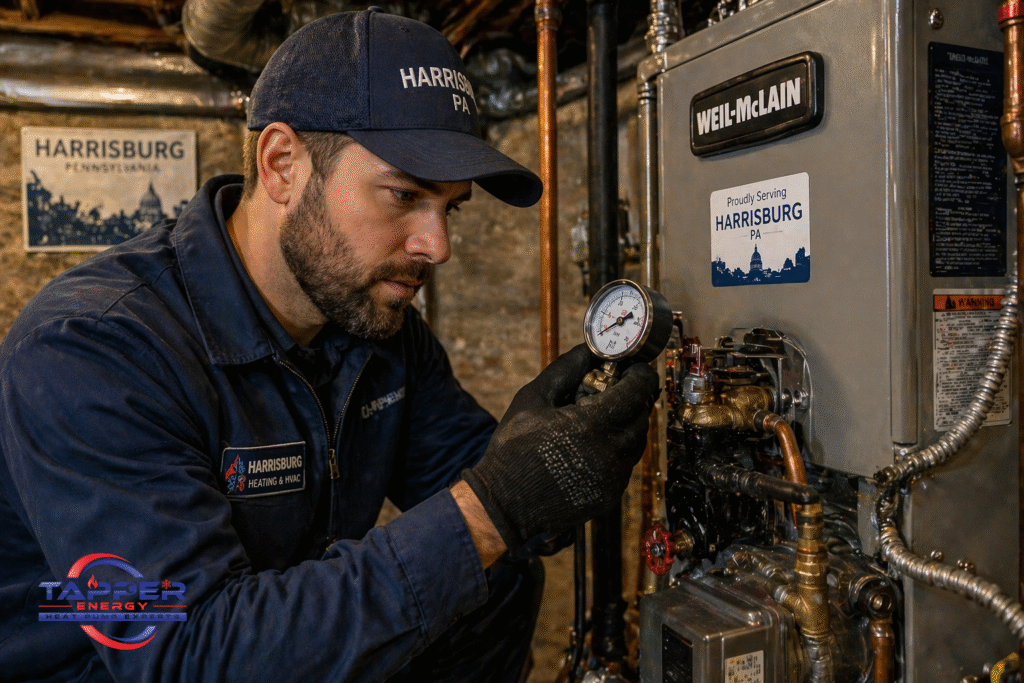
Tapper Energy technician performing boiler repair Harrisburg PA inspection with pressure gauge on a gas boiler.
Uncategorized

Boiler Repair Harrisburg PA: 8 Urgent Warning Signs You Should Never Ignore

By the Tapper Energy Heating Team | Updated for 2026 📞 Need emergency help right now? Call Tapper Energy at (717) 921-4822 for same-day boiler repair Harrisburg PA service, or request a free quote online → Table of Contents Intro Boiler repair Harrisburg PA isn’t something most homeowners think about — until their radiators go cold on a 15°F January night. By then, what started as a small $200 fix has often snowballed into a $2,000 emergency or, worse, a full system replacement. Here in Central Pennsylvania, boiler repair Harrisburg PA calls spike every winter because boiler systems work harder than almost anywhere else in the country. Freeze-thaw cycles, hard well water, and housing stock that often predates 1980 mean Harrisburg boilers fail in very specific, predictable ways. This guide covers the 8 warning signs every Harrisburg homeowner should know — plus exactly when to call a pro, what repairs typically cost, and how to avoid the most expensive mistake: waiting too long. 8 Warning Signs Your Boiler Needs Repair in Harrisburg PA After servicing thousands of boilers across Greater Harrisburg, our technicians at Tapper Energy see the same 8 warning signs again and again. Catching any of these early is the difference between a routine service call and a December disaster. 1. Banging or Kettling Sounds from the Boiler What it means: Limescale buildup on the heat exchanger — extremely common in Harrisburg due to our hard water. When water boils against scale deposits, it creates that unmistakable “kettling” sound, like a teapot about to whistle. DIY or Pro? Always pro. Descaling a heat exchanger requires chemical flushing — a standard boiler repair Harrisburg PA service. Urgency: ⚠️ Medium-High — scale buildup leads to overheating and eventual heat exchanger failure. 2. Cold Radiators While the Boiler Is Running What it means: Either trapped air in the system (easy fix) or sludge buildup blocking circulation (serious fix). If only the bottom of your radiator gets warm, it’s likely sludge. DIY or Pro? Bleeding radiators is DIY. A power flush is pro-only. Urgency: ⚠️ Medium — you’re paying to heat water that isn’t reaching your rooms. 3. Boiler Pressure Gauge Keeps Dropping What it means: Your system has a leak somewhere — could be a visible drip, a failing pressure relief valve, or a hairline crack in the heat exchanger. DIY or Pro? Pro. Diagnosing the leak source requires pressure testing by a licensed boiler repair Harrisburg PA technician. Urgency: 🚨 High — continuous pressure loss signals active damage. 4. Visible Water Leaks Around the Boiler What it means: Corroded pipe connections, failed pump seals, or a cracked tank. Never ignore standing water near a boiler. DIY or Pro? Pro. Water near electrical components is a serious hazard. Urgency: 🚨 High — water damage compounds fast in Harrisburg basements. 5. Pilot Light Keeps Going Out What it means: For gas boilers, this usually points to a faulty thermocouple, a clogged pilot tube, or — most seriously — a draft from a blocked flue. DIY or Pro? Pro. A blocked flue can cause carbon monoxide buildup. and schedule boiler repair Harrisburg PA service immediately if your pilot light keeps failing. Urgency: 🚨 High — potential CO safety issue. 6. Rust or Corrosion on the Boiler Body What it means: Internal corrosion is eating away at the boiler. Once visible externally, it’s usually advanced. DIY or Pro? Pro assessment required to determine if repair is even possible. Urgency: ⚠️ Medium-High — corroded boilers often fail within 6–12 months. 7. Heating Bills Increasing Without Explanation What it means: Your boiler is losing efficiency. Common causes: scale buildup, failing pump, degraded insulation, or a system running 24/7 because it can’t hold temperature. DIY or Pro? A professional boiler repair Harrisburg PA efficiency audit pays for itself quickly — usually within one heating season. Urgency: ⚠️ Medium — every month you wait, you’re burning cash. 8. Your Boiler Is Over 15 Years Old What it means: Most boilers in Harrisburg are rated for 15–20 years. Past that, even “working” boilers lose 20–30% efficiency compared to modern condensing models. DIY or Pro? Pro evaluation — repair vs. replace analysis. Urgency: ⚠️ Medium — plan replacement before emergency failure. Warning Signs Summary Table Warning Sign Severity Action Required Estimated Repair Cost (Harrisburg, PA) Banging / kettling sounds Medium-High Power flush + descale $350–$650 Cold radiators Medium Bleed or power flush $75–$550 Pressure keeps dropping High Leak diagnosis + repair $200–$900 Visible water leaks High Immediate pro repair $250–$1,200 Pilot light goes out High Thermocouple / flue check $150–$400 Rust or corrosion Medium-High Full inspection $300–$2,500 Unexplained high bills Medium Efficiency audit $150–$600 Boiler over 15 years old Medium Repair vs. replace assessment Varies These ranges reflect current 2026 boiler repair Harrisburg PA market rates based on our service call data across Dauphin and Cumberland counties. Pro tip from our Tapper Energy technicians: If you’re seeing two or more of these signs at once, it’s almost always cheaper to schedule boiler repair Harrisburg PA service now than to wait for a mid-winter breakdown. U.S. Department of Energy boiler efficiency guide → https://www.energy.gov/energysaver/home-heating-systems/furnaces-and-boilers] Boiler vs Furnace Problems: How to Tell the Difference Before calling for boiler repair Harrisburg PA service, make sure you actually have a boiler. Many Harrisburg homeowners — especially those who recently bought older homes — can’t tell the difference. Quick identifier: A boiler heats water (which moves through radiators, baseboards, or radiant floor loops). A furnace heats air (which moves through ducts and vents). Symptom Boiler System Furnace System Heat delivery Radiators, baseboards, radiant floors Air vents / registers Noise source Gurgling, kettling, banging Whooshing, rattling ducts Leak type Water leaks around unit No water leaks (condensate only) Pressure gauge Yes — watch this closely No gauge Pilot / ignition issues Common in older gas boilers Common in gas furnaces Cold spots in house Radiator not heating evenly One room has weak airflow Typical lifespan (PA) 15–25 years 15–20 years Either way, the right boiler

furnace repair cost Harrisburg PA
Uncategorized

Furnace Repair Cost Harrisburg PA: 7 Shocking Prices Every Homeowner Must Know (2026)

Furnace repair cost Harrisburg PA ranges from $80 to $2,500 — and knowing the difference between those numbers could save you from overpaying or replacing a furnace you didn’t need to. That wide range isn’t random. It depends entirely on which component failed, how old your system is, and whether you called a tech at 2 a.m. on a January Sunday. Most Harrisburg homeowners are surprised to learn they could solve 80% of furnace problems for under $400 — or accidentally spend $900 replacing the wrong part. This guide breaks down every major furnace repair by exact cost, explains when repair stops making financial sense, and shows you how Central PA homeowners are cutting their bills in half. If you want upfront pricing without surprises, Tapper Energy serves Harrisburg and the surrounding areas with transparent estimates — no hidden fees. 🔧 Need a furnace repair estimate today? Call Tapper Energy at (717) 921-4822 or request a free quote at tapperenergy.com/contact-us/ How Much Does Furnace Repair Cost in Harrisburg PA? [Real 2026 Pricing] Understanding furnace repair cost in Harrisburg PA starts with knowing which part failed. Each component carries a very different price tag — and some repairs are urgent while others can wait a few days. Below are the 7 most common furnace repairs Harrisburg homeowners face every winter. 1. Ignitor Replacement ($150–$300) The ignitor is the most commonly replaced furnace part in Central PA. When it fails, your furnace won’t light — you’ll notice it cycling without producing heat. Parts cost $20–$80; labor makes up most of the bill. A Harrisburg HVAC technician typically completes this in under an hour. 2. Thermocouple Replacement ($100–$250) The thermocouple is a safety sensor that cuts gas flow if the pilot flame goes out. On older furnaces, this is one of the first parts to wear out. Replacement is quick — 30 to 45 minutes — making it one of the most affordable furnace repairs in Harrisburg PA. 3. Flame Sensor Cleaning or Replacement ($80–$200) A dirty flame sensor causes a furnace to light, run for a few seconds, then shut off. Often a simple cleaning ($80–$120) fixes the problem entirely. If the sensor is cracked or corroded, full replacement runs $150–$200. This is a great example of why preventive maintenance pays off — a $20 annual cleaning prevents a $200 service call. 4. Blower Motor Repair ($400–$700) The blower motor circulates heated air through your home’s ductwork. When it fails, your furnace produces heat but can’t distribute it. Blower motor replacement is one of the pricier furnace repairs — expect $400–$700 depending on the motor type and whether it’s a single-speed or variable-speed model. 5. Draft Inducer Motor ($500–$900) The draft inducer pulls combustion gases out of the heat exchanger before the burners ignite. When it fails, your furnace won’t start at all as a safety precaution. This is a mid-range repair in terms of furnace repair cost for Harrisburg PA homeowners, but it’s non-negotiable — a faulty inducer can create carbon monoxide risk. 6. Circuit Board Replacement ($450–$800) The control board is your furnace’s brain. It manages timing, sequencing, and safety shutoffs. A failed board can mimic almost any other problem, which is why professional diagnosis is critical before replacement. Misdiagnosis is the #1 reason Harrisburg homeowners end up with an $800 repair that didn’t fix anything. 7. Heat Exchanger Replacement ($1,200–$2,500) A cracked heat exchanger is the most expensive and most serious furnace repair. It allows combustion gases — including carbon monoxide — to mix with your indoor air. At $1,200–$2,500 for replacement, this is the repair where the replace-vs-repair math becomes critical. If your furnace is over 15 years old, replacement may be the smarter move. Furnace Repair Cost Comparison Table: Harrisburg PA vs National Averages Here’s how furnace repair estimate Harrisburg PA figures stack up against national benchmarks for 2026. Local labor rates in Central PA tend to run slightly below the national average, but emergency and after-hours calls close that gap quickly. Repair Type Harrisburg PA Range National Average Time to Fix Urgency Level Ignitor Replacement $150–$300 $180–$350 45–60 min 🔴 High Thermocouple Replacement $100–$250 $150–$300 30–45 min 🟡 Medium Flame Sensor Clean/Replace $80–$200 $100–$250 30–60 min 🟡 Medium Blower Motor Repair $400–$700 $450–$800 2–3 hours 🔴 High Draft Inducer Motor $500–$900 $600–$1,000 2–4 hours 🔴 High Circuit Board Replacement $450–$800 $500–$900 1–2 hours 🔴 High Heat Exchanger Replacement $1,200–$2,500 $1,500–$3,500 4–8 hours 🚨 Critical Source: HomeAdvisor 2026 Furnace Repair Cost Data (homeadvisor.com) | Harrisburg PA figures based on Tapper Energy service history. When Is Furnace Repair Not Worth the Cost? [The $5,000 Rule] Not every furnace repair in Harrisburg PA makes financial sense. Here are three frameworks HVAC professionals use to make the repair-vs-replace call — and how to apply them to your situation. The 50% Rule: Repair Cost vs Replacement Cost If your repair quote exceeds 50% of the cost of a new furnace, replacement is almost always the better financial decision. A new mid-efficiency gas furnace in Harrisburg PA typically costs $2,500–$4,500 installed. So if a single repair is quoting you $1,500 or more, it’s time to consider replacement. The reason is simple: an aging furnace rarely fails in isolation. Repairing one expensive component often triggers the next failure within 12–24 months — and you’ve already sunk a significant sum into a system that’s living on borrowed time. The $5,000 Rule: Age × Repair Cost Calculator Multiply your furnace’s age (in years) by the quoted repair cost. If the result exceeds $5,000, replace it. Example: Your 14-year-old furnace needs a $400 blower motor repair. 14 × $400 = $5,600. That’s above the $5,000 threshold — replacement is worth considering. This formula, referenced in U.S. Department of Energy appliance guidance (energy.gov), accounts for both age-related reliability decline and diminishing returns on repair spending. The Frequency Rule: 3+ Repairs in 12 Months If you’ve called for furnace repair in Harrisburg PA three or more times in a single heating season, your system is in systemic

AC replacement cost in Harrisburg PA
Uncategorized

How Much Does AC Replacement Cost in Harrisburg PA in 2026? (Shocking Real Local Pricing)

Updated for 2026 — Replacing your air conditioner in the Greater Harrisburg area shouldn’t feel like a guessing game. Yet every homeowner who searches “AC replacement cost Harrisburg PA” gets bombarded with wildly different numbers. Some websites say $3,500. Others throw out $12,000. The truth sits somewhere in between — and it depends on factors that are unique to Central Pennsylvania homes. This guide breaks down every dollar so you can budget with confidence, avoid overpaying, and choose the right cooling system for your Dauphin County property. Why AC Replacement Cost in Harrisburg PA Varies So Much From National Averages National pricing guides rarely tell the whole story. They pull data from Miami, Phoenix, and Minneapolis — cities with vastly different climates and labor costs than Harrisburg PA. The Susquehanna Valley has its own economic fingerprint. Local contractor wages tend to run 10–15% below major metro areas like Philadelphia but remain competitive enough to attract NATE certified technicians who deliver quality work. That wage gap alone shaves hundreds off a typical AC replacement cost Harrisburg PA project compared to the East Coast average. Beyond labor, housing stock plays a massive role. Central Pennsylvania is home to thousands of pre-1960 row houses, stone farmhouses, and cape cods with unique layouts. Many of these older homes lack proper ductwork, need electrical upgrades, or have attic insulation issues that inflate the total project price. A national average ignores all of that. When you factor in Dauphin County permit fees, local code compliance requirements, and the seasonal demand patterns along the Susquehanna Valley, it becomes clear why Harrisburg pricing deserves its own conversation. Average AC Replacement Cost in Harrisburg PA in 2026: Real Price Ranges Here’s a snapshot of what homeowners across the Greater Harrisburg area actually pay in 2026. These numbers include the condenser unit, evaporator coil, standard installation cost, permits, and basic thermostat connection. Tier SEER2 Range Typical Installed Cost Best For Budget 14–15 SEER2 $3,800 – $5,200 Tight budgets, rental properties Mid-Range 16–18 SEER2 $5,200 – $7,500 Most homeowners in Harrisburg PA Premium 19+ SEER2 $7,500 – $12,000+ Long-term savings, eco-conscious buyers Keep in mind that these ranges reflect a standard 2.5 to 3.5 ton central air conditioning system swap on existing, functional ductwork. Additions like a line set replacement, condensate drain rework, or full air handler upgrade push prices higher. For a personalized breakdown, contact Tapper Energy for a free estimate on AC installation. Budget AC Replacement Cost in Harrisburg PA (14–15 SEER2 Units) Homeowners who need a working cooling system without the bells and whistles typically land in the $3,800–$5,200 range. Brands like Goodman, Amana, and Heil dominate this tier. These units meet the federal minimum SEER2 efficiency requirements and use the new R-454B refrigerant mandated by the Environmental Protection Agency (EPA) since January 2025. They cool your home reliably. They won’t win awards for whisper-quiet operation or jaw-dropping energy savings, but they get the job done. For a two-story home rental in Mechanicsburg or a starter home in Enola PA, this tier makes financial sense. Mid-Range AC Replacement Cost in Harrisburg PA (16–18 SEER2 Units) This is the sweet spot for most Harrisburg PA families. Priced between $5,200 and $7,500 installed, mid-range systems from Carrier, Trane, Rheem, and Bryant deliver noticeably better energy consumption reduction. A 17 SEER2 rating can trim cooling costs by roughly 18% compared to a baseline 14 SEER2 unit. Many models in this bracket feature two-stage or variable speed compressors that ramp up and down based on demand. The result is more consistent temperatures, better humidity control during sticky Susquehanna Valley summers, and a quieter outdoor condenser unit. Most of these systems also qualify for extended manufacturer warranties of 10 to 12 years. You can explore ENERGY STAR certified models to compare efficiency benchmarks. Premium AC Replacement Cost in Harrisburg PA (19+ SEER2 Units) If long-term value matters more than upfront cost, premium systems range from $7,500 to $12,000 or beyond. Lennox, top-tier Carrier, and Trane models with inverter compressor technology sit in this category. Some achieve 22+ SEER2 ratings and slash energy bills by up to 30% versus a minimum-efficiency unit. These units run almost silently. They modulate their output to match your home’s exact cooling load at any given moment. For a 2,500+ square footage home in Camp Hill PA or a well-insulated newer build in Cumberland County, the payback period on a premium system can be as short as 7–8 years through lower electric bills alone. What Factors Affect Your AC Replacement Cost in Harrisburg PA? No two HVAC projects are identical. Several variables determine where your final AC replacement cost Harrisburg PA invoice lands. Understanding them ahead of time prevents sticker shock on installation day. Home Size and AC Tonnage Requirements in Greater Harrisburg Tonnage is the bedrock of AC pricing. One ton of cooling equals 12,000 BTU (British Thermal Units) per hour. Most homes in the Greater Harrisburg area need between 2 and 5 tons. A 1,200 square foot ranch might need 2 tons. A sprawling 3,000 square foot colonial in South Central Pennsylvania could demand 4.5 to 5 tons. Bigger systems cost more — both for the equipment and for the labor to install them. A Manual J load calculation performed by a qualified HVAC technician ensures you get the right size. Oversized air conditioner problems include short cycling, poor dehumidification, and premature wear. Undersized AC units run nonstop and never reach your desired temperature. The Department of Energy recommends professional sizing for every replacement. Home Size (sq ft) Estimated Tonnage Approx. Equipment + Install 800 – 1,200 1.5 – 2 tons $3,500 – $5,000 1,200 – 1,800 2 – 2.5 tons $4,200 – $6,000 1,800 – 2,400 2.5 – 3 tons $5,000 – $7,500 2,400 – 3,200 3.5 – 4 tons $6,500 – $9,000 3,200+ 4.5 – 5 tons $8,000 – $12,000+ Ductwork Condition in Older Harrisburg and Central PA Homes Ductwork condition is the silent budget killer. Homes built before 1980 in Harrisburg PA frequently

Scroll to Top