Uncategorized

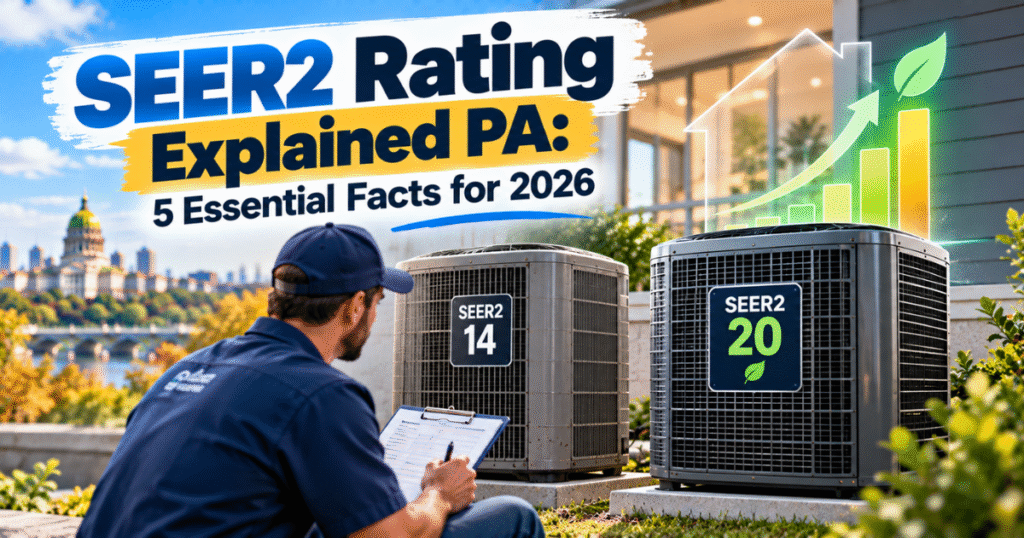
SEER2 rating explained for Pennsylvania homeowners with 2026 minimum efficiency levels
Uncategorized

SEER2 Rating Explained: 5 Essential Facts Every PA Homeowner Must Know (2026)

SEER2 rating explained in one line: it is the federal cooling-efficiency number every new central air conditioner and heat pump has carried since January 1, 2023, and in Harrisburg and the rest of Pennsylvania the legal minimum is 13.4 SEER2 for a central AC and 14.3 SEER2 for a split heat pump. SEER2 replaced the old SEER system, and many PA homeowners are confused about what the new numbers mean, what efficiency is required, and how much a higher SEER2 rating actually saves. This guide answers all three with Central PA numbers. TL;DR 📞 Replacing an AC or heat pump this year? Call Tapper Energy at (717) 921-4822 or request a free installation estimate. We will show you the SEER2 math for your actual home before you buy. Table of Contents What Is SEER2 and How Is It Different from SEER? Here is the SEER2 rating explained in plain terms. SEER2 stands for Seasonal Energy Efficiency Ratio 2. It measures how much cooling a system delivers over a full season divided by the electricity it uses. Higher is better. A 16 SEER2 unit moves the same heat as a 13.4 SEER2 unit on about 16% less electricity. Here is the SEER2 rating explained against its predecessor, because the two numbers are not interchangeable. The Old SEER System (Pre-2023) The original SEER test ran equipment against very low duct resistance, about 0.1 inches of water column. Real homes, especially older Harrisburg homes with long or undersized duct runs, push back much harder than that. So lab numbers looked better than what homeowners saw on their PPL or Met-Ed bills. That gap is exactly why homeowners now need the SEER2 rating explained before they buy. The New SEER2 Testing Method (Higher Pressure Drop) The U.S. Department of Energy’s central air conditioner and heat pump standards moved testing to a procedure called Appendix M1 in 2023. It raises external static pressure to about 0.5 inches, roughly five times the old test, to mimic real ductwork. The companion metrics are EER2 (peak-heat efficiency) and HSPF2 (heat pump heating efficiency). Why SEER2 Numbers Are Lower Than SEER (14 SEER = ~13.4 SEER2) Nothing got less efficient. The test simply got tougher, so the same unit scores about 4 to 5% lower. That is why the North region minimum is written as 13.4 SEER2 instead of 14 SEER. Keep this in mind when you compare an old quote, a used unit, or a neighbor’s system: always compare SEER2 to SEER2. A contractor who has the SEER2 rating explained correctly will quote in SEER2 numbers only. SEER2 Rating Explained: 5 Facts PA Homeowners Must Know On replacement calls across Harrisburg, Mechanicsburg, and Camp Hill, the SEER2 questions we hear boil down to these five facts. This is the SEER2 rating explained the way we explain it at the kitchen table. 1. The PA Minimum Is 13.4 SEER2 for AC and 14.3 SEER2 for Heat Pumps Pennsylvania is in the DOE North region. Any split central AC installed here must be at least 13.4 SEER2. Split heat pumps follow a national standard of 14.3 SEER2 and 7.5 HSPF2, and single-package units must hit 13.4 SEER2. The rule applies to new installations, not to the system already running in your yard. 2. Higher SEER2 Does Not Always Mean More Savings A higher SEER2 rating only saves money when the system actually runs and is installed well. An oversized unit short-cycles, a leaky duct system wastes airflow, and a mismatched indoor coil can drop real efficiency below the label. Correct sizing (see our guide on what size HVAC unit you need) often matters more than two extra SEER2 points. That is the SEER2 rating explained honestly: installation quality counts. 3. The Sweet Spot for Central PA Is 15 to 17 SEER2 Harrisburg summers are hot and humid but short compared with the South. That shorter cooling season caps how fast premium efficiency pays back. For most homes, 15 to 17 SEER2 hits the balance: meaningfully lower bills, better humidity control from two-stage models, and rebate eligibility without a runaway price. Homeowners who get the SEER2 rating explained before shopping usually land in this range. 4. SEER2 Only Measures Cooling (HSPF2 Measures Heating for Heat Pumps) With the SEER2 rating explained, remember it says nothing about winter. For a heat pump, HSPF2 is the heating number, and in Central PA a heat pump heats far more hours than it cools. ENERGY STAR’s cold-climate ducted heat pumps require at least 8.1 HSPF2, versus the 7.5 HSPF2 federal minimum. 5. PA Rebates Require Minimum Efficiency Levels The federal 25C tax credit ended for equipment placed in service after December 31, 2025, so utility rebates are now the main incentive, and this is where the SEER2 rating explained turns into real cash. PPL Electric’s current air-source heat pump rebate is $225 at Tier 1 (15.2 SEER2, 11.7 EER2, 7.8 HSPF2) or $325 at Tier 2 (16.3 SEER2, 12.9 EER2, 8.2 HSPF2), and the system must be ENERGY STAR certified and listed as a matched system in the AHRI certified directory. Programs change each Act 129 phase, so see our HVAC rebates Pennsylvania 2026 guide for the latest. The table below shows the SEER2 rating explained in dollars. Savings assume a 3-ton system, about 1,000 cooling hours a year (a reasonable Harrisburg estimate), and roughly 20 cents per kWh, close to Pennsylvania’s 2026 residential average. Cost premiums are typical Central PA ranges, not a Tapper quote. SEER2 Rating Equipment Tier Typical Cost Premium Annual Savings vs Minimum Best For 13.4 to 14.3 Minimum, single-stage Baseline $0 (about $535 a year to run) Tight budgets, rentals, light AC use 15.2 to 16 ENERGY STAR, single or two-stage +$800 to $1,500 $60 to $90 Most Harrisburg homes, rebate-eligible heat pumps 17 to 18 Two-stage +$1,800 to $3,500 $115 to $135 Heavy AC users, humidity control 19 to 21 Variable-speed inverter +$3,500 to $6,500 $160 to $195 Comfort-first homes, heat pumps that also heat 22 and up
Indoor air quality Harrisburg PA guide with 10 proven fixes for cleaner home air
Uncategorized

Indoor Air Quality Harrisburg PA: 10 Proven Ways to Breathe Cleaner Air at Home (2026)

Indoor air quality Harrisburg PA homeowners breathe every day is often worse than the air outside. The EPA reports that some pollutants are often 2 to 5 times more concentrated indoors than outdoors, and most of us spend about 90% of our time inside. In sealed, well-insulated Central PA homes, that trapped air can trigger allergies, asthma flare-ups, headaches, and fatigue with no obvious cause. The fix is rarely complicated. Most indoor air quality Harrisburg PA problems trace back to four sources: dirty filters, leaky ducts, humidity swings, and radon. Below are 10 proven fixes, what each one typically costs, and which ones you can handle yourself this weekend. TL;DR Want a clear answer on your home’s air? Call Tapper Energy at (717) 921-4822 or request a free estimate for an indoor air quality check. Table of Contents How to Improve Indoor Air Quality Harrisburg PA Homes: 10 Proven Ways In our service calls across Harrisburg, Mechanicsburg, and Camp Hill, the first three culprits we find are almost always a clogged filter, dusty return ducts, and winter air that is far too dry. 1. Replace HVAC Air Filters Every 1 to 3 Months Your air filter is the first line of defense for everything your system breathes. A clogged filter stops trapping dust, chokes airflow, and makes your furnace or AC work harder. Set a phone reminder. It is the easiest way to protect the indoor air quality Harrisburg PA households depend on through a long heating season. 2. Install a Whole House Air Purifier A whole house air purifier mounts in your ductwork and cleans the air for every room, not just one bedroom. Options include extended media cabinets, electronic air cleaners, and HEPA bypass systems. Typical installed cost runs about $500 to $3,500 depending on the technology. HEPA bypass units sit at the top of that range because they need a separate duct loop to keep airflow healthy. For allergy and asthma sufferers, this is one of the most effective upgrades for indoor air quality Harrisburg PA homes can get. 3. Add a Whole House Humidifier for Winter Central PA winters push indoor humidity well below 30%. Dry air irritates sinuses, cracks skin, and helps some viruses survive longer. A bypass or steam humidifier on your furnace holds the whole house at 35% to 45%, the range where indoor air quality Harrisburg PA families notice the biggest winter difference. See our full breakdown of whole house humidifier cost in Harrisburg PA for installed prices of $400 to $1,200. 4. Schedule Professional Duct Cleaning Every 3 to 5 Years Ducts collect dust, pet hair, and construction debris over time. Most industry guidance points to cleaning every 3 to 5 years, or sooner after a renovation, a rodent problem, or visible mold. Annual cleaning is rarely necessary. Expect about $300 to $700 for a legitimate whole-home cleaning. Anything advertised at $99 is usually a bait-and-switch, as our duct cleaning cost Harrisburg PA guide explains. 5. Install UV Germicidal Lights in Your HVAC System UV-C lamps mounted near the indoor coil kill mold, bacteria, and viruses that grow on damp surfaces inside your system. They do not catch dust, so pair them with a good filter. Installed prices usually land between $600 and $1,500 for a coil-mounted lamp. Bulbs need replacing every 1 to 2 years. 6. Use MERV 11 to 13 Filters (Not Basic Fiberglass) Cheap fiberglass filters (MERV 1 to 4) protect the blower but let most allergens pass straight through. MERV 11 to 13 filters capture pollen, pet dander, mold spores, and a large share of fine particles. Check with a technician before upgrading. Many indoor air quality Harrisburg PA visits we make start with a filter too dense for an older furnace’s small return. A 4-inch media cabinet solves that for most homes. 7. Seal Ductwork Gaps and Leaks Leaky return ducts in basements, attics, and crawl spaces pull in dust, insulation fibers, and damp air, then blow it into every room. ENERGY STAR estimates that 20% to 30% of the air moving through a typical duct system is lost to leaks, holes, and poor connections. Professional sealing with mastic or aerosol sealant usually costs a few hundred dollars to about $2,000, depending on access. If your ducts are crushed, rusted, or disconnected, compare that against full air duct replacement cost in PA. 8. Ventilate with an ERV or HRV System Modern, tightly built homes hold heat well but trap stale air. An energy recovery ventilator (ERV) or heat recovery ventilator (HRV) swaps stale indoor air for fresh outdoor air while recovering most of the heating or cooling energy. For Harrisburg’s humid summers and cold winters, an ERV is usually the better fit because it also manages moisture. Installed costs typically range from $1,500 to $4,500. Contractors size these systems to ASHRAE Standard 62.2, the national benchmark for residential ventilation and indoor air quality Harrisburg PA builders follow. 9. Control Humidity Below 50% in Summer Summers in the Susquehanna Valley bring long stretches of muggy, high dew point weather. Above 50% indoor humidity, dust mites multiply and mold grows on basement walls and inside ducts, two of the most common indoor air quality Harrisburg PA allergy triggers. A properly sized AC removes moisture as it cools. If your basement still feels damp, a whole house dehumidifier tied into your ductwork keeps levels in check. 10. Test for Radon (Pennsylvania Is a High-Risk State) Radon is an odorless, radioactive gas that seeps up from the soil through basement cracks. According to the Pennsylvania Department of Environmental Protection, about 40% of homes tested in the state have radon above the EPA action level of 4 pCi/L. Radon is the second leading cause of lung cancer in the U.S. Test kits cost about $20 to $30 at hardware stores, and DEP recommends testing in colder months when windows stay closed. If levels are high, a certified mitigation system typically costs $800 to $1,200. No list of indoor air quality

R-22 Freon phase out PA guide for Central PA homeowners in 2026
Uncategorized

R-22 Freon Phase Out PA: 7 Critical Facts Every Homeowner Must Know in 2026

The R-22 Freon phase out PA homeowners keep hearing about is already complete: R-22 has not been produced or imported in the United States since January 1, 2020, and every pound left is recycled or stockpiled. If your Harrisburg, Mechanicsburg, or Camp Hill air conditioner still runs on R-22, you are facing either skyrocketing recharge costs or a full system replacement. This guide explains what the R-22 Freon phase out PA rules mean for your home in 2026 and how to choose between repair, retrofit, or replacement. TL;DR: Not sure which refrigerant your AC uses? Call Tapper Energy at (717) 921-4822 or request a free estimate. We will check your system and give you honest options, not a sales pitch. Table of Contents What Is R-22 Freon and Why Was It Banned? R-22 (chemically HCFC-22, sold for decades under the Freon brand name) was the standard refrigerant in home air conditioners and heat pumps built before 2010. It absorbs heat inside your home and releases it outdoors. The problem is chlorine. When R-22 leaks, it damages the ozone layer, and it is also a potent greenhouse gas. The EPA scheduled a gradual phase out under the Clean Air Act and the Montreal Protocol, so the R-22 Freon phase out PA homeowners deal with is a national rule, not a state one. The EPA homeowner guide to the HCFC-22 phaseout explains the federal rules in plain language. The EPA Phase-Out Timeline Here is the good news: even under the R-22 Freon phase out PA rules, it is still legal to own and run an R-22 air conditioner in Pennsylvania. Nobody will force you to rip it out. The real issue is cost and availability the day it breaks. R-22 vs R-410A: What Changed R-410A (often sold as Puron) replaced R-22 in new systems around 2010. It contains no chlorine, but it runs at much higher pressures, so the two refrigerants are not interchangeable. You cannot put R-410A into an R-22 system. Now R-410A is being phased down too. Manufacturing of new residential R-410A systems stopped on January 1, 2025. An EPA final rule in 2026 lets contractors install leftover pre-2025 R-410A inventory until it runs out, but most new systems today use R-454B or R-32. How to Tell If Your AC Uses R-22 The first step in handling the R-22 Freon phase out PA change is knowing your refrigerant. In our service calls around Harrisburg, the fastest check is the data plate on the outdoor unit: 7 Critical Facts About the R-22 Freon Phase Out PA Homeowners Need These seven facts about the R-22 Freon phase out PA rules shape every repair decision in Harrisburg. 1. R-22 Has Not Been Manufactured Since 2020 Since January 1, 2020, no new R-22 has been made or imported in the US. Every pound available now is reclaimed from retired equipment or pulled from existing stockpiles. That is the core of the R-22 Freon phase out PA homeowners face: supply only moves in one direction, down. 2. Remaining R-22 Supply Costs $90 to $250+ Per Pound Installed R-22 prices in 2026 typically run $90 to $250 per pound, according to national cost guides from Angi. A decade ago, homeowners paid roughly $10 to $20 per pound. Because of the R-22 Freon phase out PA, contractors pay more every year for reclaimed supply. A leak that loses 3 to 5 pounds means a refrigerant bill of about $300 to $1,250 on its own. Add EPA-required recovery fees and leak repair, and a single service call can pass $1,500. 3. Most R-22 AC Systems Are Now 15+ Years Old Any R-22 system was built before 2010, so it is at least 16 years old in 2026. Most central air conditioners in Central PA last 15 to 20 years. Humid Susquehanna Valley summers keep these units running long hours, which speeds up wear. The R-22 Freon phase out PA timeline and old age now hit at the same time. When an R-22 compressor fails, the math rarely works. Our guide to AC compressor cost in Harrisburg PA shows why a $1,100 to $4,650 compressor swap on a 16-year-old unit is usually money poorly spent. 4. “Drop-In” Replacement Refrigerants Are Not Always Safe Blends like R-407C, R-438A (MO99), and R-422D are marketed as “drop-in” R-22 substitutes. Since the R-22 Freon phase out PA began, technicians see more retrofit requests. A proper retrofit means recovering the old charge, often changing the oil, and replacing the filter-drier. 5. Your AC Warranty Does Not Cover Refrigerant Availability Manufacturer warranties cover defective parts, not the rising cost of refrigerant. Most original 5 to 10 year warranties on pre-2010 units expired long ago. Even when a covered part fails, the R-22 and labor to recharge the system are billed to you. No warranty protects you from the R-22 Freon phase out PA supply squeeze. 6. A New High-Efficiency System Saves 20% to 40% on Cooling Costs According to the U.S. Department of Energy guide to central air conditioning, replacing an older AC with a newer high-efficiency model can cut cooling energy use by 20% to 40%. Look for ENERGY STAR certified central air conditioners to get the biggest savings. Lower bills are the upside of the R-22 Freon phase out PA shift: a Harrisburg home spending $400 to $600 a year on cooling could save roughly $80 to $240 every summer. 7. PA Rebates Can Offset Replacement Costs The federal 25C tax credit for AC and heat pumps expired on December 31, 2025. However, Pennsylvania utility rebates under Act 129 Phase V began June 1, 2026, and PPL and Met-Ed serve much of the Greater Harrisburg area. Manufacturer promotions and low-interest PHFA energy loans can stack on top, making the R-22 Freon phase out PA transition far more affordable. See our full breakdown of HVAC rebates in Pennsylvania for 2026 to find out which programs your home may qualify for. Worried about the R-22 Freon phase out PA rules and your old AC?

Evaporator coil cost PA chart showing 2026 AC coil replacement price ranges
Uncategorized

Evaporator Coil Cost PA: 7 Essential Prices Every Homeowner Must Know (2026)

Evaporator coil cost PA homeowners face runs from $600 to $2,500 installed, which makes it one of the most expensive central air repairs after the compressor. If your Harrisburg or Central PA home has an air conditioner that runs but will not cool, a failing evaporator coil is a common and pricey reason why. This guide breaks down every price you should expect in 2026 so you can budget with confidence and avoid overpaying. Knowing the real evaporator coil cost PA range up front protects you from two mistakes: paying for a full system you did not need, or nursing a dying coil that keeps draining your wallet on refrigerant. TL;DR: Need a real number for your home? Call Tapper Energy at (717) 921-4822 or request a free estimate. We give Central PA homeowners a written price before any work starts. In This Guide How Much Does Evaporator Coil Replacement Cost in PA? The evaporator coil cost PA homeowners pay depends on three things: the coil type, the refrigerant your system uses, and how hard the coil is to reach. National data from Angi puts the installed range at $600 to $2,000 with an average near $1,350, and Central PA pricing lands in that same band. Below are the seven price points that shape almost every quote. These are typical Central PA ranges for 2026, not a Tapper Energy quote, since your exact price depends on an in-home inspection. A-Coil / Cased Coil ($600 to $1,200 Installed) The cased A-coil is the most common type in Central PA homes with a gas furnace and split AC. The coil sits in a sealed metal cabinet above the furnace, which makes it the easiest to swap. A cased unit is the single biggest driver of evaporator coil cost PA, because it is what most homeowners end up buying. N-Coil / Uncased Coil ($500 to $1,000 Installed) An uncased N-coil ships without the metal cabinet, so the part costs less. The tradeoff is more labor to fit and seal it inside your existing plenum. It is often the lowest evaporator coil cost PA option when the old cabinet is still in good shape. Slab Coil ($800 to $1,500 Installed) Slab coils are flat and usually sit in horizontal or downflow furnace setups common in Central PA attics and crawl spaces. The coil itself is simple, but access and airflow matching push the price higher. Mini Split Evaporator Coil ($700 to $1,800) Ductless mini split systems use a coil built into the indoor wall or ceiling head. Parts are proprietary to the brand, so the mini split range is wider. If you run a ductless mini split, always confirm the coil is matched to your exact model. Labor Charges ($300 to $800) Labor is a large share of every evaporator coil cost PA estimate, and it can climb to $1,000 on complex jobs. A coil swap takes three to six hours and requires recovering old refrigerant, brazing new line connections, pulling a vacuum, and testing for leaks. Angi notes labor often costs about the same as the coil itself. Refrigerant Recharge After Replacement ($150 to $500) A new coil must be charged with refrigerant. R-410A recharge is moderate, but if your system still uses R-22 the cost can spike well past $500 because R-22 is scarce. Refrigerant is a real line item in your evaporator coil cost PA total, so ask whether it is bundled or billed separately. Warranty Coverage and What It Typically Includes Most coils carry a 5 to 10 year manufacturer parts warranty if the system was registered. Warranty covers the part, not the labor or refrigerant, so a covered coil still leaves you a $300 to $800 bill. A valid warranty can cut your evaporator coil cost PA by half, so always check your registration status first. Evaporator Coil Cost PA at a Glance This table summarizes evaporator coil cost PA by type, so you can compare parts, labor, and total installed price in one view. Coil Type Parts Cost Labor Total Installed Best For Cased A-coil $300 to $700 $300 to $800 $600 to $1,200 Standard gas furnace and split AC homes Uncased N-coil $200 to $550 $300 to $700 $500 to $1,000 Reusing a good existing coil cabinet Slab coil $350 to $800 $400 to $900 $800 to $1,500 Horizontal attic and crawl space units Mini split coil $350 to $1,000 $350 to $900 $700 to $1,800 Ductless and room-by-room systems 5 Warning Signs Your Evaporator Coil Needs Replacement Before you face the full evaporator coil cost PA, watch for these five signs. Catching a coil problem early can mean a repair instead of a replacement. 1. AC Blowing Warm Air Despite Running When the coil cannot absorb heat, your vents blow room-temperature or warm air even though the unit is on. This is the most common complaint we hear. If your AC is not cooling in Harrisburg PA, a leaking coil is high on the suspect list. 2. Frozen Evaporator Coil (Repeated Ice Buildup) Ice on the indoor coil or the copper line means airflow or refrigerant is off. A coil that keeps freezing after you thaw it is often cracked or leaking. See our guide on AC freezing up in Harrisburg PA for the full cause list. 3. Refrigerant Leak Detected Oily residue near the coil, weak cooling, and a system that needs yearly recharges all point to a leak. Coils develop tiny pinhole leaks from formicary corrosion, which is common in humid PA summers. A leaking coil rarely gets cheaper to fix by waiting. 4. Hissing or Bubbling Sound from Indoor Unit A hiss or gurgle near the air handler can be refrigerant escaping through a crack. These sounds mean the sealed system is compromised and a recharge alone will not hold. 5. AC Short Cycling On and Off A coil that cannot hold the right pressure makes the system start and stop in short bursts. Short cycling wastes energy, wears the compressor, and

Whole house humidifier cost Harrisburg PA 2026 guide showing $400 to $1,200 installed price range
Uncategorized

Whole House Humidifier Cost Harrisburg PA: 5 Best Options for Dry Winter Air (2026)

Whole house humidifier cost Harrisburg PA homeowners can expect runs $400 to $1,200 installed, depending on the type of unit and your existing HVAC setup. Central Pennsylvania winters routinely drop indoor humidity below 30 percent, which dries out skin, cracks hardwood, and forces your furnace to work harder for the same comfort. A whole house humidifier wired into your ductwork keeps every room in the healthy 30 to 50 percent range automatically, and it usually costs far less than homeowners assume. TL;DR Get a firm number for your home. Call Tapper Energy at (717) 921-4822 or request a free estimate. We install and service humidifiers on furnaces and heat pumps across Harrisburg, Mechanicsburg, Camp Hill, Enola, and the rest of Central PA. In This Guide How Much Does a Whole House Humidifier Cost in Harrisburg PA? The whole house humidifier cost Harrisburg PA families pay depends mostly on which of three humidifier types you choose. Bypass units are the budget option, fan-powered units add capacity, and steam units deliver the most precise humidity for large or very dry homes. Here is what each type typically costs, installed, in the Central PA market for 2026. Bypass Humidifier ($400 to $700 Installed) A bypass humidifier is the most affordable and most common choice for Harrisburg homes. It uses your furnace’s own airflow to pass air across a wet evaporator pad, adding moisture with no electricity beyond the furnace fan. Equipment runs roughly $150 to $500, and the installed cost lands around $400 to $700. It comfortably covers homes up to about 5,000 square feet, which keeps the whole house humidifier cost Harrisburg PA homeowners pay at the low end of the range. Fan-Powered Humidifier ($500 to $900 Installed) A fan-powered unit, also called a power humidifier, adds a small internal fan that pushes air across the pad. It produces more moisture and does not need the furnace blower running to work. Expect $500 to $900 installed, a mid-range whole house humidifier cost Harrisburg PA choice for larger Central PA homes or homes where the furnace does not run constantly. One unit covers up to roughly 5,300 square feet. Steam Humidifier ($800 to $1,200 Installed) A steam humidifier boils water and injects clean vapor into the ductwork, giving the fastest and most precise humidity control. It works even when your furnace is not actively heating, which makes it a smart match for heat pump homes. Installed cost typically runs $800 to $1,200, with premium high-capacity models higher. It sits at the top of the whole house humidifier cost Harrisburg PA range, but one unit can serve a home up to about 10,000 square feet. Installation Labor and Ductwork Modifications Labor is a big part of the whole house humidifier cost Harrisburg PA homeowners see on the invoice. A straightforward install on an accessible furnace runs about $150 to $400 in labor. Costs climb when a technician has to cut into tight ductwork, add a water line, wire a dedicated circuit for a steam unit, or route a condensate drain. Older homes in neighborhoods like Midtown Harrisburg and Camp Hill sometimes need extra ductwork adaptation, which adds time. Annual Maintenance and Filter/Pad Costs Ongoing costs are modest. A replacement evaporator pad runs about $10 to $20 and should be swapped once or twice per heating season. Bypass and fan-powered units add only a few dollars a year in water and electricity, while a steam unit uses more, roughly $150 or more per season. Folding humidifier service into an annual HVAC maintenance checklist keeps the system efficient and mold-free, and it barely moves the whole house humidifier cost Harrisburg PA owners pay over the life of the unit. Humidifier Type Equipment Cost Install Cost Total Installed Best For Coverage Area Bypass $150 to $500 $150 to $300 $400 to $700 Budget-minded homes Up to 5,000 sq ft Fan-Powered $200 to $600 $200 to $400 $500 to $900 Larger homes, less furnace runtime Up to 5,300 sq ft Steam $400 to $1,000 $300 to $600 $800 to $1,200 Very dry or large homes, heat pumps Up to 10,000 sq ft Figures are typical 2026 Central PA installed ranges, not a Tapper Energy quote. Your exact price depends on your home, unit choice, and ductwork. Not sure which type fits your home? A quick call to Tapper Energy at (717) 921-4822 gets you a straight answer on your whole house humidifier cost Harrisburg PA and a free estimate, with no pressure. 5 Signs Your Harrisburg PA Home Needs a Whole House Humidifier Not sure the investment makes sense? These five signs almost always point to indoor air that has dropped well below the healthy 30 percent mark during a Central PA winter. If several sound familiar, the whole house humidifier cost Harrisburg PA is likely worth it for your home. 1. Frequent Static Electricity in Winter If you get zapped every time you touch a doorknob or pet the dog, your air is too dry. Static builds up fast once indoor humidity falls under about 30 percent, which is common in heated Harrisburg homes from December through March. A whole house humidifier is the simplest fix. 2. Cracking Wood Floors, Furniture, or Trim Hardwood floors, cabinets, trim, and musical instruments shrink and crack when dry air pulls moisture out of them. Gaps between floorboards that open every winter and close again in summer are a textbook low-humidity symptom, and those repairs cost far more than a humidifier ever will. 3. Persistent Dry Skin, Nosebleeds, or Sore Throats Dry winter air chaps skin, cracks lips, triggers nosebleeds, and leaves you waking up with a scratchy throat. Balanced indoor humidity keeps skin and sinuses more comfortable through the long Pennsylvania heating season, especially for kids and older family members. 4. Thermostat Set High but Home Still Feels Cold Dry air feels colder than humid air at the same temperature, so you crank the thermostat and still feel chilly. Add moisture and 68 degrees suddenly feels comfortable again. That

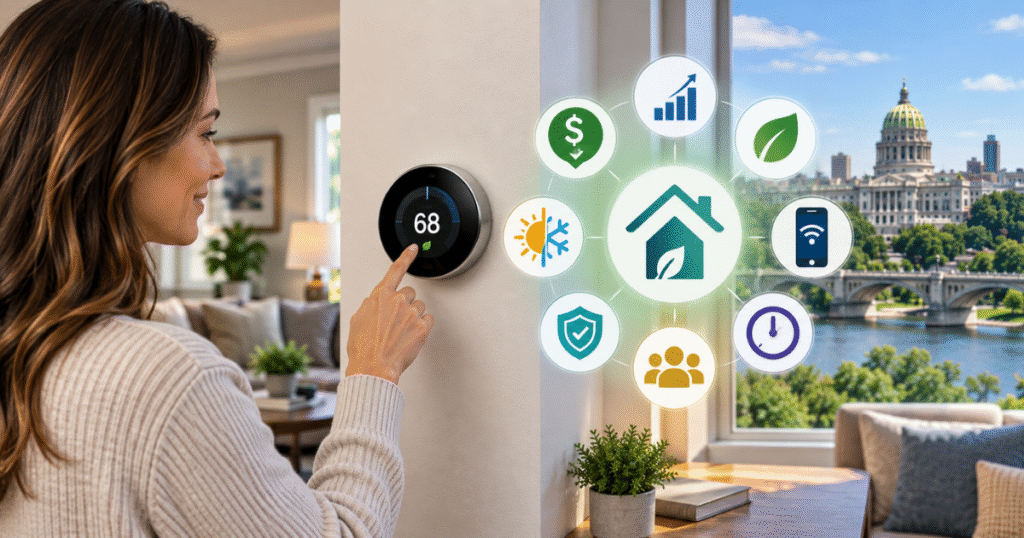
Smart thermostat Harrisburg PA guide showing 8 proven benefits to lower energy bills
Uncategorized

Smart Thermostat Harrisburg PA: 8 Proven Benefits That Lower Energy Bills in 2026

A smart thermostat Harrisburg PA homeowners install can cut annual heating and cooling costs by 10% to 23%, according to the U.S. Department of Energy and leading manufacturers. For a Central Pennsylvania household that spends around $2,000 a year keeping the house comfortable through cold winters and humid summers, that is roughly $200 to $460 back in your pocket every year. A professionally installed smart thermostat usually pays for itself within one to two heating seasons, and it adds remote phone control, automatic scheduling, and system alerts that a basic dial thermostat can never match. Below, the Tapper Energy team breaks down the 8 biggest benefits, real 2026 cost ranges, a side by side comparison with older thermostats, and exactly how a smart thermostat Harrisburg PA install works with the gas furnaces, heat pumps, and boilers common in Harrisburg area homes. TL;DR: Smart Thermostat Benefits at a Glance Ready to upgrade? Call Tapper Energy at (717) 921-4822 or request a free estimate for smart thermostat Harrisburg PA installation and service across Central PA. Table of Contents 8 Benefits of a Smart Thermostat for Harrisburg PA Homes A smart thermostat Harrisburg PA households depend on does far more than turn the heat up and down. It manages your comfort around your real schedule, the local weather, and your equipment, so your furnace and air conditioner only run when they need to. Here are the 8 benefits that matter most for Central Pennsylvania homeowners. 1. Automatic Temperature Scheduling (Set It and Forget It) You program your ideal temperatures once, and the thermostat handles the rest, warming the house before you wake up and easing off while you sleep or work. In a Harrisburg winter, that means the furnace is not heating an empty house at 2 p.m. and not blasting all night. Automatic setbacks are the single biggest source of savings from a smart thermostat Harrisburg PA homeowners install, and they happen without you touching a dial. 2. Remote Control From Your Phone Forgot to turn down the heat before a weekend trip to the Poconos? Open the app and fix it from anywhere. Every smart thermostat Harrisburg PA installers set up connects to your Wi-Fi, so you can adjust the temperature, check whether the AC is running, and get your house comfortable before you walk in the door. This is one of the features homeowners tell us they use every single day. 3. Learning Your Habits to Optimize Efficiency Learning models like the Nest study when you raise and lower the temperature, then build an efficient schedule for you automatically. Over a few weeks, the thermostat figures out that you like it at 68 degrees in the evening and cooler overnight, and it adjusts on its own. The result is steady comfort with less guesswork and less wasted energy. 4. Energy Usage Reports and Insights Most smart thermostats send monthly energy reports showing how many hours your system ran and how you compare to previous months. For smart thermostat Harrisburg PA homeowners watching their PPL Electric and gas bills, these insights make it easy to spot a problem early, such as a system running far longer than it should, which often signals a maintenance issue worth a professional look. 5. Geofencing (Adjusts When You Leave or Return) Geofencing uses your phone’s location to know when the house is empty. Leave for work and the thermostat eases back automatically. Head home and it returns to your comfort setting so the house is ready when you arrive. You get the savings of setbacks without ever remembering to change anything, which is why a smart thermostat Harrisburg PA install suits busy families and unpredictable schedules. 6. Works With Heat Pumps, Furnaces, and Dual Fuel Systems The right smart thermostat Harrisburg PA homeowners install manages gas furnaces, air source heat pumps, and dual fuel systems that switch between electric and gas as temperatures drop. This matters in Central PA, where heat pumps are increasingly popular. If you are weighing your options, our guide on heat pumps vs furnaces in Central PA explains which pairs best with a smart control for our climate. 7. Alerts for Filter Changes and System Issues A smart thermostat Harrisburg PA homeowners install reminds you when to change your air filter and warns you if temperatures drift far outside your setting, an early sign of a failing furnace or AC. Pair those alerts with a seasonal tune-up from our HVAC maintenance checklist for Harrisburg homeowners, and you catch small problems before they become expensive breakdowns on the coldest night of the year. 8. Potential Utility Rebates From PPL Electric PPL Electric has offered rebates of $50 to $100 on ENERGY STAR certified smart thermostats through its energy efficiency programs, though funding runs in cycles and the most recent phase deadline has passed. Rebate amounts and availability change, so confirm the current offer on the PPL rebate portal before you buy. Our roundup of HVAC rebates in Pennsylvania for 2026 tracks the incentives most homeowners miss. Smart Thermostat Cost and Installation in Harrisburg PA A smart thermostat Harrisburg PA homeowners buy typically runs $70 to $300 for the device, plus $100 to $250 for professional installation. All in, most quality installs land between $230 and $520 depending on the model and whether your wiring needs an update. The table below shows current 2026 ranges for the three most popular brands. These are typical Central PA ranges, not a Tapper Energy quote, so request a free estimate for your exact price. Thermostat Model Device Cost Professional Install Total Installed Key Feature Nest Learning Thermostat $130 to $280 $100 to $250 $230 to $480 Learns your schedule automatically Ecobee Smart Thermostat Premium $230 to $280 $100 to $250 $330 to $500 Built-in air quality monitor and remote room sensor Honeywell Home T9/T10 $170 to $300 $100 to $250 $270 to $520 Smart room sensors that balance temperature room to room Nest Learning Thermostat The Nest is the best known learning thermostat for a

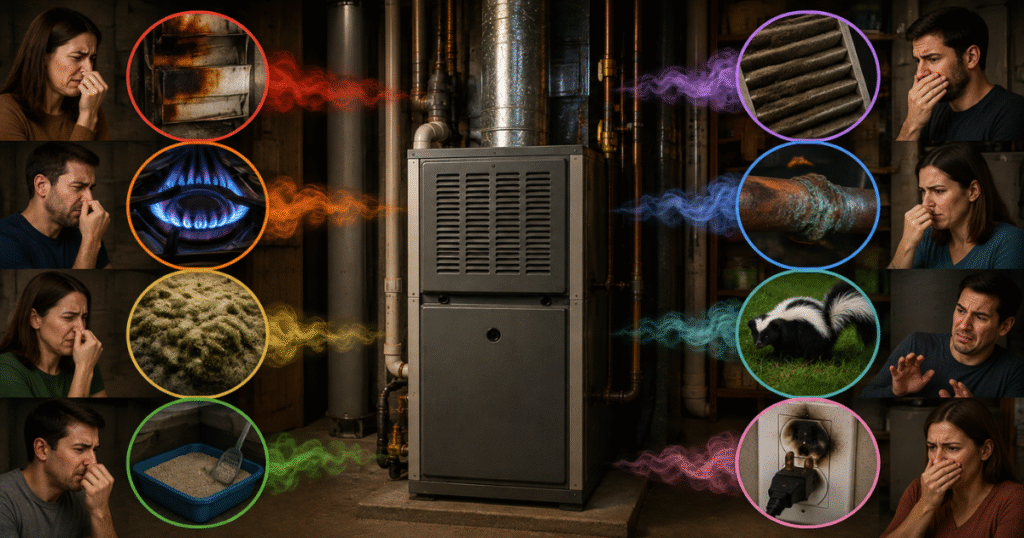
furnace smell Harrisburg PA warning signs and danger levels
Uncategorized

Furnace Smell Harrisburg PA: 7 Dangerous Odors Your Family Must Recognize

If your furnace smells like burning, rotten eggs, or chemicals, do not ignore it. Some furnace odors are harmless, but others signal gas leaks, electrical fires, or carbon monoxide risks that require immediate action. A furnace smell Harrisburg PA homeowners report generally falls into one of seven categories. A faint dusty smell at your furnace’s first run of the season is normal and should clear within 15 to 30 minutes. A rotten egg smell means a gas leak: leave the house immediately. Burning plastic, metallic, musty, chemical, and oil odors each point to a specific problem, from a $15 filter to a cracked heat exchanger. Below, we rank all 7 by danger level and tell you exactly what to do next. TL;DR Smelling something off right now? Call Tapper Energy at (717) 921-4822 for a same-day furnace smell Harrisburg PA inspection, or request a free estimate online. In this guide: 7 Furnace Smells and What They Mean Here is what each furnace smell Harrisburg PA homes commonly report means, ranked least to most dangerous. Smell Likely Cause Danger Level What to Do Burning dust Dust burning off the heat exchanger at startup Low (Medium if it lingers) Ventilate and monitor. Call a pro past 30 minutes Musty or moldy Dirty filter or mold in the ductwork Low to Medium Replace the filter. Inspect ducts if it continues Metallic or hot metal Overheating motor, bearing, or belt Medium Turn off, let it cool, call a pro Oil or fuel smell Oil furnace leak or a clogged nozzle/filter Medium to Emergency Turn off, do not restart, call a pro Burning plastic or rubber Overheated wiring or a melted component Medium to Emergency Shut off at the breaker, call a pro same day Rotten eggs or sulfur Natural gas leak Emergency Leave immediately, call 911 and UGI Chemical or formaldehyde Cracked heat exchanger, CO risk Emergency Evacuate, ventilate, call a pro now 1. Burning Dust (Normal at Startup, Dangerous If Persistent) This furnace smell Harrisburg PA homeowners notice most is normal at your furnace’s first run of the season, and should clear in 15 to 30 minutes. Means: dust burning off the heat exchanger. Do now: ventilate and give it 30 minutes. DIY or pro: DIY to monitor; call a pro if it returns, or it’s been over a year since your last furnace tune-up. Danger: Low, Medium if it persists. 2. Rotten Eggs or Sulfur (Gas Leak: Leave Immediately) Natural gas is odorless; utilities add mercaptan, which smells like rotten eggs, so a leak is impossible to miss. Means: a gas leak, possibly at the furnace’s gas valve or a nearby connection. Do now: leave the house immediately, do not flip switches or light a match. Full steps below. DIY or pro: pro and your gas utility only, never DIY. Danger: Emergency. 3. Burning Plastic or Rubber (Electrical or Wiring Problem) A burning plastic furnace smell Harrisburg PA households report is almost always wiring or a motor, not the fuel system: overheated insulation or a melted part near the burner are common causes on our service calls across Harrisburg. Means: overheated wiring, a failing motor, or a melted component. Do now: turn the furnace off at the switch or breaker; do not run it again until inspected. DIY or pro: pro only, an electrical and fire hazard. Danger: Medium to Emergency. 4. Metallic or Hot Metal Smell (Overheating Components) A sharp “hot penny” smell means a part is running hotter than it should: a worn belt, a dry bearing, or a blower wheel rubbing its housing. Means: a motor, bearing, belt, or blower component overheating. Do now: turn off the furnace and let it cool an hour before restarting. DIY or pro: pro. Often tied to furnace short cycling and worth a full inspection. This furnace smell Harrisburg PA technicians flag most often points to simple wear, not a fuel problem. Danger: Medium. 5. Musty or Moldy Odor (Dirty Filter or Ductwork Mold) Usually a dirty filter, or moisture and mold in the ductwork, common in Central PA basements after humid summers. Means: a clogged filter, or mold and moisture in the ducts. Do now: replace the filter first ($15 to $35, every 1 to 3 months; see our maintenance checklist). DIY or pro: DIY for the filter; pro for duct inspection if it stays. Danger: Low to Medium, an air-quality irritant rather than fire or gas risk, and one of the most common furnace smell Harrisburg PA calls we get in spring. 6. Chemical or Formaldehyde Smell (Cracked Heat Exchanger) One of the most serious furnace smell Harrisburg PA calls we take, this sharp, hospital-like smell is often linked to a cracked heat exchanger letting carbon monoxide and other combustion byproducts leak into your air instead of venting outside. Means: a cracked or corroded heat exchanger, or a broken burner seal. Do now: turn off the furnace, ventilate, and get everyone to fresh air, especially with a headache, nausea, or dizziness. DIY or pro: pro only, same day; see our carbon monoxide warning signs guide. Danger: Emergency. 7. Oil or Fuel Smell (Oil Furnace Leak or Clogged Filter) On oil heat, common across Newport and Millersburg, this usually means a clogged nozzle, a puffback, or a small leak at a fitting. Means: a clogged filter, nozzle, or leaking fitting. Do now: turn off the furnace, do not restart, ventilate. DIY or pro: pro only. Danger: Medium to Emergency, and a furnace smell Harrisburg PA oil-heat households should never ignore. Not sure which of these matches your furnace smell Harrisburg PA home is dealing with? Call Tapper Energy at (717) 921-4822. We’ll talk it through and get a technician out the same day when it’s urgent. What to Do If You Smell Gas from Your Furnace A rotten egg smell is the one odor that always means stop and act. Here is exactly what to do, in order. Step 1: Do Not Flip Any Switches or Light Matches Do not turn

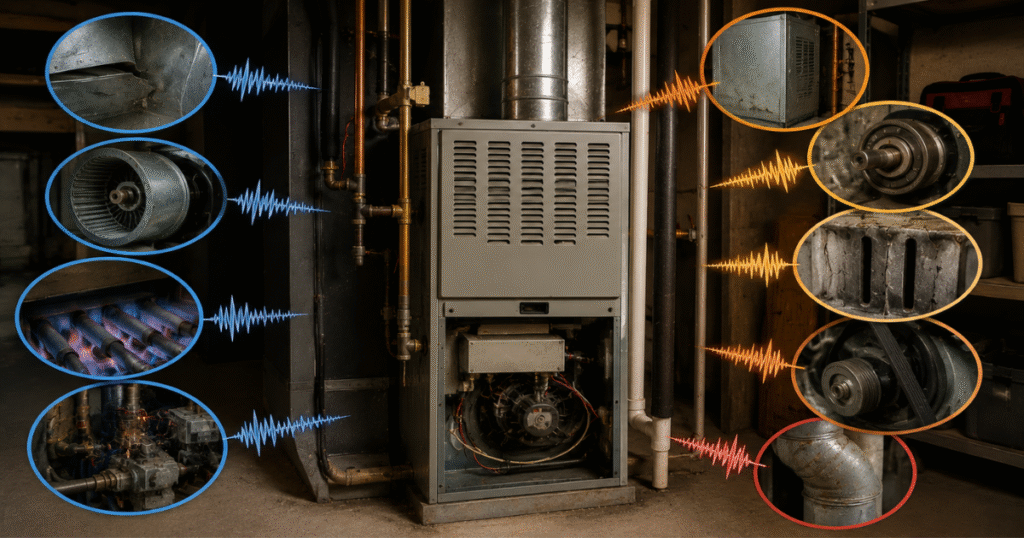
Furnace noise Harrisburg PA guide covering 9 alarming furnace sounds and what they mean
Uncategorized

Furnace Noise Harrisburg PA: 9 Alarming Sounds Explained (2026)

Furnace noise Harrisburg PA homeowners hear almost always points to one specific, identifiable problem, and a few of these sounds are safety emergencies that need attention right away. Banging usually means delayed ignition. Screeching points to a belt or bearing. Grinding means a failing blower motor. Rumbling can signal a dirty burner or a carbon monoxide risk. Central PA winters push a furnace to run for hours at a stretch from November through March, and that workload is exactly when a new sound tends to show up. This furnace noise Harrisburg PA guide breaks down all nine common sounds, what causes each one, whether it is a DIY check or a professional repair, and what it typically costs to fix. TL;DR Not sure what your furnace noise means or how urgent it is? Call Tapper Energy at (717) 921-4822. We offer free estimates and same-day furnace noise Harrisburg PA diagnostics across Central PA. Table of Contents 9 Furnace Noises and What They Mean Every furnace noise Harrisburg PA homeowners report has a mechanical explanation. Here is what each of the nine most common sounds means, what it takes to fix, and how urgent it is. 1. Banging or Booming (Delayed Ignition) A bang or boom right when the furnace kicks on is almost always delayed ignition: gas builds up in the burner chamber for a few extra seconds, then ignites all at once instead of smoothly. The usual cause is a dirty burner or a slow-to-spark ignitor. This is not a DIY fix. Delayed ignition can crack a heat exchanger over time, so it needs a professional inspection. Call today rather than waiting. Expect to pay $150 to $300 for burner cleaning and ignitor service. If banging shows up alongside frequent on-and-off cycling, see our guide on furnace short cycling in Harrisburg PA. 2. Screeching or Squealing (Belt or Bearing Failure) A high-pitched screech, especially when the blower first kicks on, usually means a fan belt is slipping or worn, or a motor bearing is losing lubrication. Older belt-drive blowers are the most common source of this furnace noise. You can safely check whether the filter is clogged first, since restricted airflow forces the blower to work harder and can worsen the sound, but the belt or bearing itself is a professional repair. Treat it as a call-today issue. A slipping belt left alone eventually snaps and the blower stops moving air entirely. 3. Rattling (Loose Panels, Screws, or Ductwork) Rattling is usually the least urgent sound on this list. Furnace cabinets are held together by a handful of screws, and normal vibration over months of run time works them loose. Loose duct connections rattle the same way. This is genuinely DIY-friendly: turn off the furnace, check that all panels are seated and tight, and inspect any visible duct joints nearby. If tightening the panels does not solve it, the rattle likely comes from inside the cabinet, and it is worth a technician visit to rule out a loose motor mount. 4. Humming or Buzzing (Electrical Issue or Transformer) A steady hum or buzz points to an electrical component: a failing transformer, a worn contactor, or a capacitor starting to go. A faint hum from the transformer at idle can be normal, but a loud or new buzz that grows louder over a few days is not. Electrical components are not a DIY repair given the shock risk and the cost of guessing wrong. Schedule a diagnostic within the week, or call today if the buzzing is loud and constant. 5. Clicking (Ignitor or Flame Sensor Problem) Repeated clicking when the furnace tries to start, especially several clicks without the burner lighting, usually means the ignitor is failing or the flame sensor is dirty and cannot confirm a flame, so the control board keeps retrying. A single click at startup and shutdown is normal. Repeated or rapid clicking is not. A confident DIYer can sometimes clean a flame sensor with fine sandpaper, but ignitor replacement is a professional job. Typical cost runs $80 to $300 depending on the part. 6. Grinding (Blower Motor Bearing Failure) Grinding is a metal-on-metal sound, and it means the blower motor’s bearings are failing. This is one of the more urgent types of furnace noise Harrisburg PA technicians see, because a seized blower can shut the whole system down without warning on a cold night. There is no DIY fix for a bad bearing. Call today. Bearing repair typically runs $150 to $450, and a full motor replacement runs higher depending on the model. 7. Whistling (Dirty Filter or Ductwork Gap) A whistle or high-pitched hiss almost always means air is forcing through a gap that is too small, either a severely clogged filter restricting airflow or a loose duct connection pulling air from the wrong place. This is the easiest DIY check on the list: replace the filter first. If the whistle continues with a fresh filter, the noise is coming from ductwork and is worth a technician visit to locate and seal. 8. Popping (Ductwork Expansion and Contraction) Metal ductwork expands as heated air moves through it and contracts as it cools, and thin sheet metal can pop or oil-can as it flexes, similar to a metal roof warming in the sun. This is common and usually not a safety concern. If the popping is loud, frequent, or coming from one section of ductwork, a technician can reinforce an undersized or poorly supported run to quiet it down. 9. Rumbling (Dirty Burner or Draft Issue) A low rumble that continues through the whole burner cycle, rather than just at startup, can mean the burners are dirty and burning unevenly, or there is a draft or venting problem affecting combustion. This is the furnace noise Harrisburg PA homeowners should treat with the most caution, because incomplete combustion is linked to elevated carbon monoxide production. Do not wait on rumbling. If it comes with a burning smell, soot near the furnace, or a yellow

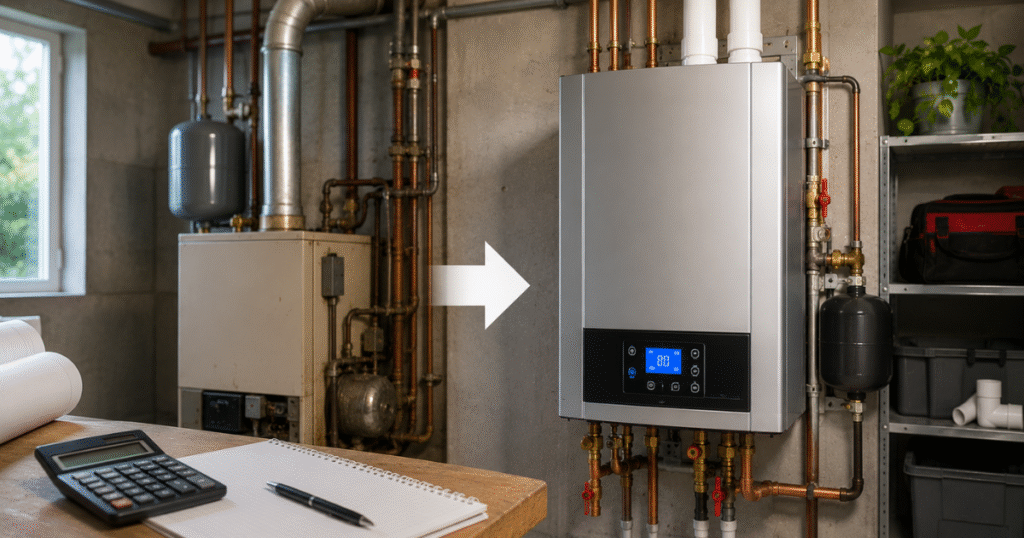
Boiler replacement cost Harrisburg PA pricing guide showing 9 critical 2026 prices for Central PA homeowners
Uncategorized

Boiler Replacement Cost Harrisburg PA: 9 Critical Prices Every Homeowner Must Know (2026)

Boiler replacement cost Harrisburg PA ranges from $3,500 to $12,000 depending on the boiler type, size, and fuel source. For Central PA homeowners staring down an aging or failing boiler, knowing these 2026 prices before calling a contractor can save you thousands. The right boiler can cut your heating bills by 30% or more, while the wrong choice locks you into 15 to 20 years of higher energy costs. Harrisburg winters regularly drop below freezing from November through March, and a failing boiler puts your home, your pipes, and your family’s comfort at serious risk. Whether you are replacing a standard gas boiler, switching from oil to a high-efficiency system, or upgrading an old steam boiler in a pre-war row home, this pricing guide breaks down all 9 critical price points so you can budget accurately and make a confident decision. Quick Summary: Ready for an exact quote? Call Tapper Energy at (717) 921-4822 or request a free boiler replacement estimate to get pricing specific to your home. Table of Contents How Much Does Boiler Replacement Cost in Harrisburg PA? (2026 Pricing) Your total boiler replacement cost Harrisburg PA depends on three main factors: the boiler type, your home’s fuel source, and the complexity of the installation. Below are all 9 pricing categories Central PA homeowners need to know, based on 2026 market data and typical Harrisburg-area installation costs. Standard Gas Boiler ($3,500 to $6,000) The most common replacement in Harrisburg homes connected to UGI Gas. A standard gas boiler with 80 to 84% AFUE rating costs $3,500 to $6,000 installed. These units work well for smaller homes under 2,000 square feet with hot water baseboard or radiator systems. Installation typically takes one day for a straightforward swap where the fuel type and venting stay the same. When budgeting boiler replacement cost Harrisburg PA homeowners should know that standard gas boilers are reliable and affordable, but they leave 16 to 20 cents of every heating dollar unrecovered as waste heat. For homeowners on a tighter budget who plan to sell within 5 years, a standard unit still makes financial sense. High-Efficiency Gas Boiler ($5,000 to $8,000) For a higher-tier boiler replacement cost Harrisburg PA homeowners can expect to pay $5,000 to $8,000 for condensing gas boilers with 90 to 97% AFUE ratings. The higher upfront cost pays back through significantly lower fuel consumption. A 95% AFUE boiler extracts nearly all usable heat from natural gas, compared to just 80% from a standard model. For a typical 2,000-square-foot Harrisburg home, the annual fuel savings range from $200 to $400. According to the U.S. Department of Energy, a 0.97 AFUE boiler saves approximately $1,824 in lifetime energy costs compared to a 0.84 AFUE model. If you plan to stay in your home for 10 or more years, a high-efficiency model is the stronger investment. Oil Boiler Replacement ($4,000 to $7,500) Oil boilers remain common in rural parts of Central PA, especially in areas like Halifax, Millersburg, and Duncannon where natural gas lines are unavailable. Replacing an oil boiler costs $4,000 to $7,500 installed. Modern oil boilers reach up to 87% AFUE, which meets the ENERGY STAR threshold for oil-fired boilers. Oil fuel costs tend to be higher and more volatile than natural gas. If gas service is available on your street through UGI, this is a smart time to consider a fuel switch. The gas line installation typically adds $1,000 to $3,000, but most homeowners recoup that within 3 to 5 years through lower fuel bills. Electric Boiler ($2,500 to $5,000) Electric boilers cost $2,500 to $5,000 installed and offer near 99% efficiency, since there is no combustion heat loss. They produce zero emissions at the point of use, require no flue or chimney, and need very little maintenance. However, electricity rates in PPL’s Central PA service area mean annual operating costs run higher than gas or even oil. Electric boilers work best as supplemental heat for home additions, small apartments, or spaces where running gas lines or installing combustion venting is impractical. An electrical panel upgrade ($1,400 to $2,800) may also be required for larger electric boiler units. Combi Boiler ($3,500 to $7,000) A combi boiler replacement cost Harrisburg PA homeowners between $3,500 and $7,000 installed. These combination units handle both space heating and domestic hot water in a single unit, eliminating the need for a separate water heater. Combi boilers save space and simplify your mechanical room, making them ideal for smaller homes. The tradeoff: combi boilers work best in homes with 2 or fewer bathrooms. High hot water demand from multiple showers or fixtures running simultaneously can exceed a combi unit’s flow rate. For larger families, a traditional boiler paired with a separate water heater is the better setup. Steam Boiler Replacement ($5,000 to $10,000) Steam boilers are found in many older Harrisburg homes, especially row homes and pre-1950 construction throughout Midtown and Uptown. Replacing a steam boiler costs $5,000 to $10,000 due to the specialized piping, controls, and safety devices required. If your home has large cast iron radiators with air vents and a single pipe running to each unit, you likely have a steam system. Steam boiler replacements are more complex than hot water systems and often require a two-day installation. In our service calls across Harrisburg, steam boiler replacements are among the most involved jobs we handle, but the result is reliable, even heat throughout these older homes. Cast Iron vs Steel Boiler ($4,000 to $12,000) Cast iron boilers are heavier, more durable, and can last 25 to 30+ years with proper maintenance. They cost $6,000 to $12,000 installed. Steel boilers are lighter, heat up faster, and cost $4,000 to $8,000, but their lifespan averages 15 to 20 years. For Harrisburg homeowners planning to stay in their home long-term, cast iron offers the better lifetime value despite the higher upfront price. If you plan to move within 10 years, a steel boiler delivers solid performance at a lower cost. Labor and Installation Charges ($1,500 to

AC compressor cost Harrisburg PA
Uncategorized

AC Compressor Cost Harrisburg PA: 7 Shocking Prices Every Homeowner Must Know (2026)

AC compressor cost Harrisburg PA ranges from $1,100 to $4,650 fully installed in 2026, depending on the compressor type, system size, and whether your unit is still under warranty. The compressor is the most expensive single component in your air conditioning system, and replacing it can cost nearly as much as a brand-new condenser unit. For Harrisburg and Central PA homeowners facing this repair, understanding the real price breakdown before you call for service is the difference between a smart investment and an expensive mistake. TL;DR Need a straight answer on your AC compressor cost? Call Tapper Energy at (717) 921-4822 or request a free estimate for upfront, no-surprise pricing. Table of Contents How Much Does AC Compressor Replacement cost Harrisburg PA? What drives the total AC compressor cost Harrisburg PA? It comes down to four main factors: the compressor type, your system size in tons, whether the manufacturer warranty still covers parts, and the refrigerant your system uses. Here is what each piece of the bill looks like in 2026. Single-Stage Compressor ($500 to $1,500 for the Part) Single-stage compressors are the most common type in Central PA homes built before 2015. They run at full capacity whenever they cycle on, which makes them less efficient but also the most affordable to replace. For this compressor type, the AC compressor cost Harrisburg PA runs $1,100 to $2,700 fully installed, with the part itself at $500 to $1,500 depending on tonnage. Two-Stage Compressor ($700 to $2,100 for the Part) Two-stage compressors run at a lower speed most of the time and ramp up to full power only on the hottest days. They cost more upfront but deliver better humidity control during Central PA’s humid summers. The two-stage AC compressor cost Harrisburg PA runs $1,500 to $3,400 installed, with the part at $700 to $2,100. Variable-Speed / Inverter Compressor ($1,100 to $3,000+ for the Part) Variable-speed (inverter-driven) compressors adjust output continuously, delivering the quietest operation and lowest electric bills. They carry the highest AC compressor cost Harrisburg PA homeowners will encounter. Parts range from $1,100 to $3,000 or more, and total installed cost can reach $2,200 to $4,650. In our service calls across Harrisburg and Mechanicsburg, we find these are most common in systems installed after 2018. Labor and Installation Charges ($500 to $1,200) Labor is a major factor in the total AC compressor cost Harrisburg PA homeowners pay. Compressor replacement takes 4 to 8 hours of on-site labor for a certified HVAC technician. Labor rates in the Harrisburg PA market run $85 to $150 per hour, putting the labor portion at $500 to $1,200. The job includes recovering the existing refrigerant (required by EPA regulations), removing the old compressor, brazing the new one into the refrigerant lines, pulling a vacuum on the system, and recharging with fresh refrigerant. Refrigerant Recharge Cost ($100 to $800) Refrigerant adds to the overall AC compressor cost Harrisburg PA jobs. Every compressor replacement requires a full refrigerant recharge. For modern R-410A systems, refrigerant runs $40 to $90 per pound at residential service pricing in 2026, and a typical 2.5 to 3-ton system needs 6 to 9 pounds. That puts the refrigerant portion at $240 to $810. Older R-22 (Freon) systems cost significantly more because R-22 has been phased out of production since January 2020 under the EPA Clean Air Act, making remaining supply scarce and expensive. Warranty vs Out-of-Warranty Pricing Most major AC brands (Carrier, Trane, Lennox, Rheem, Goodman) offer a 10-year parts warranty on registered systems and 5 years on unregistered units. A few brands like Amana offer a lifetime compressor warranty on registered equipment. If your compressor is under warranty, the manufacturer covers the part itself and you pay only labor, refrigerant, and small parts, typically $600 to $2,000 total. Out of warranty, you pay for everything, pushing the total AC compressor cost Harrisburg PA to $1,100 to $4,650. Knowing your warranty status is the fastest way to narrow your AC compressor cost Harrisburg PA estimate before calling for service. Pro tip: Dig out your original installation paperwork or check the manufacturer’s warranty lookup tool online before calling for service. A valid warranty can cut your bill in half. Emergency Weekend and After-Hours Surcharges Emergency timing can spike the AC compressor cost Harrisburg PA by $150 to $400. If your compressor fails on a July weekend (and it often does, since compressors work hardest during Central PA’s 90-degree summer stretches), expect that surcharge on top of the standard repair cost. Tapper Energy maintenance plan members get priority 24-hour emergency service, which can save both time and money when every hour without AC matters. Already seeing warning signs? Don’t wait for a weekend emergency. Call Tapper Energy at (717) 921-4822 for a same-day diagnostic. AC Compressor Cost Comparison: Harrisburg PA vs National Averages How does the AC compressor cost Harrisburg PA homeowners pay compare to the rest of the country? Central PA compressor replacement pricing falls slightly below the national average thanks to moderate labor rates compared to major metro areas. Here is how Harrisburg stacks up: System Size Harrisburg PA Installed Cost National Average Installed Cost Typical Home Size 1.5 to 2 ton $1,100 to $2,700 $1,200 to $2,800 600 to 1,200 sq ft 2.5 to 3 ton $1,500 to $3,400 $1,800 to $3,500 1,200 to 2,000 sq ft 3.5 to 4 ton $1,850 to $4,000 $2,000 to $4,200 2,000 to 2,800 sq ft 5 ton $2,200 to $4,650 $2,500 to $5,200 2,800+ sq ft These numbers show that the AC compressor cost Harrisburg PA homeowners face is competitive with (and often below) what homeowners pay in Philadelphia, Pittsburgh, or other metro areas. Most homes in Harrisburg, Mechanicsburg, and the surrounding Central PA towns run 2.5 to 3-ton systems. The Department of Energy recommends roughly 1 ton of cooling capacity per 500 to 600 square feet, though factors like insulation quality, window count, and attic ventilation can shift the sizing. If you are unsure what size system you have, the model number

Scroll to Top