SEER2 rating explained in one line: it is the federal cooling-efficiency number every new central air conditioner and heat pump has carried since January 1, 2023, and in Harrisburg and the rest of Pennsylvania the legal minimum is 13.4 SEER2 for a central AC and 14.3 SEER2 for a split heat pump. SEER2 replaced the old SEER system, and many PA homeowners are confused about what the new numbers mean, what efficiency is required, and how much a higher SEER2 rating actually saves. This guide answers all three with Central PA numbers.
TL;DR
- Pennsylvania sits in the DOE North region: new central ACs must be at least 13.4 SEER2 (about 14 old SEER), and split heat pumps at least 14.3 SEER2 and 7.5 HSPF2.
- SEER2 numbers read about 4 to 5% lower than old SEER numbers for the same equipment, because the test adds more duct resistance. A 14 SEER unit is roughly 13.4 SEER2.
- For most Harrisburg homes, 15 to 17 SEER2 is the payback sweet spot. PPL heat pump rebates start at 15.2 SEER2, while 20+ SEER2 rarely pays back on cooling savings alone.
📞 Replacing an AC or heat pump this year? Call Tapper Energy at (717) 921-4822 or request a free installation estimate. We will show you the SEER2 math for your actual home before you buy.
Table of Contents
- What Is SEER2 and How Is It Different from SEER?
- SEER2 Rating Explained: 5 Facts PA Homeowners Must Know
- SEER2 vs SEER Conversion Chart
- How Do You Choose the Right SEER2 Rating for a Harrisburg PA Home?
- FAQ: SEER2 Rating Explained
- Need Help Choosing the Right Efficiency? Call Tapper Energy
What Is SEER2 and How Is It Different from SEER?
Here is the SEER2 rating explained in plain terms. SEER2 stands for Seasonal Energy Efficiency Ratio 2. It measures how much cooling a system delivers over a full season divided by the electricity it uses. Higher is better. A 16 SEER2 unit moves the same heat as a 13.4 SEER2 unit on about 16% less electricity.
Here is the SEER2 rating explained against its predecessor, because the two numbers are not interchangeable.
The Old SEER System (Pre-2023)
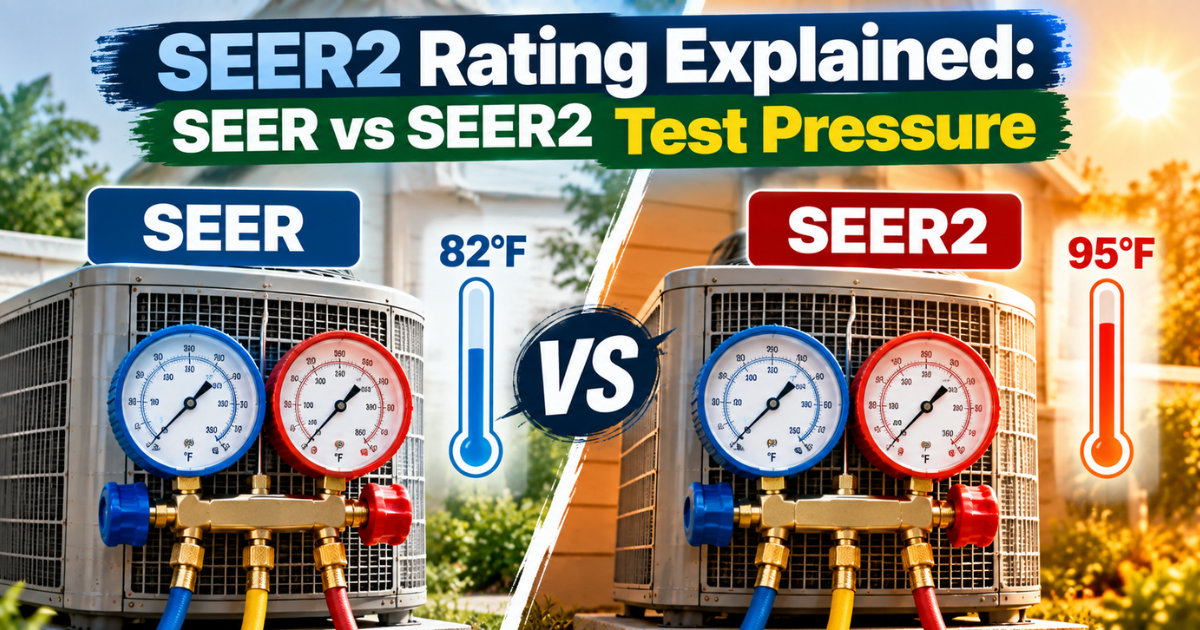
The original SEER test ran equipment against very low duct resistance, about 0.1 inches of water column. Real homes, especially older Harrisburg homes with long or undersized duct runs, push back much harder than that. So lab numbers looked better than what homeowners saw on their PPL or Met-Ed bills. That gap is exactly why homeowners now need the SEER2 rating explained before they buy.
The New SEER2 Testing Method (Higher Pressure Drop)
The U.S. Department of Energy’s central air conditioner and heat pump standards moved testing to a procedure called Appendix M1 in 2023. It raises external static pressure to about 0.5 inches, roughly five times the old test, to mimic real ductwork. The companion metrics are EER2 (peak-heat efficiency) and HSPF2 (heat pump heating efficiency).
Why SEER2 Numbers Are Lower Than SEER (14 SEER = ~13.4 SEER2)
Nothing got less efficient. The test simply got tougher, so the same unit scores about 4 to 5% lower. That is why the North region minimum is written as 13.4 SEER2 instead of 14 SEER. Keep this in mind when you compare an old quote, a used unit, or a neighbor’s system: always compare SEER2 to SEER2. A contractor who has the SEER2 rating explained correctly will quote in SEER2 numbers only.
SEER2 Rating Explained: 5 Facts PA Homeowners Must Know
On replacement calls across Harrisburg, Mechanicsburg, and Camp Hill, the SEER2 questions we hear boil down to these five facts. This is the SEER2 rating explained the way we explain it at the kitchen table.
1. The PA Minimum Is 13.4 SEER2 for AC and 14.3 SEER2 for Heat Pumps
Pennsylvania is in the DOE North region. Any split central AC installed here must be at least 13.4 SEER2. Split heat pumps follow a national standard of 14.3 SEER2 and 7.5 HSPF2, and single-package units must hit 13.4 SEER2. The rule applies to new installations, not to the system already running in your yard.
2. Higher SEER2 Does Not Always Mean More Savings
A higher SEER2 rating only saves money when the system actually runs and is installed well. An oversized unit short-cycles, a leaky duct system wastes airflow, and a mismatched indoor coil can drop real efficiency below the label. Correct sizing (see our guide on what size HVAC unit you need) often matters more than two extra SEER2 points. That is the SEER2 rating explained honestly: installation quality counts.
3. The Sweet Spot for Central PA Is 15 to 17 SEER2
Harrisburg summers are hot and humid but short compared with the South. That shorter cooling season caps how fast premium efficiency pays back. For most homes, 15 to 17 SEER2 hits the balance: meaningfully lower bills, better humidity control from two-stage models, and rebate eligibility without a runaway price. Homeowners who get the SEER2 rating explained before shopping usually land in this range.
4. SEER2 Only Measures Cooling (HSPF2 Measures Heating for Heat Pumps)
With the SEER2 rating explained, remember it says nothing about winter. For a heat pump, HSPF2 is the heating number, and in Central PA a heat pump heats far more hours than it cools. ENERGY STAR’s cold-climate ducted heat pumps require at least 8.1 HSPF2, versus the 7.5 HSPF2 federal minimum.
5. PA Rebates Require Minimum Efficiency Levels
The federal 25C tax credit ended for equipment placed in service after December 31, 2025, so utility rebates are now the main incentive, and this is where the SEER2 rating explained turns into real cash. PPL Electric’s current air-source heat pump rebate is $225 at Tier 1 (15.2 SEER2, 11.7 EER2, 7.8 HSPF2) or $325 at Tier 2 (16.3 SEER2, 12.9 EER2, 8.2 HSPF2), and the system must be ENERGY STAR certified and listed as a matched system in the AHRI certified directory. Programs change each Act 129 phase, so see our HVAC rebates Pennsylvania 2026 guide for the latest.

The table below shows the SEER2 rating explained in dollars. Savings assume a 3-ton system, about 1,000 cooling hours a year (a reasonable Harrisburg estimate), and roughly 20 cents per kWh, close to Pennsylvania’s 2026 residential average. Cost premiums are typical Central PA ranges, not a Tapper quote.
| SEER2 Rating | Equipment Tier | Typical Cost Premium | Annual Savings vs Minimum | Best For |
|---|---|---|---|---|
| 13.4 to 14.3 | Minimum, single-stage | Baseline | $0 (about $535 a year to run) | Tight budgets, rentals, light AC use |
| 15.2 to 16 | ENERGY STAR, single or two-stage | +$800 to $1,500 | $60 to $90 | Most Harrisburg homes, rebate-eligible heat pumps |
| 17 to 18 | Two-stage | +$1,800 to $3,500 | $115 to $135 | Heavy AC users, humidity control |
| 19 to 21 | Variable-speed inverter | +$3,500 to $6,500 | $160 to $195 | Comfort-first homes, heat pumps that also heat |
| 22 and up | Premium variable-speed | +$5,000 or more | $210 or more | Rarely pays back on cooling savings alone |
💡 Not sure which tier fits your house? Call (717) 921-4822 and a Tapper technician will size the system and run the payback math with you, free with any installation estimate.
SEER2 vs SEER Conversion Chart
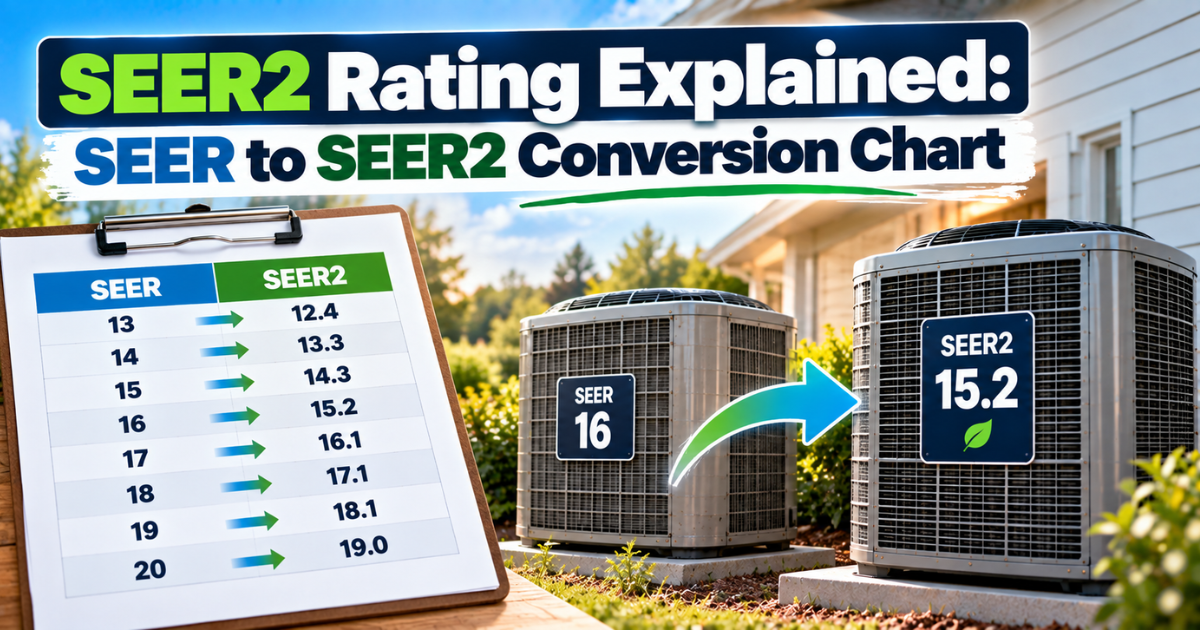
This chart is the SEER2 rating explained side by side with old SEER. Use it to translate an old SEER label into today’s SEER2 terms. Values are approximate, using the roughly 0.955 ratio the DOE translation implies.
| Old SEER | New SEER2 Equivalent | Efficiency Tier | Meets 2023 PA Minimum? |
|---|---|---|---|
| 10 | About 9.6 | Pre-2006 legacy unit | No, cannot be installed new |
| 13 | About 12.4 | Old 2006 to 2022 minimum | No |
| 14 | 13.4 | Current North region AC minimum | Yes, for central AC |
| 15 | 14.3 | Heat pump minimum | Yes, AC and heat pump |
| 16 | About 15.2 | ENERGY STAR level | Yes |
| 17 | About 16.2 | High efficiency | Yes |
| 18 | About 17.2 | High efficiency, two-stage | Yes |
| 20 | About 19.1 | Premium variable-speed | Yes |
| 22 | About 21.0 | Top tier | Yes |
To confirm any model’s real rating, look it up in the ENERGY STAR certified central air conditioner finder. Rebates are based on the matched outdoor unit plus indoor coil, not the outdoor unit alone.
How Do You Choose the Right SEER2 Rating for a Harrisburg PA Home?
With the SEER2 rating explained, the right choice comes down to three things: your climate, how hard your system works, and how long you will stay in the home.
Climate Zone: What Central PA Weather Demands
Dauphin and Cumberland counties sit on the line between IECC Climate Zones 4A and 5A, depending on the code edition, and counties just north are firmly 5A. Either way, heating dominates the year. That is why a heat pump’s HSPF2 and a furnace’s AFUE usually drive more of your annual bill than the cooling rating. Our heat pump installation cost Pennsylvania guide covers the heating side in detail. It is the part of the SEER2 rating explained that most national guides skip.
Your Cooling Hours and Usage Patterns
If you run central air from May through September, keep the house at 70 degrees, or work from home, lean toward 16 to 18 SEER2. If you open windows most of the summer or cool only a few weeks a year, 14.3 to 15.2 SEER2 is usually enough. Humidity matters too: two-stage and variable-speed units run longer at low speed and pull more moisture out of Susquehanna Valley air.
Upgrading From a Very Old Unit
The biggest jump is not 16 versus 20 SEER2. It is replacing a 20-year-old 10 SEER unit. Swapping that unit for a 16 SEER2 system cuts cooling electricity by about 40%, roughly $300 a year in our 3-ton example.
ROI Calculation: Higher Efficiency vs Higher Upfront Cost
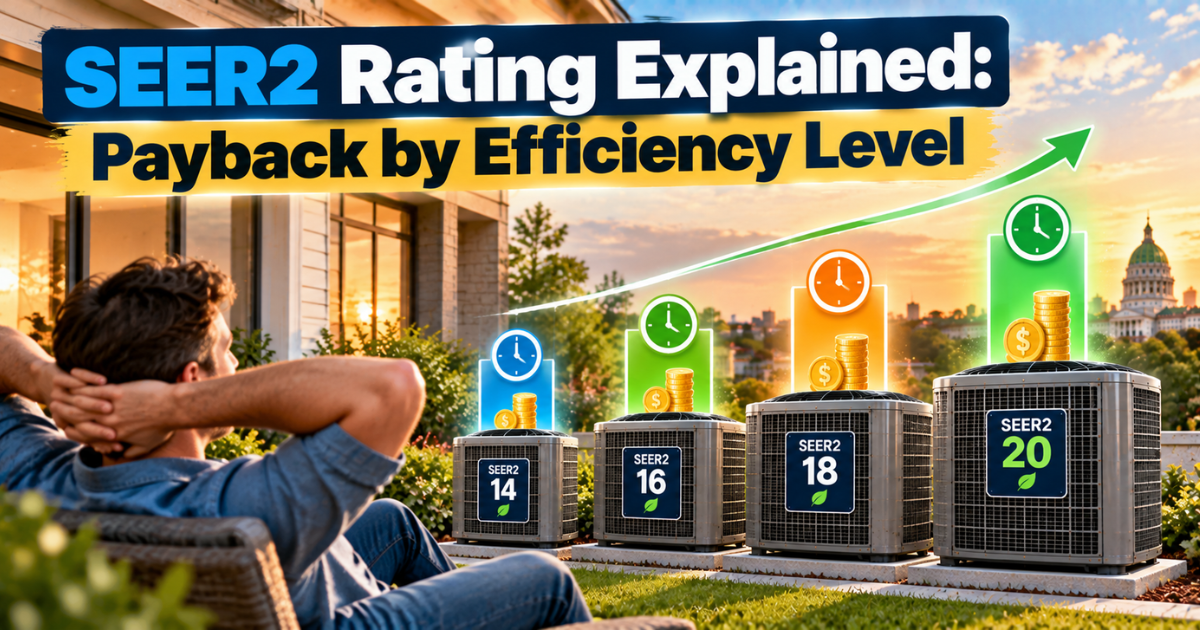
Simple payback is the SEER2 rating explained in plain math: the extra cost divided by the annual savings. Using the table above:
- 16 SEER2 vs 13.4 SEER2: about $1,000 extra divided by about $87 a year is roughly 11 years. A PPL heat pump rebate trims that further.
- 18 SEER2 vs 13.4 SEER2: about $2,500 extra divided by about $137 a year is roughly 18 years.
- 20 SEER2 vs 13.4 SEER2: about $4,500 extra divided by about $177 a year is roughly 25 years, longer than the typical 15 to 20 year system life.
That is the SEER2 rating explained as an investment: the first few points over the minimum pay back, and each point after that returns less. Premium tiers are worth it for comfort, quiet, and humidity control, but buy them for those reasons, not the power bill. For full installed pricing, see our AC replacement cost Harrisburg PA breakdown.
FAQ: SEER2 Rating Explained
What SEER2 rating do I need in Pennsylvania?
With the SEER2 rating explained for Pennsylvania, the state is in the DOE North region, so a new split central air conditioner must be at least 13.4 SEER2, and a new split heat pump must be at least 14.3 SEER2 and 7.5 HSPF2. Those are legal minimums. For most Harrisburg area homes, a 15 to 17 SEER2 system offers the best balance of upfront price, lower bills, and utility rebate eligibility.
Is a higher SEER2 always better?
Not always. A higher SEER2 unit uses less electricity per hour of cooling, but Central PA has a fairly short cooling season, so savings grow slowly. Jumping from 13.4 to 16 SEER2 usually pays back within the system’s life, while 20+ SEER2 often does not. Proper sizing, sealed ducts, and a matched indoor coil matter as much as the rating.
What is HSPF2 for heat pumps?
HSPF2, or Heating Seasonal Performance Factor 2, measures how efficiently a heat pump heats your home over a winter season under the same tougher 2023 test used for SEER2. The federal minimum for split heat pumps is 7.5 HSPF2. In Central PA, where heating hours far outnumber cooling hours, HSPF2 often affects your annual energy bill more than SEER2.
Is my old 10 SEER AC still legal to use in PA?
Yes. The 2023 SEER2 standards apply to newly manufactured and newly installed equipment, not to systems already running. You can keep using and repairing a 10 SEER or 13 SEER air conditioner in Pennsylvania. The catch is cost: older units, especially those using phased-out R-22 refrigerant, are expensive to repair and use far more electricity than a modern SEER2 system.
How much more does a 20 SEER2 AC cost than a 14 SEER2?
A 20 SEER2 variable-speed air conditioner typically costs about $3,500 to $6,500 more installed than a 14 SEER2 single-stage unit in Central PA, depending on brand, size, and ductwork. At around 20 cents per kWh and about 1,000 cooling hours a year, it saves roughly $150 to $180 annually for a 3-ton home, so payback usually exceeds 20 years.
Does the SEER2 rating explained on the yellow EnergyGuide label match the AHRI rating?
Mostly, but the label shows a range for the outdoor unit, while the AHRI certificate lists the exact SEER2 for the specific outdoor unit, indoor coil, and furnace or air handler combination. Rebates and code compliance rely on that matched AHRI rating, so ask your contractor for the AHRI reference number before you sign a quote.
Need Help Choosing the Right Efficiency? Call Tapper Energy
Now you have the SEER2 rating explained from test method to payback, and the next step is matching it to your home. Tapper Energy is a family-owned HVAC company serving Harrisburg, Mechanicsburg, Camp Hill, Enola, Marysville, Newport, Millersburg, Duncannon, Dauphin, and Halifax. We size every system with a load calculation, show you the matched AHRI rating, and point out every rebate you qualify for.
📞 Call (717) 921-4822 to get the SEER2 rating explained for your own home, or request your free installation estimate today. Maintenance plan customers also get 24-hour emergency service.
About the author: Written by the Tapper Energy HVAC team. Our technicians diagnose and repair furnaces, AC systems, boilers, and heat pumps across Harrisburg, Mechanicsburg, and Central PA.