Indoor air quality Harrisburg PA homeowners breathe every day is often worse than the air outside. The EPA reports that some pollutants are often 2 to 5 times more concentrated indoors than outdoors, and most of us spend about 90% of our time inside. In sealed, well-insulated Central PA homes, that trapped air can trigger allergies, asthma flare-ups, headaches, and fatigue with no obvious cause.
The fix is rarely complicated. Most indoor air quality Harrisburg PA problems trace back to four sources: dirty filters, leaky ducts, humidity swings, and radon. Below are 10 proven fixes, what each one typically costs, and which ones you can handle yourself this weekend.
TL;DR
- About 40% of tested Pennsylvania homes have radon above the EPA action level of 4 pCi/L, according to PA DEP. A $20 to $30 test kit is the only way to know your level.
- A MERV 11 to 13 filter, changed every 1 to 3 months, is the cheapest high-impact upgrade for indoor air quality Harrisburg PA families can make.
- Keep indoor humidity between 30% and 50%. Below 30% dries out airways in winter, and above 50% feeds mold and dust mites in summer.
Want a clear answer on your home’s air? Call Tapper Energy at (717) 921-4822 or request a free estimate for an indoor air quality check.
Table of Contents
- 10 Proven Ways to Improve Your Home’s Air
- Cost Comparison: Which Fix Gives the Best Value?
- Common Air Problems in Central PA Homes
- How Your HVAC System Affects Air Quality
- Frequently Asked Questions
- Schedule an Air Quality Assessment
How to Improve Indoor Air Quality Harrisburg PA Homes: 10 Proven Ways
In our service calls across Harrisburg, Mechanicsburg, and Camp Hill, the first three culprits we find are almost always a clogged filter, dusty return ducts, and winter air that is far too dry.
1. Replace HVAC Air Filters Every 1 to 3 Months
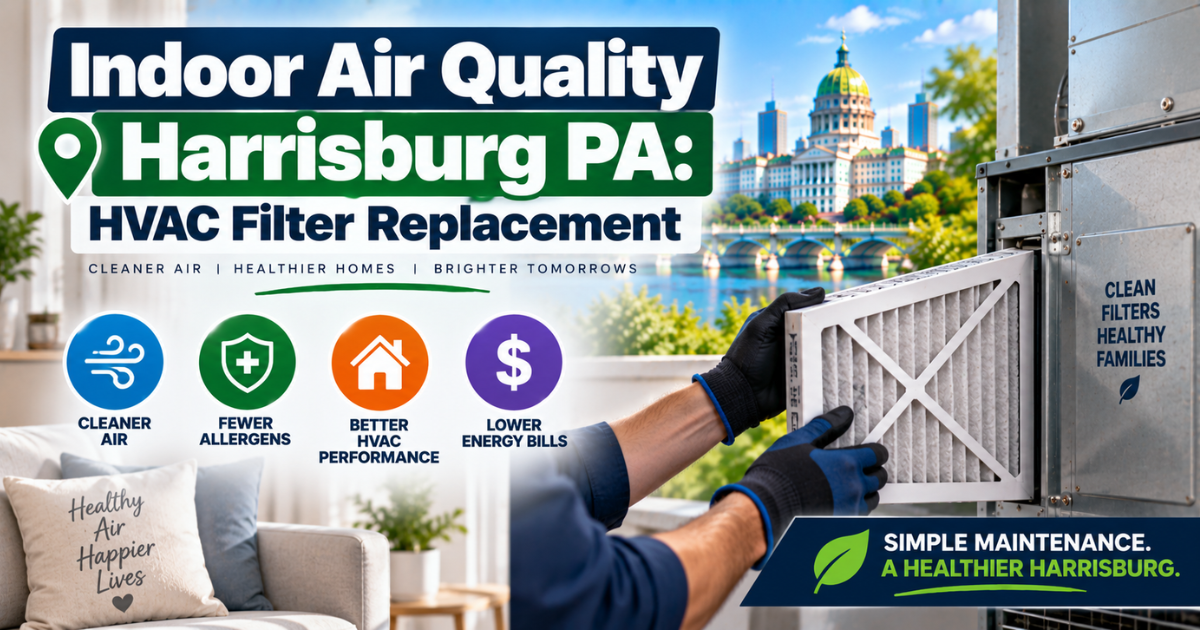
Your air filter is the first line of defense for everything your system breathes. A clogged filter stops trapping dust, chokes airflow, and makes your furnace or AC work harder.
- 1-inch filters: change every 1 to 3 months
- 4 to 5-inch media filters: change every 6 to 12 months
- Homes with pets, smokers, or renovation dust: check monthly
Set a phone reminder. It is the easiest way to protect the indoor air quality Harrisburg PA households depend on through a long heating season.
2. Install a Whole House Air Purifier
A whole house air purifier mounts in your ductwork and cleans the air for every room, not just one bedroom. Options include extended media cabinets, electronic air cleaners, and HEPA bypass systems.
Typical installed cost runs about $500 to $3,500 depending on the technology. HEPA bypass units sit at the top of that range because they need a separate duct loop to keep airflow healthy. For allergy and asthma sufferers, this is one of the most effective upgrades for indoor air quality Harrisburg PA homes can get.
3. Add a Whole House Humidifier for Winter
Central PA winters push indoor humidity well below 30%. Dry air irritates sinuses, cracks skin, and helps some viruses survive longer. A bypass or steam humidifier on your furnace holds the whole house at 35% to 45%, the range where indoor air quality Harrisburg PA families notice the biggest winter difference.
See our full breakdown of whole house humidifier cost in Harrisburg PA for installed prices of $400 to $1,200.
4. Schedule Professional Duct Cleaning Every 3 to 5 Years
Ducts collect dust, pet hair, and construction debris over time. Most industry guidance points to cleaning every 3 to 5 years, or sooner after a renovation, a rodent problem, or visible mold. Annual cleaning is rarely necessary.
Expect about $300 to $700 for a legitimate whole-home cleaning. Anything advertised at $99 is usually a bait-and-switch, as our duct cleaning cost Harrisburg PA guide explains.
5. Install UV Germicidal Lights in Your HVAC System
UV-C lamps mounted near the indoor coil kill mold, bacteria, and viruses that grow on damp surfaces inside your system. They do not catch dust, so pair them with a good filter.
Installed prices usually land between $600 and $1,500 for a coil-mounted lamp. Bulbs need replacing every 1 to 2 years.
6. Use MERV 11 to 13 Filters (Not Basic Fiberglass)
Cheap fiberglass filters (MERV 1 to 4) protect the blower but let most allergens pass straight through. MERV 11 to 13 filters capture pollen, pet dander, mold spores, and a large share of fine particles.
Check with a technician before upgrading. Many indoor air quality Harrisburg PA visits we make start with a filter too dense for an older furnace’s small return. A 4-inch media cabinet solves that for most homes.
7. Seal Ductwork Gaps and Leaks
Leaky return ducts in basements, attics, and crawl spaces pull in dust, insulation fibers, and damp air, then blow it into every room. ENERGY STAR estimates that 20% to 30% of the air moving through a typical duct system is lost to leaks, holes, and poor connections.
Professional sealing with mastic or aerosol sealant usually costs a few hundred dollars to about $2,000, depending on access. If your ducts are crushed, rusted, or disconnected, compare that against full air duct replacement cost in PA.
8. Ventilate with an ERV or HRV System
Modern, tightly built homes hold heat well but trap stale air. An energy recovery ventilator (ERV) or heat recovery ventilator (HRV) swaps stale indoor air for fresh outdoor air while recovering most of the heating or cooling energy.
For Harrisburg’s humid summers and cold winters, an ERV is usually the better fit because it also manages moisture. Installed costs typically range from $1,500 to $4,500. Contractors size these systems to ASHRAE Standard 62.2, the national benchmark for residential ventilation and indoor air quality Harrisburg PA builders follow.
9. Control Humidity Below 50% in Summer
Summers in the Susquehanna Valley bring long stretches of muggy, high dew point weather. Above 50% indoor humidity, dust mites multiply and mold grows on basement walls and inside ducts, two of the most common indoor air quality Harrisburg PA allergy triggers.
A properly sized AC removes moisture as it cools. If your basement still feels damp, a whole house dehumidifier tied into your ductwork keeps levels in check.
10. Test for Radon (Pennsylvania Is a High-Risk State)
Radon is an odorless, radioactive gas that seeps up from the soil through basement cracks. According to the Pennsylvania Department of Environmental Protection, about 40% of homes tested in the state have radon above the EPA action level of 4 pCi/L. Radon is the second leading cause of lung cancer in the U.S.
Test kits cost about $20 to $30 at hardware stores, and DEP recommends testing in colder months when windows stay closed. If levels are high, a certified mitigation system typically costs $800 to $1,200. No list of indoor air quality Harrisburg PA fixes is complete without this step.
Not sure which fix your home needs first? A Tapper Energy technician can inspect your filter, ducts, humidity, and equipment in one visit. Call (717) 921-4822 or book a free estimate.
Indoor Air Quality Harrisburg PA Costs: Which Fix Gives the Best Value?
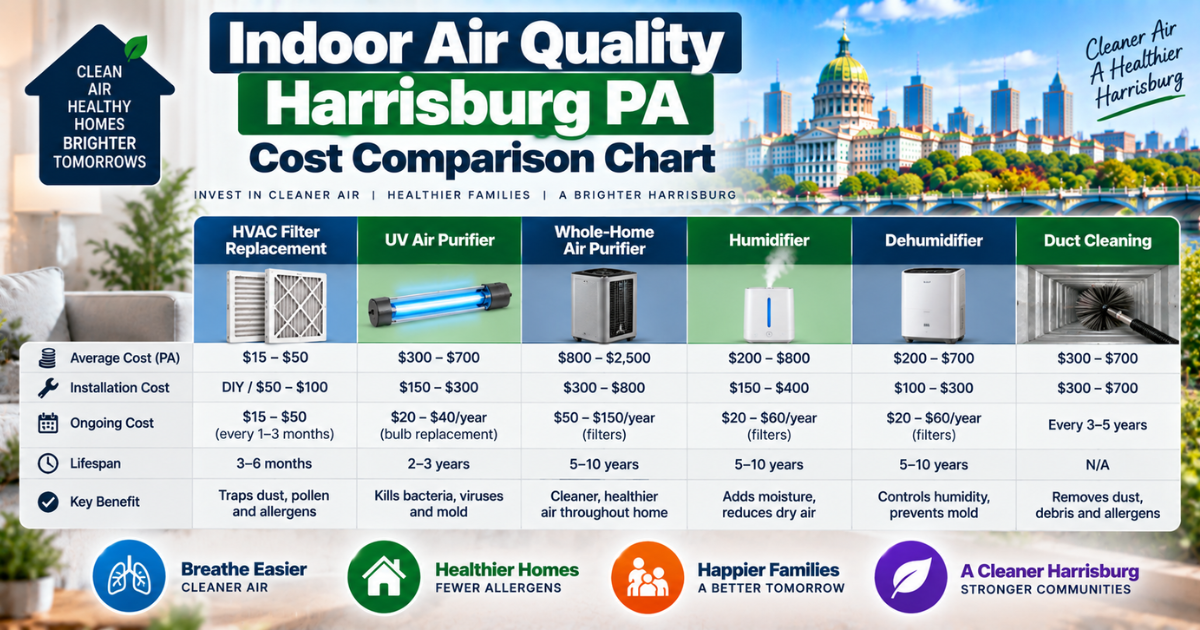
Use this table to compare the 10 indoor air quality Harrisburg PA fixes side by side. Prices are typical Central PA and national ranges for 2026, not Tapper Energy quotes. Your exact price depends on home size, system age, and access.
| Solution | Typical Cost | DIY or Pro | Impact Level |
|---|---|---|---|
| Replace filters every 1 to 3 months | $10 to $60 per filter | DIY | High |
| Whole house air purifier | $500 to $3,500 installed | Pro | High |
| Whole house humidifier | $400 to $1,200 installed | Pro | Medium |
| Duct cleaning (every 3 to 5 years) | $300 to $700 | Pro | Medium |
| UV germicidal lights | $600 to $1,500 installed | Pro | Medium |
| MERV 11 to 13 filter upgrade | $15 to $80 per filter | DIY | High |
| Duct sealing | $300 to $2,000 | Pro | High |
| ERV or HRV ventilation | $1,500 to $4,500 installed | Pro | High |
| Summer humidity control | $0 to $3,000 (setting change to whole house dehumidifier) | Pro | High |
| Radon test and mitigation | $20 to $30 test, $800 to $1,200 mitigation | DIY test, Pro mitigation | High |
For most homes, the best value path is simple: upgrade the filter, test for radon, and check humidity with a $15 hygrometer. Those three steps cost under $100 and address the biggest indoor air quality Harrisburg PA risks before you spend on equipment.
What Causes Poor Indoor Air Quality in Central PA Homes?
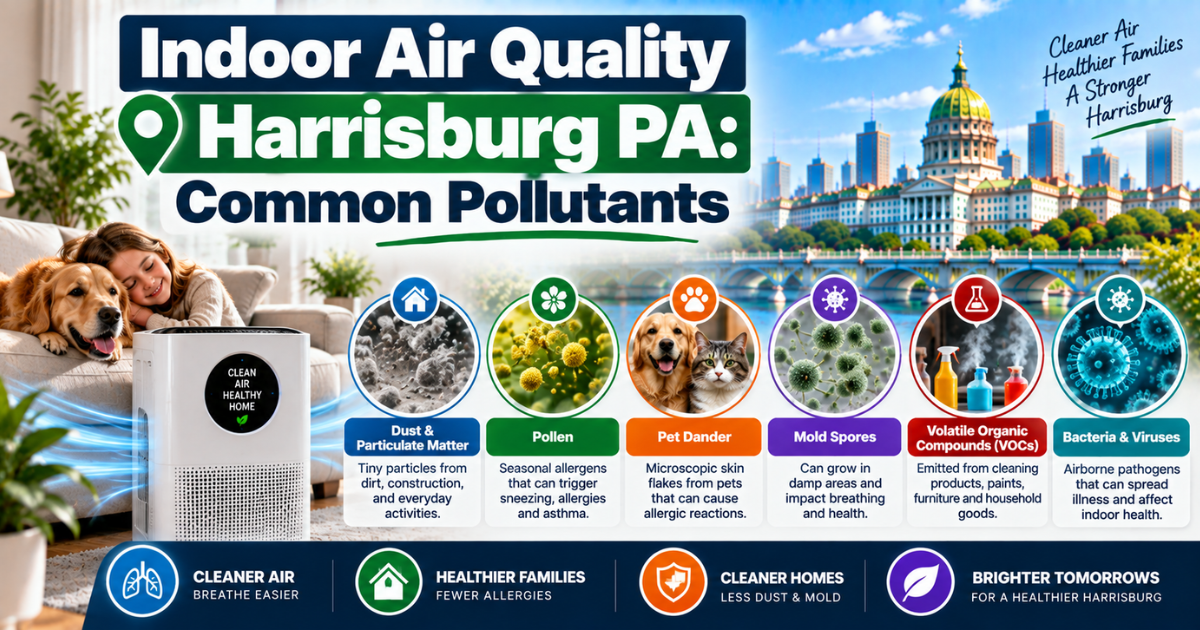
The same five problems show up again and again when we evaluate indoor air quality Harrisburg PA homes. Here is what to watch for.
Dust and Allergens from Leaky Ductwork
Older homes in Harrisburg, Camp Hill, and New Cumberland often have return ducts running through unfinished basements or attics. Every gap pulls in unfiltered air. If you dust constantly and it comes right back, leaky returns are the likely culprit. Sealing them is one of the fastest indoor air quality Harrisburg PA wins.
Mold from High Summer Humidity
Basements and crawl spaces in the Susquehanna Valley stay damp through summer. A musty smell when the AC kicks on often means moisture on the coil, in the drain pan, or inside the ducts. Mold spores then ride the airflow into every room, which is why damp basements are one of the top indoor air quality Harrisburg PA complaints we hear.
Carbon Monoxide from Gas Appliances
Furnaces, water heaters, and gas ranges can release carbon monoxide if a heat exchanger cracks or a flue backdrafts. CO has no smell or color. Install a CO detector on every level and near bedrooms, and learn the carbon monoxide furnace leak signs PA families should never ignore.
Radon Gas (PA Has Some of the Highest Radon Levels in the US)
Radon has been detected in all 67 Pennsylvania counties. It collects in basements, and your HVAC system can spread it upstairs when return ducts or the air handler sit down there.
VOCs from Paint, Cleaners, and Flooring
Volatile organic compounds come from fresh paint, new vinyl flooring, cleaning sprays, air fresheners, and furniture. EPA research on indoor air found about a dozen common organic pollutants at levels 2 to 5 times higher inside homes than outside. Ventilate during projects and choose low-VOC products.
How Does Your HVAC System Affect Indoor Air Quality Harrisburg PA Homes?
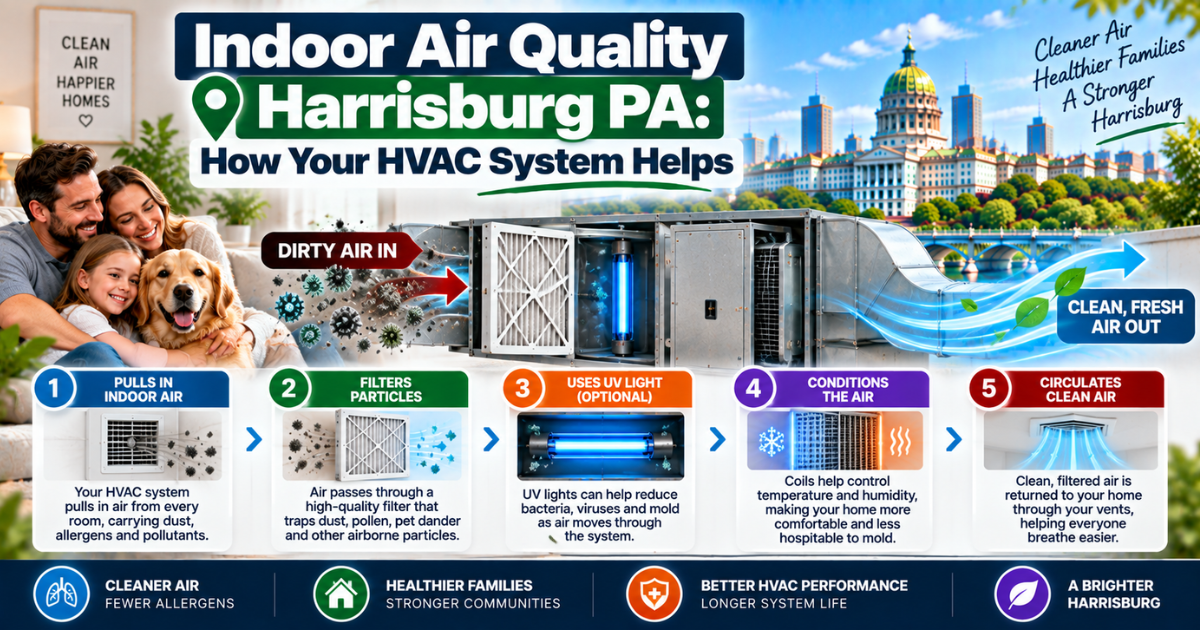
Your furnace and AC circulate the air in your house many times a day. That makes your HVAC system either the best tool for indoor air quality Harrisburg PA families have or the biggest source of the problem. Three factors decide which.
Filter Quality and MERV Ratings Explained
MERV (Minimum Efficiency Reporting Value) rates how well a filter captures particles between 0.3 and 10 microns, on a scale of 1 to 16. Here is the quick guide:
- MERV 1 to 4: fiberglass, protects equipment only
- MERV 5 to 8: catches household dust and larger pollen
- MERV 11 to 13: captures pet dander, mold spores, and fine dust. The sweet spot for most homes.
- MERV 14 to 16: near hospital grade, often too restrictive for residential systems
Ductwork Condition and Air Leaks
Crushed flex duct, disconnected joints, and rusted metal all pull in dirty air and reduce comfort. A quick inspection during your annual tune-up catches most of these issues. Our HVAC maintenance checklist for Harrisburg homes shows what should be checked each season.
Humidity Control Through Your HVAC
The EPA recommends keeping indoor humidity below 60%, ideally between 30% and 50%. Your AC dehumidifies in summer, and a furnace humidifier adds moisture in winter. When both are sized and set correctly, the indoor air quality Harrisburg PA homeowners enjoy stays steady all year. Explore all of our heating, cooling, and air quality services.
FAQ: Indoor Air Quality Harrisburg PA
How can I test the air quality in my home?
Start with three low-cost tools: a radon test kit ($20 to $30), a carbon monoxide detector on every level, and a home air monitor that tracks humidity, fine particles, and VOCs ($80 to $250). For a full picture of indoor air quality Harrisburg PA homeowners can trust, a professional assessment checks your filter, ductwork, humidity, and combustion safety in one visit.
What MERV rating filter should I use?
Most Central PA homes do best with a MERV 11 to 13 filter. It captures pollen, pet dander, mold spores, and fine dust without choking airflow in most modern systems. Older furnaces with small return ducts may need a 4-inch media cabinet to use MERV 13 safely. Change 1-inch filters every 1 to 3 months.
Do air purifiers really work?
Yes, when they match the problem. Whole house purifiers with high-MERV or HEPA media reduce dust, pollen, and dander throughout the home. UV lights control mold and bacteria on the coil but do not catch dust. No purifier removes radon or carbon monoxide, so testing and detectors still matter for the indoor air quality Harrisburg PA families rely on.
Is radon a problem in Harrisburg PA?
Yes. The Pennsylvania DEP estimates about 40% of tested homes in the state have radon above the EPA action level of 4 pCi/L, and radon has been found in all 67 counties, including Dauphin and Cumberland. The only way to know your level is to test. Kits cost $20 to $30, and mitigation typically runs $800 to $1,200.
How much does a whole house air purifier cost?
Most whole house air purifiers cost $500 to $3,500 installed in 2026. Extended media filter cabinets sit at the low end, electronic air cleaners and UV systems fall in the middle, and HEPA bypass units sit at the top because they need extra ductwork. Ongoing filter or bulb replacements usually run $50 to $300 per year.
Does duct cleaning improve indoor air quality?
It can, but only when ducts are actually dirty. Cleaning helps after renovations, rodent or insect problems, visible mold, or heavy dust blowing from vents. For most homes, every 3 to 5 years is enough. Pair cleaning with duct sealing and a better filter, or the dust simply returns. Avoid $99 whole-house offers, which are often bait-and-switch.
Can Tapper Energy help improve my home’s air quality?
Yes. Tapper Energy’s HVAC technicians evaluate your filtration, ductwork, humidity, and combustion safety, then recommend the right upgrades, from better filters to whole house purifiers and humidifiers. We serve Harrisburg, Mechanicsburg, Camp Hill, and nearby Central PA towns. Call (717) 921-4822 for a free estimate on improving indoor air quality Harrisburg PA homes need.
Breathe Better: Schedule an Indoor Air Quality Assessment
Better indoor air quality Harrisburg PA homeowners can feel usually starts with small steps: a better filter, balanced humidity, and a radon test. When those are not enough, the fix is often in your ductwork or HVAC equipment.
Tapper Energy is a family-owned HVAC company handling indoor air quality Harrisburg PA upgrades plus service across Mechanicsburg, Camp Hill, Enola, Marysville, and the rest of Central PA. Maintenance customers get 24-hour emergency service, and every new equipment installation comes with a free estimate.
Call (717) 921-4822 or request your free estimate online today.
About the Author: Written by the Tapper Energy HVAC team. Our technicians diagnose and repair furnaces, AC systems, boilers, and heat pumps across Harrisburg, Mechanicsburg, and Central PA.