Carbon monoxide furnace leak signs PA homeowners can spot early may be the difference between a safe winter and a life-threatening emergency. Carbon monoxide — CO — is colorless, odorless, and produced by every gas-burning furnace. It cannot be smelled or seen, which is what makes it so dangerous. Every heating season in Pennsylvania, families are hospitalized because they missed the warning signs their furnace was giving them.
This guide covers all 9 carbon monoxide furnace leak signs PA families need to recognize, what causes CO to escape from a furnace, exactly what to do if you suspect a leak, and how to prevent it entirely with an annual inspection.
- The CDC reports approximately 400 CO-related deaths and 100,000+ ER visits in the U.S. each year — most happen in winter when furnaces run around the clock
- A yellow or orange burner flame (should always be blue) is one of the fastest visual carbon monoxide furnace leak signs PA homeowners can check without tools
- Pennsylvania law (Act 129 of 2013) requires working CO detectors in all homes with fossil-fuel appliances — including gas furnaces
- If you suspect a CO leak: leave immediately, call 911 from outside, and do not re-enter until first responders clear the home
Need an inspection now? Call Tapper Energy at (717) 829-1231 or request a free furnace safety estimate.
What Causes Carbon Monoxide Leaks from Furnaces?
Gas furnaces produce carbon monoxide as a normal byproduct of combustion. In a properly functioning system, that CO is channeled through flue pipes and vented outside. When any part of that process fails — even a small crack or blockage — CO can enter your living space in dangerous concentrations.
Understanding these causes helps you recognize why the carbon monoxide furnace leak signs PA residents see are often tied to a specific mechanical failure.
Cracked Heat Exchangers
The heat exchanger is a metal chamber inside your furnace that separates combustion gases (including CO) from the air circulating through your home. Over time — typically after 15–20 years — thermal stress, age, or restricted airflow causes the metal to crack. When it does, combustion gases flow directly into your duct system and into every room of your house.
Replacing a cracked heat exchanger costs $500–$1,500 depending on the furnace model and part availability. On older units (15+ years), full furnace replacement is often more economical. Our emergency furnace repair team can evaluate which path makes sense for your home.
Blocked Flue Pipes or Venting
Flue pipes carry combustion gases from the furnace to the outside. Bird nests, ice buildup, debris, or corrosion can completely block these pathways — causing back-drafting, where CO reverses course and enters the home instead of venting out. This is especially common in Pennsylvania winters when outdoor vent terminations can seal with ice after a freeze-thaw cycle.
Incomplete Combustion from Poor Maintenance
A furnace that hasn’t been serviced in 12–18 months may have a dirty burner, restricted air filter, or a failing flame sensor — all of which cause incomplete combustion. Fuel that doesn’t burn completely produces dramatically higher CO concentrations. This is why annual HVAC maintenance is a furnace safety issue, not just a comfort issue.
9 Warning Signs of a Carbon Monoxide Leak from Your Furnace
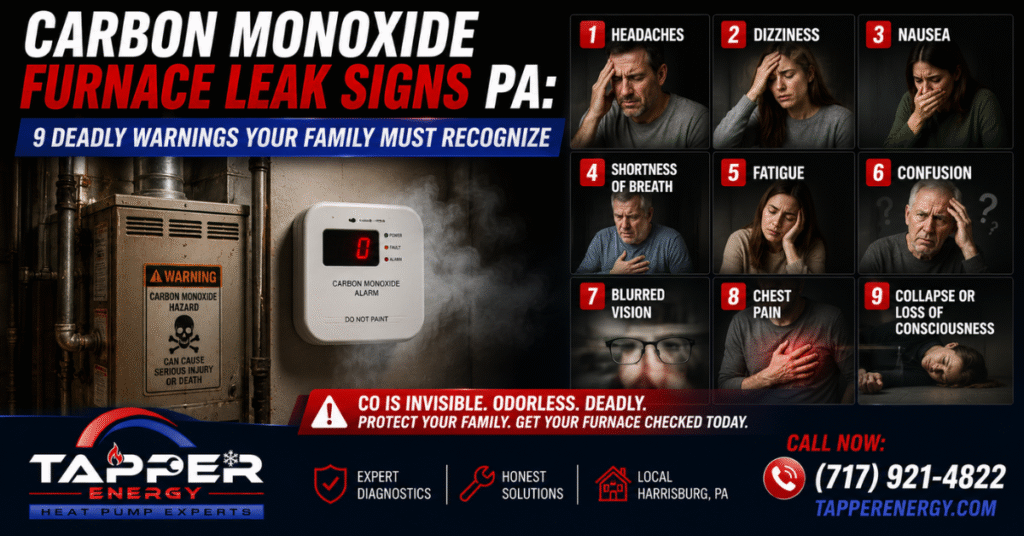
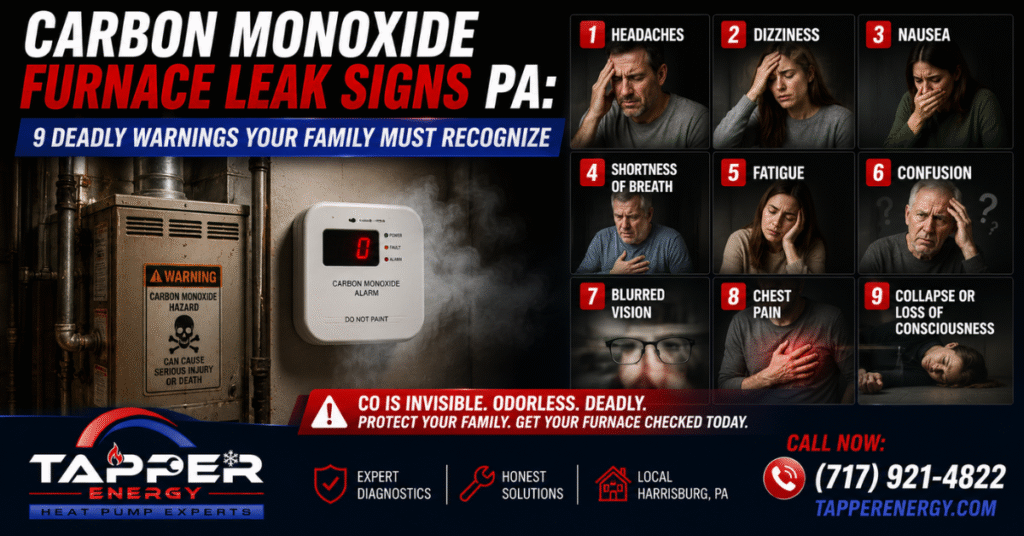
Because CO has no color or odor, your furnace itself and your family’s physical symptoms are often the only early indicators. These are the carbon monoxide furnace leak signs PA homeowners should check every heating season.
1. Yellow or Orange Burner Flame (Should Be Blue)
Open your furnace’s access panel and observe the burner flame. A properly functioning gas furnace produces a crisp, steady blue flame. A yellow, orange, or flickering flame means incomplete combustion is occurring — your furnace is producing excess CO with each burn cycle. This is one of the most reliable carbon monoxide furnace leak signs PA homeowners can verify themselves in under 60 seconds.
2. Soot or Black Marks Around the Furnace
Soot streaks — black or brown residue — around the furnace housing, burner compartment, or flue pipe joints indicate combustion gases are escaping where they should not. If you see fresh soot marks near registers, vents, or the furnace cabinet, treat it as a CO warning.
3. Excessive Moisture on Windows Near the Furnace
Condensation forming on windows in rooms near your furnace can indicate that combustion byproducts — water vapor, CO, and other gases — are entering your living space instead of venting outside. In tightly sealed Central PA homes, this moisture buildup is more pronounced and easier to spot.
4. Family Members Experiencing Headaches, Nausea, or Dizziness
CO poisoning symptoms closely mimic the flu — but without fever. If multiple household members experience headaches, nausea, dizziness, confusion, or fatigue that improve when they leave the house, treat it as a CO emergency immediately. Pets are often affected first. The CDC notes that CO is responsible for more than 100,000 emergency room visits in the U.S. each year, with a disproportionate number occurring during winter heating season.
5. Stale, Stuffy Air Despite Ventilation
A home that feels unusually stuffy or where the air quality seems “off” — even with windows cracked — may be experiencing back-drafting from the furnace. Combustion gases entering the living space instead of venting outside is one of the subtler carbon monoxide furnace leak signs PA residents frequently overlook or attribute to other causes.
6. No Updraft in Chimney or Flue
Your furnace flue should create an upward draft that pulls combustion gases out. You can test this by holding a lit match or incense stick near the flue cleanout — smoke should be drawn inward toward the flue. If smoke drifts back into the room or hangs in place, venting has failed and CO may already be accumulating.
7. Rust on Flue Pipes or Vent Connectors
Rust, corrosion, or moisture stains on flue pipe joints or vent connectors indicate that condensation from combustion gases is collecting at seams — a sign CO may be escaping before reaching the outdoor vent termination. Pay special attention to rust at elbow joints and where the flue connects to the furnace draft hood.
8. Furnace Cycling On and Off Frequently
Short cycling — where the furnace starts, runs for a brief period, and shuts off before completing a full heating cycle — is often caused by a cracked heat exchanger or blocked flue, the same failures that produce CO leaks. If your furnace is short cycling, schedule an emergency furnace inspection without delay.
9. Visible Cracks on the Heat Exchanger
During a visual inspection, any cracks, holes, or deep rust pits visible on the heat exchanger indicate a furnace that is actively at risk of CO leakage into your air supply. A cracked heat exchanger is the single most dangerous furnace defect for carbon monoxide. Do not run the furnace until a licensed technician has evaluated it.
What to Do Immediately If You Suspect a Carbon Monoxide Leak
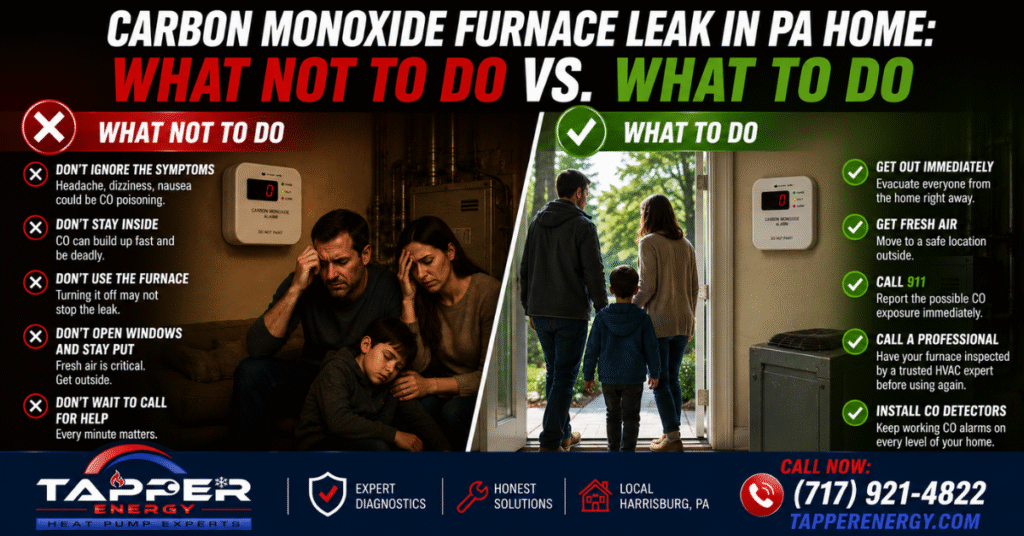
If you notice any carbon monoxide furnace leak signs PA safety experts warn about — or if your CO detector activates — act immediately. Every second you spend inside with elevated CO is dangerous.
Step 1: Leave the House Immediately
Get everyone out — every family member, every pet. Do not stop to grab belongings. Do not investigate the furnace. Leave doors open behind you as you go to help ventilate the space.
Step 2: Call 911 from Outside
Once outside and away from the building, call 911. First responders carry CO meters and can safely determine whether concentrations are life-threatening before anyone re-enters.
Step 3: Do Not Re-Enter Until Cleared
Wait for fire department personnel to inspect the home and give an explicit all-clear. CO can persist in a home for hours even after the source is addressed.
Step 4: Call an HVAC Technician for Furnace Inspection
After emergency services clear your home, call Tapper Energy at (717) 829-1231 for an emergency furnace inspection. Our NATE-certified technicians will locate the source of the CO leak, inspect the heat exchanger and all flue venting, and determine whether your furnace can be safely operated.
Don’t want to wait for an emergency? Schedule a preventive inspection with Tapper Energy →
CO Detector Placement Guide for Furnace-Heated Pennsylvania Homes
Recognizing carbon monoxide furnace leak signs PA homeowners can spot visually is important — but a properly placed CO detector is your primary, most reliable warning system. Detector placement matters as much as having one.
| Furnace Location | Recommended Detector Placement | Why |
|---|---|---|
| Basement furnace | Within 10 ft of furnace AND bedroom hallway on each sleeping level | CO rises; a basement furnace leak quickly floods upper floors |
| First-floor utility room | Same floor near the door + sleeping area hallway | Proximity to bedrooms is the highest-risk scenario |
| Garage-adjacent utility room | Inside the home near the connecting door | CO from vehicles and furnace combustion can combine |
| Attic-mounted furnace | Top-floor ceiling + one per floor below | CO collects near the ceiling on the highest level first |
| Multi-story home (any furnace location) | One working detector per floor minimum | CO can accumulate on any level depending on HVAC airflow |
PA Law Requirements for Carbon Monoxide Detectors
Pennsylvania Act 129 of 2013 requires CO detectors in all residential buildings with fossil-fuel-burning appliances — including gas furnaces, boilers, and water heaters. Detectors must be installed outside each sleeping area and on every level of the home. Batteries must be maintained and working. The law applies to new construction and existing homes. Noncompliant homes may also face complications with homeowner’s insurance claims following a CO incident.
How Annual Furnace Inspections Prevent CO Leaks
Nearly every carbon monoxide furnace leak signs PA homeowners encounter after a heating-season emergency was detectable — and preventable — during a routine inspection the previous fall. Here is what Tapper Energy’s NATE-certified technicians check during every annual furnace safety visit:
- Heat exchanger inspection — visual and camera examination for cracks, holes, and distortion
- Burner flame analysis — confirms a clean blue flame and complete combustion
- Flue pipe integrity check — inspects all joints, elbow connections, corrosion, and outdoor termination for blockage
- Draft test — verifies the flue is creating adequate updraft so combustion gases exit the home
- Live CO measurement — measures actual carbon monoxide parts per million (ppm) at the supply register during operation
- Air filter condition — a clogged filter restricts combustion airflow and stresses the heat exchanger
Our HVAC maintenance checklist walks through every one of these safety checks in detail. At Tapper Energy, the majority of cracked heat exchangers we find were in furnaces that had gone 2–3 years without any professional inspection.
A preventive inspection costs $89–$149. A heat exchanger replacement runs $500–$1,500. A CO emergency is immeasurable. Tapper Energy’s annual maintenance plan includes a complete furnace safety inspection each fall — before heating season — plus a CO detector battery and sensor age check at every visit.
Important: Boilers that run on natural gas or oil are also significant CO sources. If your home is heated by a boiler system, the same carbon monoxide furnace leak signs PA homeowners watch for apply — and the same annual inspection protocols are required.
FAQ: Carbon Monoxide and Furnaces in PA
What are the most dangerous carbon monoxide furnace leak signs PA homeowners overlook?
The most dangerous carbon monoxide furnace leak signs PA homeowners miss are the gradual ones: family members with recurring morning headaches that clear up after leaving the house, a furnace that short-cycles multiple times per heating cycle, and faint soot streaks near vents or registers. These individually seem minor but together indicate a cracked heat exchanger may be actively leaking CO into your air supply.
How fast can carbon monoxide from a furnace become life-threatening?
CO concentrations above 70 ppm cause headaches and dizziness within 1–2 hours of exposure. Above 400 ppm, life-threatening symptoms can develop within 3 hours. At 1,600 ppm — possible with a severely failed heat exchanger in a sealed home — CO poisoning can be fatal in under an hour. This is why the only safe response to a suspected CO leak is to leave immediately and call 911.
Does my Pennsylvania home legally need a CO detector if I have a gas furnace?
Yes. Pennsylvania Act 129 of 2013 requires CO detectors in any home with fossil-fuel-burning appliances, which includes all gas furnaces. Detectors must be placed outside each sleeping area and on every level of the home. This is not optional — it is state law.
Can I run my furnace if I see a yellow or orange flame?
No. A yellow or orange burner flame is direct evidence of incomplete combustion and elevated CO production from your furnace. Shut the furnace off immediately and call a licensed HVAC technician before restarting it. Do not operate the furnace until a technician inspects and clears the unit.
How much does it cost to fix a CO leak from a furnace in PA?
Cost depends on the cause. A blocked flue cleaning runs $100–$250. Repairing or replacing a cracked heat exchanger costs $500–$1,500. If the heat exchanger has failed in a furnace over 15 years old, full furnace replacement ($2,500–$5,500 installed in Central PA) is often the more cost-effective long-term solution. Tapper Energy provides upfront pricing before any work begins.
Can I detect CO in my home without a detector?
No — not reliably. Carbon monoxide is colorless and odorless; you cannot detect it with your senses. The visual and physical warning signs in this guide are indicators that a problem may exist, but only a working CO detector or a professional CO meter can confirm actual concentrations in your air. This is why the EPA recommends CO detectors in every home with a fossil-fuel appliance.
Schedule a Furnace Safety Inspection with Tapper Energy
Carbon monoxide furnace leak signs PA families miss each winter are responsible for preventable tragedies across Central Pennsylvania. The 9 warning signs above — a yellow flame, soot marks, short cycling, family symptoms — are your furnace telling you something is wrong. Don’t wait for a CO detector to confirm what a visual inspection could have caught.
Tapper Energy serves Harrisburg, Mechanicsburg, Camp Hill, Enola, Duncannon, and all of Central PA with honest diagnostics and upfront pricing before any work begins. Our NATE-certified technicians have completed thousands of furnace safety inspections across the Greater Harrisburg region.
Schedule your furnace safety inspection with Tapper Energy today →
Or call (717) 829-1231 — available evenings and weekends.
Written by the Tapper Energy HVAC team. Our NATE-certified technicians have diagnosed and repaired thousands of furnaces, heat pumps, and boilers across the Harrisburg and Mechanicsburg area, specializing in fast, honest, no-upsell furnace safety inspections and emergency CO diagnostics.