Propane tank installation Camp Hill homeowners trust starts with knowing your home’s actual energy needs. You are standing in your backyard near Market Street Camp Hill, staring at the space between the fence and the patio. Will a tank even fit here? Which size makes sense for your household?
These questions come up for thousands of homeowners across the West Shore PA region every single year. Getting the answer right means cozy winters and lower fuel bills. Getting it wrong means overpaying for capacity you will never use — or worse, running dry during a bitter January cold snap.
This guide covers everything you need. From 120-gallon “DOT” cylinders for modest setups to 1,000-gallon tanks for sprawling estates, each option serves a purpose. You will also learn about BTU load calculation, Cumberland County zoning, safety setbacks, and frost line depth requirements. Whether you are asking “what size propane tank for a 3-bedroom house?” or “do I need a permit for a propane tank in Camp Hill?”, every answer is right here. For personalized guidance, the experts at Tapper Energy are always ready to help.
Table of Contents
- Planning Your Propane Tank Installation Camp Hill: Where to Start?
- Understanding Common Propane Tank Sizes for Central PA Homes
- Factors That Determine Your Perfect Propane Tank Size
- Space Constraints and Propane Tank Installation Camp Hill
- Safety First: Understanding Distance Requirements and Setbacks
- Above-Ground vs. Underground: Which Is Best for Curb Appeal?
- The Financial Side: Installation Costs and Fuel Savings in PA
- Navigating Local Permits for Propane Tank Installation Camp Hill
- Refill Frequency: How Tank Size Affects Your Delivery Schedule
- Preparing Your Yard for Installation Day
- Expert Advice: Get a Free Site Assessment from Tapper Energy
- Frequently Asked Questions
Planning Your Propane Tank Installation Camp Hill: Where to Start?
The first step toward a successful propane tank installation Camp Hill project is not picking a tank. It is understanding your home inside and out.
Walk through every room and count each appliance that runs on propane. Your furnace, water heater, stove, dryer, and fireplace all consume fuel at different rates. Write those numbers down.
This simple inventory becomes the foundation of your entire sizing decision. Too many homeowners skip this step and default to the biggest tank they can afford. Bigger is not always better — especially on a compact Borough lot.
Think about your property next. The Borough of Camp Hill features a mix of historic homes with narrow side yards and newer builds with more generous layouts. Your lot dimensions, existing landscaping, and proximity to property lines all dictate where a tank can go.
A quick measurement of your available outdoor space narrows your options immediately. Combine that with your appliance inventory and you have already eliminated guesswork. That is exactly how the professionals at Tapper Energy approach every installation across the Capital City Region.
Understanding Common Propane Tank Sizes for Central PA Homes
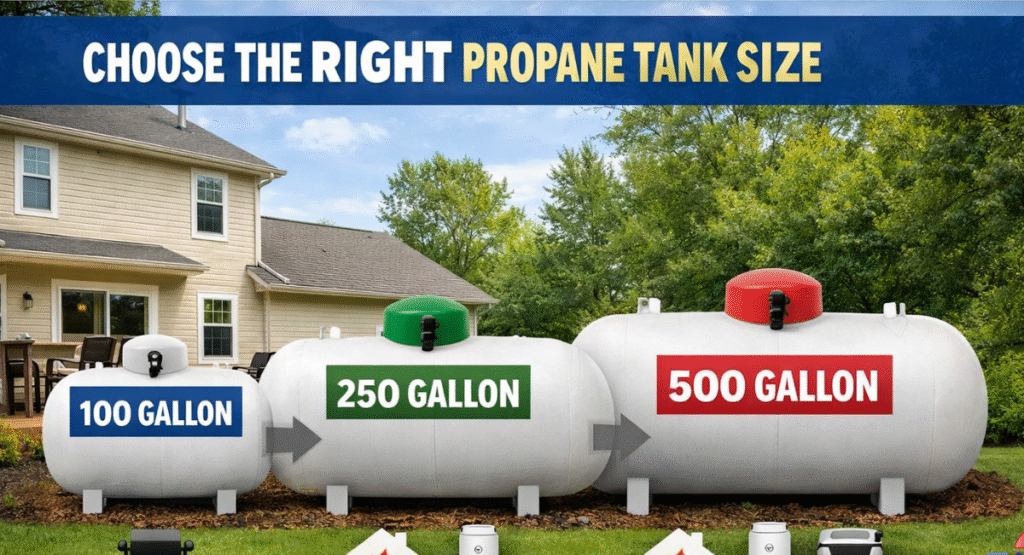
Propane tanks come in four standard residential sizes. Each serves a different type of household and energy demand. The table below gives you a quick snapshot.
| Tank Size | Best For | Estimated Annual Usage |
|---|---|---|
| 120 Gallon | Cooking, fireplaces, grills | Under 500 gallons/year |
| 250 Gallon | Furnace + 1–2 appliances | 500–800 gallons/year |
| 500 Gallon | Whole-home heating | 800–1,500 gallons/year |
| 1,000 Gallon | Large estates, pools, generators | 1,500+ gallons/year |
Understanding these sizes helps you ask better questions when you call a provider. You will already know which category fits your lifestyle across the Susquehanna Valley.
120-Gallon Tanks: Ideal for Cooking and Fireplaces
The smallest option is the 120-gallon “DOT” cylinder. DOT stands for Department of Transportation. These tanks meet federal standards for portable and semi-permanent use.
They stand upright, making them a smart choice when considering vertical vs. horizontal tanks in tight spaces. If your home uses natural gas or electric heating but you want propane for a kitchen range or fireplace, this size handles it beautifully.
However, a 120-gallon tank runs out quickly if you push it beyond its purpose. Think of it as a supplemental tank rather than a primary fuel source. Many homeowners near Hampden Township and Lower Allen pair these with an existing electric HVAC system.
250-Gallon Tanks: The Middle Ground for Moderate Energy Use
Stepping up to a 250-gallon tank opens the door to moderate whole-home propane use. This size supports a furnace combined with a water heater or cooking range comfortably.
It is the sweet spot for smaller Camp Hill homes, condominiums, and townhouses. If you have searched “what size propane tank for a 3-bedroom house?”, this is frequently the answer for homes under 1,800 square feet.
The 250-gallon tank also introduces you to the tank gauge reading system. A dial on top shows the percentage of fuel remaining. The industry follows the 80% fill rule, meaning your tank only gets filled to 80% capacity. This leaves room for the propane to expand safely in warm weather.
500-Gallon Tanks: The Standard for Whole-Home Heating in Camp Hill
The 500-gallon ASME tank is the undisputed residential standard across Camp Hill and the broader West Shore PA area. ASME stands for the American Society of Mechanical Engineers.
This size handles everything a typical household throws at it. Central heating, hot water, cooking, clothes drying, and even a best propane tank for home backup generator setup — it manages all of it. It delivers reliable performance without excessive bulk.
If you are pairing your new tank with an upgraded furnace, the team at Tapper Energy’s HVAC services in Camp Hill can coordinate both projects seamlessly.
The vaporization rate performs optimally at this volume for average residential demand. During cold snaps, smaller tanks can struggle to convert liquid propane to gas fast enough. A 500-gallon tank maintains steady vaporization even when Susquehanna Valley temperatures plummet well below freezing.
1,000-Gallon Tanks: Maximum Capacity for Large Estates
When a 500-gallon tank is not enough, the 1,000-gallon model steps in. This tank serves large estates, homes with heated pools, and properties with guest houses.
It is common on larger lots in Hampden Township and Lower Allen. If you have wondered about the cost of underground propane tank installation for a large property, this is typically the size that gets buried.
The advantage is straightforward. Fewer deliveries and better bulk pricing. A 1,000-gallon tank lets you purchase propane during summer when pre-season rates drop significantly.
Factors That Determine Your Perfect Propane Tank Size
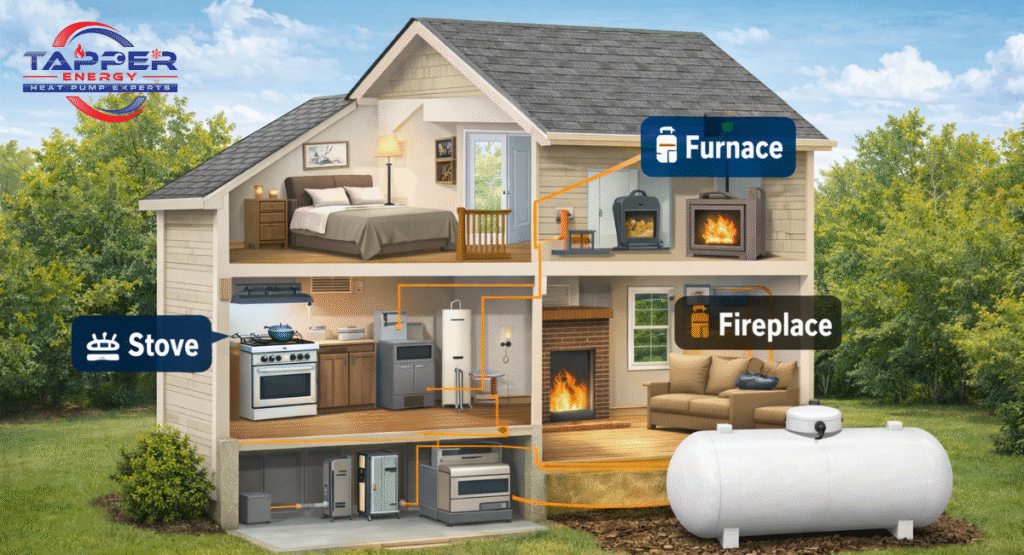
Choosing correctly requires evaluating three interconnected factors. Ignoring any one of them leads to a misfit installation that costs more over time.
A professional BTU load calculation quantifies your total energy demand. BTU stands for British Thermal Unit. Your furnace might consume 100,000 BTUs per hour. Your water heater adds 40,000. The range contributes another 65,000.
Add those figures together and you get a clear picture of peak demand. This calculation directly determines which tank keeps your home comfortable without overspending. It is the most important number in the entire sizing process.
Total Square Footage and Home Insulation Quality
Square footage matters — but it does not tell the whole story. A 2,800-square-foot home built in 2020 with spray-foam insulation consumes far less propane than a drafty 2,000-square-foot bungalow from 1955.
Older Camp Hill homes near Market Street Camp Hill often lack modern insulation. Their furnaces run harder and longer to maintain the same temperature. That extra runtime burns through fuel faster and demands a larger tank.
Consider getting an energy audit before sizing your tank. Some homeowners discover that upgrading insulation lets them drop down a tank size. The Tapper Energy HVAC team can assess your heating system’s efficiency alongside your sizing needs.
Number of Propane Appliances (Furnaces, Water Heaters, and Ranges)
Every propane appliance carries a BTU rating. A high-efficiency furnace draws between 60,000 and 120,000 BTUs per hour. A tankless water heater can demand 150,000 or more. Gas ranges average around 65,000 BTUs.
When you stack these numbers, the total climbs quickly. That total determines which tank sustains your household’s peak demand. The table below gives a practical reference.
| Appliance | Average BTU/Hour | Annual Gallons Used |
|---|---|---|
| Furnace (high-efficiency) | 60,000–120,000 | 500–1,200 |
| Tankless Water Heater | 120,000–199,000 | 200–300 |
| Gas Range/Oven | 40,000–65,000 | 35–50 |
| Gas Clothes Dryer | 18,000–22,000 | 20–40 |
| Gas Fireplace | 20,000–40,000 | 50–100 |
| Standby Generator | 130,000–200,000 | Varies by usage |
Adding more appliances also impacts the second-stage regulator that controls gas pressure from the tank to your home. Heavier loads sometimes require upgraded regulators and larger-diameter piping.
Climate Considerations: Preparing for Cold Susquehanna Valley Winters
The Susquehanna Valley does not ease into winter gently. Temperatures across Cumberland County regularly stay below freezing for weeks. January averages hover around 25–30°F, and nighttime lows dip into the single digits during severe cold snaps.
Your furnace runs nearly nonstop during these stretches. That sustained operation burns propane far faster than shoulder-season months. Undersizing your tank in this climate is one of the costliest mistakes a homeowner can make.
When tanks run critically low during peak winter, emergency deliveries cost more per gallon. Availability also tightens across the entire West Shore PA delivery network. Always size for your worst-case winter, not your mildest autumn.
Space Constraints and Propane Tank Installation Camp Hill
Property layout is the invisible constraint that many homeowners forget. The Borough of Camp Hill features some of the most compact residential lots in the Capital City Region.
Homes built along tree-lined streets were not designed with outdoor fuel storage in mind. Side yards often measure just eight to twelve feet wide. Every square foot matters when positioning a 10-foot-long tank.
Cumberland County zoning ordinances and propane tank setbacks add complexity. Local codes require minimum distances between a tank and your home, neighbor’s property line, and any public right-of-way. If you have searched “propane tank distance from property line PA”, the general answer is ten feet.
A professional installer measures your yard precisely and cross-references those measurements against current Borough requirements. Review local zoning details at the Borough of Camp Hill official website or through the Cumberland County government portal. This prevents the costly nightmare of relocating a tank after installation.
Safety First: Understanding Distance Requirements and Setbacks
Safety is the backbone of every responsible propane tank installation Camp Hill project. The regulations exist because propane is a pressurized, flammable fuel that demands careful handling.
NFPA 58, the National Fuel Gas Code, establishes the minimum safety standards every installation must meet. Pennsylvania adopts these standards and sometimes adds stricter local requirements through county codes.
Every tank includes a pressure relief valve designed to vent excess pressure safely. Proper clearance ensures this valve functions without directing gas toward a building, window, or ignition source. Review the full NFPA 58 standard at the National Fire Protection Association website.
The 10-Foot Rule: Clearances for Residential Tanks
The most widely cited safety standard is the 10-foot rule. Any propane tank holding more than 125 gallons must sit at least ten feet from any building, structure, or property line.
On compact Camp Hill lots, this single requirement often eliminates certain yard locations entirely. A side yard measuring nine feet from your wall to the fence simply will not work.
This rule also influences your choice between vertical vs. horizontal tanks. In tight spaces, going vertical — or going underground — may be the only way to meet the clearance while placing the tank where you actually need it.
Staying Safe: Distance from Windows, Doors, and Ignition Sources
NFPA 58 specifies additional distances beyond the basic 10-foot perimeter. The fill valve must sit at least ten feet from any air intake, window, or door.
HVAC condenser units, dryer vents, and electrical panels all have their own minimum distances. The table below gives a simplified reference.
| Feature | Minimum Distance from Tank |
|---|---|
| Building or structure | 10 feet |
| Property line | 10 feet |
| Window or door (fill connection) | 10 feet |
| Air intake or vent | 10 feet |
| Ignition source (A/C unit, dryer vent) | 10 feet |
| Public road or sidewalk | 10 feet |
| Septic tank or well | Varies by local code |
Professional installers walk the entire perimeter of your home with a measuring tape and a checklist before finalizing placement. This prevents costly repositioning after the concrete pad is already poured.
Above-Ground vs. Underground: Which Is Best for Your Curb Appeal?
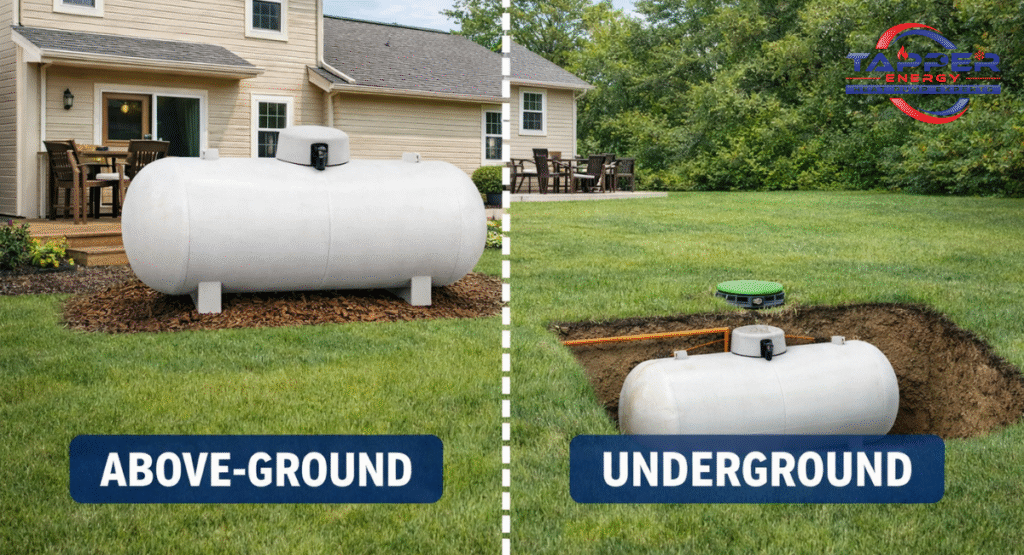
Camp Hill residents take pride in their homes. Manicured lawns, pruned hedges, and coordinated hardscaping define the neighborhood’s visual character. Placing a large white propane tank into that landscape feels jarring to many homeowners.
That is why the above-ground versus underground decision often comes down to aesthetics as much as practicality. If you have searched “hidden propane tank ideas for small yards”, you are already thinking about this the right way.
Both options have loyal advocates across the West Shore PA community. Your decision should weigh aesthetics alongside practicality, budget, and long-term maintenance preferences.
The Benefits of a Discreet Underground Propane Tank
An underground propane tank disappears beneath your lawn. Only a small access dome remains visible at the surface. For Camp Hill homeowners who have invested thousands in landscaping, this justifies the higher installation cost.
Underground tanks also resist temperature extremes better. The surrounding soil insulates them from summer heat and winter cold. This thermal stability improves the vaporization rate and ensures consistent gas delivery year-round.
However, underground installations involve significantly more site preparation. Excavation requires heavy equipment. The hole must reach below the frost line depth, which in Pennsylvania sits between 36 and 42 inches depending on your location within Cumberland County.
Trenching and piping from the buried tank to your home also add labor and material costs. The tank itself needs cathodic protection — an electrochemical system that prevents underground metal corrosion from soil moisture. The cost of underground propane tank installation typically runs $3,000 to $5,000 more than a comparable above-ground setup. However, the visual payoff lasts for the tank’s entire 30-year lifespan.
Above-Ground Tanks: Faster Installation and Easier Maintenance
Above-ground tanks install quickly and cost less upfront. Technicians access them easily for inspections, tank gauge reading checks, and maintenance. A typical installation takes just a few hours once the site is prepared.
No excavation. No backfilling. No cathodic protection systems. The simplicity appeals to homeowners who want their propane system running fast.
Many homes along Market Street Camp Hill and in Lower Allen use decorative screening to blend above-ground tanks into their landscape designs. A well-placed fence or row of evergreen shrubs hides the tank while keeping it accessible for delivery drivers.
The Financial Side: Installation Costs and Fuel Savings in PA
Propane tank installation Camp Hill costs vary based on several factors. Tank size, placement type, and site preparation complexity all influence the bill. Pennsylvania homeowners typically spend between $1,500 and $6,000 for a complete residential installation.
Do not let the upfront cost paralyze your decision. The real financial story unfolds over years of fuel purchases. The table below breaks down estimated costs by installation type.
| Installation Type | Estimated Cost Range | Key Cost Drivers |
|---|---|---|
| 120-gallon above-ground | $500–$1,500 | Minimal site prep, small pad |
| 250-gallon above-ground | $1,000–$2,500 | Pad, regulator, piping |
| 500-gallon above-ground | $1,500–$3,500 | Pad, trenching, regulator, permits |
| 500-gallon underground | $3,000–$5,500 | Excavation, cathodic protection, backfill |
| 1,000-gallon above-ground | $2,500–$4,500 | Large pad, extended piping |
| 1,000-gallon underground | $5,000–$8,000+ | Heavy excavation, full cathodic system |
Why a Larger Tank Can Lower Your Annual Energy Costs
A larger tank lets you buy propane in bulk during summer when pre-season prices drop by 20–30 cents per gallon. You fill the tank in July at the lowest rate of the year. You carry that fuel into peak heating season without paying premium winter rates.
Smaller tanks cannot hold enough volume to take full advantage of seasonal price swings. Over a typical Susquehanna Valley winter consuming 800 gallons, that discount translates to $160–$240 in direct savings every year.
Fewer deliveries also mean lower transportation costs. A 120-gallon tank needing six refills per winter accumulates far more delivery overhead than a 500-gallon tank requiring just two visits. The math favors sizing up in nearly every scenario.
Upfront Investment vs. Long-Term Reliability
Cheaper installations sometimes use lower-grade regulators or skip installing a second-stage regulator for consistent gas pressure. These cost-cutting measures save money today but create problems later.
Inconsistent gas pressure reduces appliance efficiency and shortens equipment lifespan. A cracked concrete pad allows the tank to shift, stressing pipe connections. Repairing these issues costs more than doing the job right the first time.
Think of your propane installation like a roof. A quality roof lasts 25 years. The cheapest option lasts eight. The cost per year of the quality choice is actually lower. Tapper Energy builds every installation to last using industry-standard materials and code-compliant practices.
Navigating Local Permits for Propane Tank Installation Camp Hill
“Do I need a permit for a propane tank in Camp Hill?” The answer is almost always yes.
The Borough of Camp Hill requires permits for most tank installations — particularly for tanks exceeding 125 gallons. You will submit an application that includes your proposed tank location, size, setback distances, and piping layout.
Find contact details and application information through the Borough of Camp Hill official website or the Cumberland County government site.
Tapper Energy’s team handles permit applications regularly across Camp Hill, Hampden Township, Lower Allen, and the broader Cumberland County region. They know which forms to file and which common pitfalls to avoid. Most residential permits get approved within one to two weeks.
Starting the permit process early prevents scheduling delays. This ensures your propane tank installation Camp Hill project happens before the first frost arrives.
Refill Frequency: How Tank Size Affects Your Delivery Schedule
Tank size directly controls how often a delivery truck visits your property. A 500-gallon tank filled to the 80% fill rule standard holds 400 usable gallons.
If your household burns 150 gallons per month during winter, that tank lasts nearly three months before reaching the 20% reorder threshold on your tank gauge reading. A 250-gallon tank under the same consumption rate needs refilling every six weeks. A 120-gallon tank? Every three to four weeks during peak cold.
Tapper Energy’s Automatic Delivery service eliminates the guesswork entirely. Using degree-day calculations and your historical consumption data, they predict when your tank will hit the reorder point. They schedule a delivery before you ever need to call.
During the busy West Shore PA winter season, this proactive approach prevents the dreaded empty-tank emergency. A larger tank gives the system more buffer — even if a snowstorm delays routes by a day or two, you still have plenty of fuel.
Preparing Your Yard for Installation Day
Installation day goes smoothly when you prepare your property in advance. A few simple steps save significant time and keep the project on schedule.
Before anything happens on your property, call Pennsylvania’s 811 One Call service at least three business days ahead. This free service marks buried gas, electric, water, sewer, and cable lines throughout your yard.
Digging without this information risks striking a buried utility — causing injuries, service outages, and enormous repair costs. Visit PA One Call to submit your request online or dial 811 from any phone. It is required by Pennsylvania state law for any excavation project.
Clearing the Path for Delivery Trucks and Equipment
Propane delivery trucks need clear, stable access from the street to your tank location. Trim overhanging tree branches. Move cars and trailers out of the driveway. Relocate garden furniture and portable sheds.
A minimum twelve-foot-wide clearance path allows the truck and supporting equipment to navigate safely. Properties near Market Street Camp Hill with alley access sometimes offer better rear entry than front driveway access.
Communicate any driveway constraints to your installer before installation day. Your installer’s site assessment identifies the optimal delivery path and flags any obstacles.
Ground Leveling and Concrete Pad Requirements
Above-ground propane tanks must sit on a level, stable surface. An uneven base causes the tank to lean over time, stressing pipe connections and fittings.
Most professional installers require a poured concrete pad at least four inches thick. A full 500-gallon tank weighs over 2,000 pounds. The pad distributes that weight evenly and prevents shifting during Pennsylvania’s seasonal freeze-thaw cycles.
For underground installations, the excavation depth must reach below the local frost line depth. In the Camp Hill area, the frost line sits between 36 and 42 inches below grade. Trenching and piping from the buried tank to your home’s gas entry point must also sit below the frost line to prevent freezing.
Expert Advice: Get a Free Site Assessment from Tapper Energy

Stop guessing about which tank size belongs on your Camp Hill property. Online calculators provide a starting point — but nothing replaces a trained technician standing in your yard with a measuring tape and firsthand knowledge of local codes.
Tapper Energy’s team performs comprehensive site assessments that evaluate your lot dimensions, appliance load, soil conditions, and setback compliance in a single visit. They’ve handled propane tank installation Camp Hill projects on every type of property — from narrow Borough lots to spacious Hampden Township acreages.
Their HVAC services in Camp Hill also ensure your heating system works in perfect harmony with your new propane setup.
Tapper Energy does not push the biggest tank to boost a sale. They recommend the size that genuinely fits your household’s needs and your budget. Contact Tapper Energy today for a free, no-obligation site assessment. Your cozy, worry-free winter starts with one phone call.
Frequently Asked Questions
What size propane tank is right for a 3-bedroom house in Camp Hill?
For a typical three-bedroom home with average insulation, a 500-gallon ASME tank usually provides enough fuel for heating, hot water, and cooking. If the house only uses propane for a stove and fireplace, a 250-gallon tank may be sufficient. A professional BTU load calculation confirms the exact size you need.
How far must a propane tank be from the property line in Pennsylvania?
Pennsylvania follows the 10-foot rule from NFPA 58. The tank, its fill valve, and the pressure relief valve must all sit at least ten feet from any building, fence, or property line. This rule also applies to windows, doors, and any ignition source. Following propane tank setbacks protects your entire household.
Do I need a permit for a propane tank installation in Camp Hill?
Yes. The Borough of Camp Hill requires a permit for any residential propane tank larger than 125 gallons. The permit process checks that your tank meets Cumberland County zoning, setback distances, and fire-code requirements. A licensed installer like Tapper Energy can file the paperwork and coordinate the inspection for you.
What are the best hidden propane tank ideas for small yards?
If your yard is tight, a vertical 120-gallon DOT cylinder fits neatly behind a fence or planter box. For an even cleaner look, an underground 250-gallon tank with a small access dome blends into the lawn completely. Both options respect propane tank setbacks and keep visual impact low without sacrificing performance.
Which propane tank works best for a home backup generator?
A 500-gallon tank is the most popular choice for a backup generator in Camp Hill. It stores enough fuel to run the generator for several continuous days. If you expect longer outages or run a larger generator, a 1,000-gallon tank provides extra security and reduces delivery frequency during winter storms.
How does tank size affect my refill schedule and delivery cost?
A larger tank means fewer deliveries. A 500-gallon tank typically needs two refills per winter, while a 250-gallon tank may require four or five. Fewer deliveries lower your overall delivery costs significantly. Tapper Energy’s Automatic Delivery service monitors your tank gauge reading and schedules refills before you ever run low.