
Choosing the right HVAC system is one of the most important financial decisions a homeowner will ever make. Get it wrong and you’ll spend years battling sky-high energy bills, uneven temperatures, and repair costs that never seem to stop. Get it right and your home stays perfectly comfortable through every season — efficiently, quietly, and affordably. Millions of American homeowners replace or install a new system every year without fully understanding what they’re buying or why. That’s an expensive mistake.
Whether you’re weighing a central air conditioner replacement, comparing ducted vs ductless AC options, exploring the benefits of an air-source heat pump, or simply trying to decode SEER2 ratings and Manual J calculations, this guide covers everything. Choosing the right HVAC system doesn’t have to feel overwhelming. With the right knowledge — about system types, sizing, efficiency ratings, installation costs, top brands, and contractor red flags — you can make a confident, well-informed decision that protects your home and your wallet for the next 15 to 20 years. This is the only guide you’ll need in 2026.
How Central Air Conditioning Works (and Why It Matters Before You Choose the Right HVAC System)
Most homeowners try to choose the right HVAC system the same way they buy a refrigerator — pick a size and a price. That approach almost always backfires. Central AC pulls warm air from inside your home through return vents. That air passes over refrigerant circulation coils, which absorb the heat. The cooled air then pushes back through supply registers into every room. The heat absorbed by the refrigerant gets expelled outside through the outdoor condenser. It’s a continuous loop — and every single component must work in harmony for the system to perform efficiently. Understanding this cycle is the foundation of choosing the right HVAC system for your specific home.
The key players in this process are the compressor unit, the air handler, the blower motor, and the thermostat control. The compressor pressurizes the refrigerant. The air handler distributes conditioned air throughout your home. The blower motor pushes that air through your ductwork. The thermostat tells the whole system when to start and stop. There’s also a condensate drain that removes moisture pulled from your indoor air — a component many homeowners completely overlook until it clogs and causes water damage. Knowing these parts helps you ask better questions, catch problems early, and make a smarter decision when it’s time to choose the right HVAC system.
Why the Refrigerant Your System Uses Matters More Than Ever in 2026
The refrigerant inside your system isn’t just a technical detail — it’s a financial and environmental consideration. R-22 refrigerant, also known as Freon, was fully phased out due to its role in ozone depletion. If you own an older system still running on R-22 refrigerant, replacement parts and refrigerant are now extremely expensive. The industry shifted to R-410A refrigerant, but even that’s being phased down. The Environmental Protection Agency (EPA) now pushes the industry toward lower-GWP refrigerants like R-454B refrigerant and R-32 refrigerant. The HVAC refrigerant transition is well underway and refrigerant regulations 2026 requirements are already reflected in most new systems. Always ask your contractor which refrigerant your new system uses before choosing the right HVAC system and signing anything.
Central AC vs. Ductless Mini-Split vs. Heat Pump: Choosing the Right HVAC System Type for Your Home
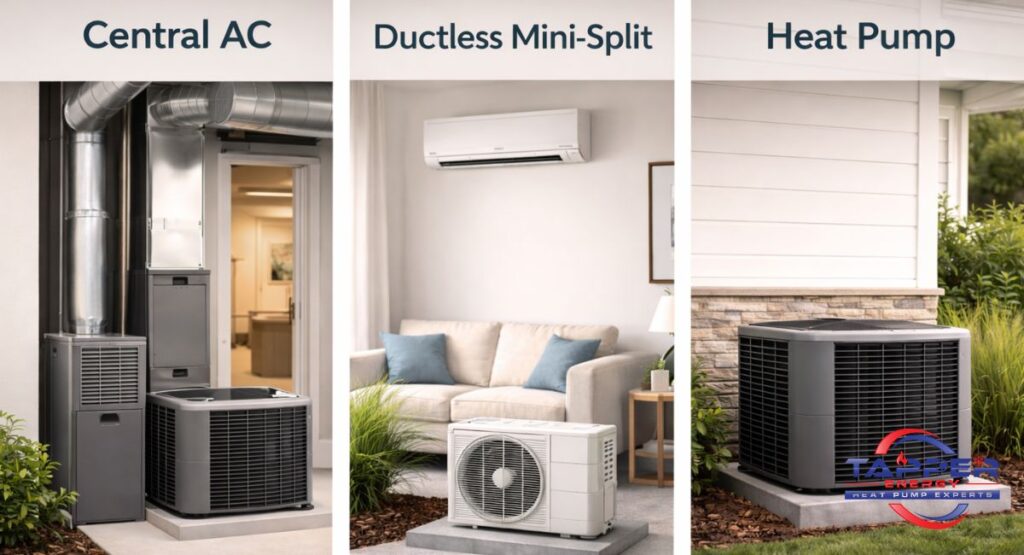
This comparison is the heart of how to choose the right HVAC system. Each system type carries a distinct profile — different costs, different use cases, and different long-term implications. A ducted air conditioning system works through a network of ducts running through your walls, floors, and ceilings. It’s the most common setup in American homes built after the 1970s. However, a ducted vs ductless AC comparison reveals that ductless systems win clearly in homes without existing infrastructure. A ductless mini split installation typically costs less than adding new ductwork and delivers surprisingly powerful cooling performance for individual zones or rooms. Choosing the right HVAC system means honestly evaluating which setup your home can realistically support.
Then there’s the heat pump — arguably the most versatile option for homeowners choosing the right HVAC system in 2026. An air-source heat pump doesn’t just cool your home. It reverses the refrigeration cycle in winter to extract heat from outdoor air and push it inside. That makes it a genuine hybrid heating and cooling system. In mild climates, a heat pump replaces both your furnace and your AC entirely. In colder northern states, a dual-fuel HVAC system pairs a heat pump with a gas furnace — the heat pump handles moderate temperatures while the furnace activates during deep freezes. This configuration is now one of the most energy-efficient setups available. When choosing the right HVAC system for a cold climate, this dual-fuel approach deserves serious consideration.
| System Type | Best For | Heating Capable | Avg Install Cost | Ductwork Needed |
|---|---|---|---|---|
| Central AC | Ducted homes | No | $3,500–$7,500 | Yes |
| Mini Split vs Central Air | Ductless homes | Yes | $2,000–$5,500 | No |
| Air-Source Heat Pump | Mild-to-moderate climates | Yes | $4,000–$8,000 | Optional |
| Dual-Fuel HVAC System | Cold climates | Yes | $5,000–$10,000 | Yes |
How Your Climate Zone Should Drive Your Final Decision
The US Department of Energy divides the country into climate zones and your zone should heavily influence how you choose the right HVAC system. Homeowners in Florida, Texas, and the Gulf Coast states primarily need powerful energy-efficient cooling with strong humidity control — central AC or a high-SEER heat pump fits best. In the Midwest and Northeast where winters are brutal, a heat pump for cold climate only works reliably if it’s a cold-climate-rated model or paired with a gas furnace in a dual-fuel HVAC system configuration. The Pacific Northwest with its mild temperatures is arguably the best region for pure heat pump adoption. Always factor climate first when choosing the right HVAC system. The retrofit air conditioning system you choose today should still perform reliably fifteen winters from now.
How to Choose the Right Size Central AC Unit (BTUs, Tonnage & Load Calculations)
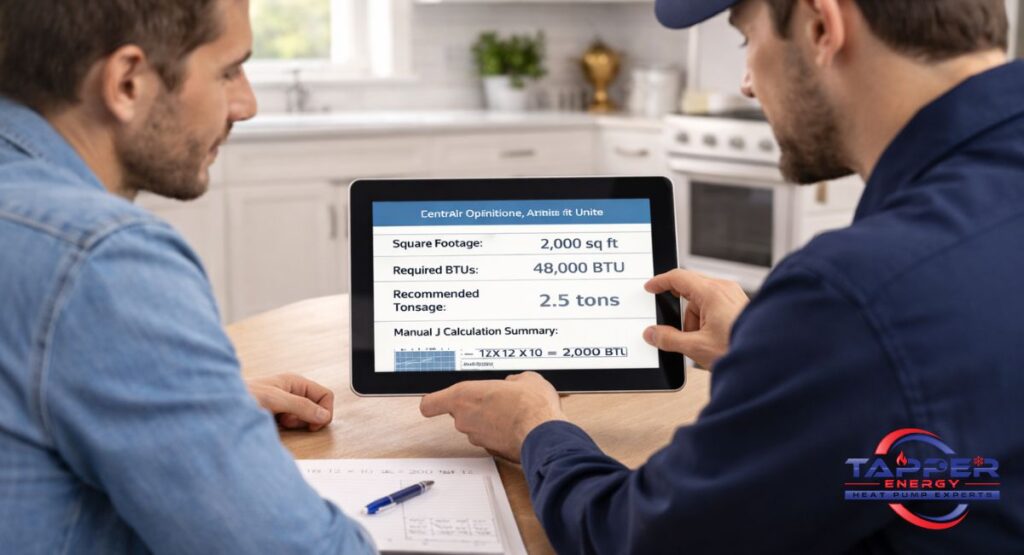
Sizing is where most homeowners go wrong when trying to choose the right HVAC system. An oversized AC unit blasts cold air rapidly and shuts off before completing a full cooling cycle. This short-cycling leaves excess humidity unresolved and accelerates compressor failure risk dramatically. An undersized air conditioner runs constantly, spikes your energy bill, and never quite reaches your target temperature on the hottest days. Neither outcome is acceptable. The industry-standard solution is a Manual J calculation — a room-by-room engineering analysis that accounts for your home’s square footage, insulation levels, window orientation, ceiling height, and local climate data. Choosing the right HVAC system size always starts here.
ACCA guidelines require every legitimate HVAC contractor to perform a Manual J calculation before recommending any equipment. Alongside it, a Manual D duct design analysis ensures your existing or new ductwork can deliver proper airflow to every room. This load calculation method removes all guesswork from the process of choosing the right HVAC system. The result tells you the exact cooling capacity your home needs, expressed in BTU per hour (Btu/hr) or AC tonnage. Use the table below as a starting reference — but never replace a professional room-by-room cooling analysis with a generic online estimate.
| Home Size (sq ft) | Recommended AC Tonnage | Approximate Btu/hr |
|---|---|---|
| 600–1,000 | 1.5 tons | 18,000 Btu/hr |
| 1,000–1,500 | 2 tons | 24,000 Btu/hr |
| 1,500–2,000 | 2.5–3 tons | 30,000–36,000 Btu/hr |
| 2,000–2,500 | 3.5 tons | 42,000 Btu/hr |
| 2,500–3,500 | 4–5 tons | 48,000–60,000 Btu/hr |
Why Proper System Sizing Protects Your Investment Long-Term
Proper system sizing directly impacts predicted reliability and lifespan. A correctly sized system cycles on and off at natural intervals — typically 15 to 20 minutes. This rhythm protects the compressor unit from overwork, reduces compressor failure risk, and keeps cooling cost reduction consistent month over month. HVAC contractors who skip the Manual J calculation and simply replace your old unit with the same size are gambling with your money. Your old unit may have been incorrectly sized from the start. Always insist on documented ACCA guidelines-compliant sizing before any equipment gets ordered. It’s a non-negotiable standard for proper system sizing — and it’s the mark of a contractor who genuinely knows how to help you choose the right HVAC system.
Top Features to Look for When Choosing the Right HVAC System in 2026
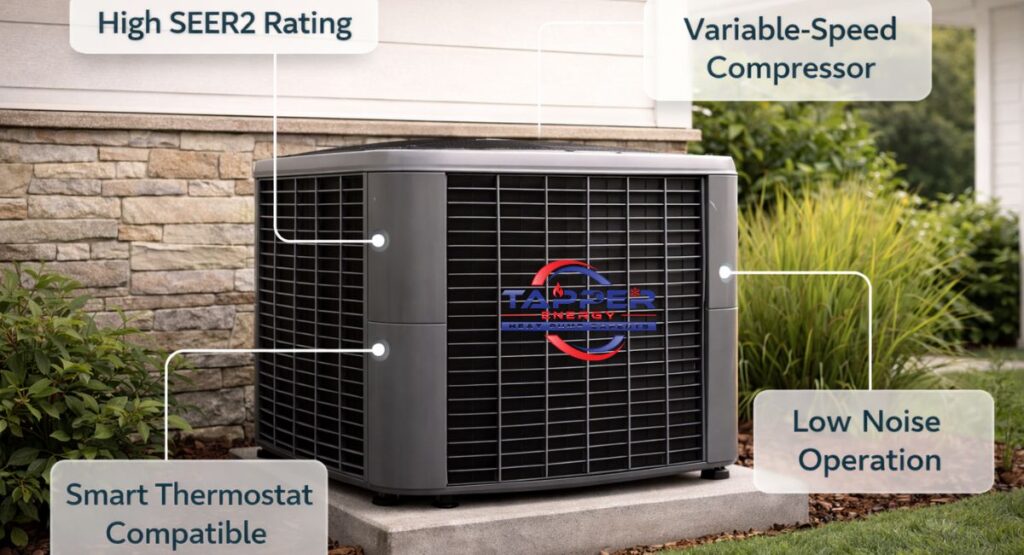
The best systems for choosing the right HVAC system in 2026 look dramatically different from units sold just five years ago. Variable-speed compressors are now the gold standard. Unlike single-stage units that run at full blast or shut off completely, variable-speed systems modulate their output continuously — matching your home’s actual cooling demand at any given moment. The result is extraordinary temperature consistency, dramatically lower watt consumption, and whisper-quiet quiet AC operation. Two-stage compressors offer a practical middle ground — operating at high and low speeds to deliver better efficiency than single-stage without the premium price of fully variable systems. For most American homeowners choosing the right HVAC system, a two-stage unit hits the sweet spot of performance and value.
Smart thermostat control compatibility is now a baseline expectation when choosing the right HVAC system — not a luxury feature. The best central air conditioner 2026 models integrate seamlessly with Google Home, Amazon Alexa, and Apple HomeKit. This enables remote control from anywhere and automated scheduling that cuts watt consumption during off-peak hours. Humidity control is another feature that separates premium units from budget models — especially critical in humid southeastern states. Look for units with a decibel rating below 70 dB for quiet AC operation near bedrooms or outdoor living spaces. Always confirm the unit carries Energy Star certified AC status which signals compliance with Department of Energy guidelines for energy-efficient cooling.
Must-Have vs. Nice-to-Have Features in 2026
| Feature | Priority Level | Why It Matters |
|---|---|---|
| Variable or two-stage compressor | Must-Have | Efficiency and temperature consistency |
| SEER2 rating of 15+ | Must-Have | Meets 2026 federal minimums |
| Energy Star certified AC label | Must-Have | Qualifies for rebates and tax credits |
| 10-year parts warranty | Must-Have | Industry standard for quality brands |
| Smart thermostat control compatibility | Nice-to-Have | Convenient but not essential |
| Quiet AC operation below 70 dB | Nice-to-Have | Comfort-based preference |
| Zoning compatibility | Nice-to-Have | Valuable in larger or multi-story homes |
Understanding SEER2 Ratings and Energy Efficiency Standards
The SEER rating — Seasonal Energy Efficiency Ratio — tells you how efficiently a system converts electricity into cooling over an entire season. Choosing the right HVAC system means understanding this number deeply. The higher the SEER2 rating, the less electricity the unit consumes to deliver the same cooling output. In January 2023, the federal government replaced the old SEER standard with SEER2 using a more rigorous real-world testing process. The new federal minimum is 14.3 SEER2 in northern states and 15.2 SEER2 across the South and Southwest. Any contractor quoting systems below these thresholds in 2026 is a serious red flag. A high-SEER air conditioner rated at 18–22 SEER2 cuts cooling cost reduction by 20–35% compared to minimum-efficiency models — and those utility bill savings compound significantly across a 15-year ownership period.
The financial case for choosing the right HVAC system with a high SEER2 rating gets even stronger when you factor in available incentives. The Inflation Reduction Act offers federal heat pump rebates 2026 and state HVAC tax incentives for homeowners installing qualifying high-efficiency systems. HVAC financing options are widely available through manufacturers and utility companies alike. Visit EnergyStar.gov to find current rebates available in your state — many utility programs stack directly on top of federal credits making a premium system surprisingly affordable. Choosing the right HVAC system with a 16+ SEER2 rating is consistently the recommendation from Department of Energy guidelines for most US climate zones.
SEER2 Ratings vs. Estimated Annual Energy Cost
| SEER2 Rating | Est. Annual Cooling Cost* | Efficiency vs. Minimum |
|---|---|---|
| 14.3 (minimum) | $550–$650 | Baseline |
| 16 | $480–$570 | ~12% savings |
| 18 | $420–$510 | ~22% savings |
| 20 | $370–$460 | ~32% savings |
| 22+ | $320–$400 | ~40%+ savings |
*Estimates based on 2,000 sq ft home, average US electricity rates, moderate climate zone.
Ductwork Requirements: A Critical Step in Choosing the Right HVAC System
Your ductwork is the circulatory system of any ducted air conditioning system — and it’s a step most homeowners skip entirely when choosing the right HVAC system. Studies show duct sealing and insulation improvements alone can reduce HVAC energy losses by up to 30%. That means nearly a third of the air your system produces never reaches the rooms it’s supposed to cool. Leaky ducts force your blower motor to overwork, your compressor unit to run longer cycles, and your monthly bills to climb without explanation. Before choosing the right HVAC system, your existing ductwork must be professionally assessed — no exceptions.
A central AC with ductwork already in place still needs a thorough inspection before new equipment is installed. Old flex ducts deteriorate over time. Sheet metal ducts develop leaks at joints and connections. Improperly sized ducts create wildly uneven cooling performance — some rooms freeze while others barely cool at all. If your home has no ductwork, adding it costs $2,000–$10,000 depending on home size and accessibility. In that scenario, choosing the right HVAC system may mean opting for a ductless mini split installation or a retrofit air conditioning system instead. Always pair your Manual J calculation with a Manual D duct design analysis — together they give you everything you need to choose the right HVAC system with complete confidence.
Signs Your Ductwork Needs Immediate Attention
| Warning Sign | What It Likely Means |
|---|---|
| Uneven temperatures room-to-room | Leaky or undersized ducts |
| Unusually high energy bills | Major duct air loss |
| Excessive dust near supply registers | Duct gaps pulling in attic air |
| Rooms that never cool properly | Blocked or crushed flex duct |
| AC runs constantly | Undersized air conditioner or severe duct leakage |
How Much Does It Cost to Choose and Install the Right HVAC System?

Understanding costs is fundamental to choosing the right HVAC system responsibly. The new central AC system cost varies widely depending on equipment tier, home size, regional labor rates, and ductwork condition. A straightforward central air conditioner replacement in a home with existing ductwork runs $3,500–$7,500 for equipment and installation combined. Premium high-efficiency systems push that number toward $10,000–$12,000. Add new ductwork and you’re potentially looking at $15,000 or more in a larger home. The central AC installation cost in high-cost states like California or New York typically runs 20–30% above the national average. Collecting three HVAC installation quotes minimum is non-negotiable when choosing the right HVAC system at the right price.
Operating costs deserve equal attention when choosing the right HVAC system. A properly sized Energy Star certified AC system costs the average US homeowner $400–$650 annually to run. An HVAC maintenance plan pricing agreement adds $150–$300 per year. Central AC repair cost for issues like refrigerant leaks or blower motor failure ranges from $200 to $1,500 depending on severity. Always evaluate upfront central AC installation cost alongside projected lifetime operating expenses. Choosing the right HVAC system isn’t just about the purchase price — it’s about the total 15-year cost of ownership. A system costing $1,500 more upfront but saving $120 per year on energy pays for itself in under 13 years.
Complete Central AC Cost Breakdown
| Cost Category | Low Estimate | High Estimate |
|---|---|---|
| Equipment (unit only) | $1,200 | $4,500 |
| Installation labor | $1,500 | $3,500 |
| New ductwork (if needed) | $2,000 | $10,000 |
| Duct sealing and insulation | $300 | $1,500 |
| Annual energy cost | $300 | $650 |
| Annual HVAC maintenance plan pricing | $150 | $300 |
The Best Central AC Brands for Choosing the Right HVAC System
AC brand reliability ratings matter enormously across a 15-to-20-year ownership period. When choosing the right HVAC system, the most reliable AC brands consistently named in independent surveys are Carrier, Trane, Lennox, Rheem, and Goodman. Carrier earns top marks for consistency and wide dealer availability nationwide. Trane leads in build quality — their predicted reliability scores rank among the highest in the industry according to Consumer Reports data. Lennox pushes efficiency hardest, offering some of the highest SEER2-rated residential units available in 2026. If maximum utility bill savings is your priority when choosing the right HVAC system, Lennox deserves serious consideration. For budget-conscious homeowners, Goodman delivers genuine value with a lifetime compressor warranty on select models.
AC repair frequency data shows that installation quality ultimately matters more than brand name alone when choosing the right HVAC system. A premium Carrier unit installed carelessly will underperform a budget Goodman unit installed correctly every single time. AC brand reliability ratings assume correct installation and regular annual HVAC maintenance — both are non-negotiable regardless of which brand you select. The best central air conditioner 2026 for your home is ultimately the one correctly sized, properly installed, and consistently maintained — not necessarily the most expensive name on the market.
Top AC Brand Comparison: 2026
| Brand | Compressor Warranty | SEER2 Range | Price Tier | Predicted Reliability |
|---|---|---|---|---|
| Carrier | 10 years | 14–24 | Premium | Excellent |
| Trane | 12 years | 14.3–22 | Premium | Excellent |
| Lennox | 10 years | 14.3–28 | Premium | Very Good |
| Rheem | 10 years | 14.3–20 | Mid-Range | Very Good |
| Goodman | Lifetime (select) | 14.3–19 | Budget | Good |
| York | 10 years | 14.3–20 | Mid-Range | Good |
How to Hire the Right HVAC Contractor (and Avoid Costly Mistakes)

Finding a trustworthy HVAC contractor near me is as important as choosing the right HVAC system itself. A great system installed poorly performs like a bad one — for its entire lifespan. Every contractor you consider must be a licensed HVAC technician credentialed in your state, carry full liability insurance, and operate as a bonded and insured contractor. The gold standard for technical competence is NATE certified technician status — requiring rigorous exams and demonstrating verified real-world knowledge. Some contractors additionally hold HVAC Excellence certification. Always verify credentials directly through your state’s contractor licensing board before choosing the right HVAC system installer for your home.
The bidding process reveals everything about a contractor’s professionalism. Any contractor quoting a price without performing a Manual J calculation or inspecting your ductwork is cutting corners that will cost you later. Collect at least three HVAC installation quotes and compare them line by line — not just the final number. Check Better Business Bureau HVAC complaints for every contractor under consideration. Ask explicitly whether they pull permits, perform system commissioning tests, and ensure proper airflow clearance around the outdoor condenser after installation. Choosing the right HVAC system and then trusting the wrong contractor to install it is one of the costliest mistakes American homeowners make every single year.
Red Flags to Watch for When Hiring an HVAC Contractor
| Red Flag | What It Signals |
|---|---|
| No Manual J calculation offered | Guessing on system size |
| Unusually low bid (30%+ below others) | Cutting corners on equipment or labor |
| No proof of licensed HVAC technician status | Unlicensed operator |
| Refuses to pull permits | Avoiding inspections |
| No written warranty on labor | No accountability after installation |
| Pressure to decide same day | High-pressure sales tactic |
| Can’t provide insurance certificate | Liability risk for homeowner |
Central AC Maintenance Schedule: How to Maximize Lifespan and Efficiency
Annual HVAC maintenance is the single most impactful habit for protecting your investment after choosing the right HVAC system. A well-maintained system consistently lasts 15 to 20 years. A neglected one fails in 8 to 10. During a professional service plan agreement tune-up, a technician performs coil cleaning, checks for refrigerant leaks, inspects electrical connections, tests the blower motor, performs drain pan flushing, and verifies thermostat control calibration. Scheduling this every spring — before peak cooling season — ensures the right HVAC system you chose continues performing at its best when temperatures climb and demand surges.
Between professional visits, monthly HVAC filter replacement is the single easiest way to protect the right HVAC system you’ve invested in. A clogged filter restricts airflow, overworks the blower motor, drops cooling performance, and accelerates compressor failure risk — all from a $10 part that takes three minutes to swap. Keep the outdoor condenser clear of leaves and debris year-round. Maintain at least 18–24 inches of proper airflow clearance on all sides. Blower compartment cleaning annually keeps debris away from moving parts. These small consistent habits are what separates a system that reaches 20 years from one that fails at 10. Choosing the right HVAC system is only half the equation — maintaining it properly is the other half.
Seasonal Maintenance Schedule
| Season | Maintenance Task | DIY or Pro |
|---|---|---|
| Spring | Full tune-up, coil cleaning, refrigerant check | Professional |
| Spring | Drain pan flushing, electrical inspection | Professional |
| Summer | Monthly HVAC filter replacement | DIY |
| Summer | Clear outdoor condenser debris | DIY |
| Fall | Heating component inspection, duct check | Professional |
| Winter | Filter replacement, thermostat control test | DIY |
Frequently Asked Questions About Choosing the Right HVAC System
Getting the right answers before you invest saves you thousands. These are the most common questions homeowners across the US ask when choosing the right HVAC system — answered clearly and directly.
Which Is Better, R-410A or R-32?
R-32 refrigerant is the better choice in 2026 — and the HVAC industry broadly agrees. R-410A refrigerant was the standard for decades but carries a Global Warming Potential (GWP) of 2,088 — meaning it traps significantly more heat in the atmosphere than R-32 refrigerant which has a GWP of just 675. That’s a 68% reduction in environmental impact. The Environmental Protection Agency (EPA) and refrigerant regulations 2026 are actively pushing manufacturers away from R-410A refrigerant toward lower-GWP alternatives like R-32 refrigerant and R-454B refrigerant. Beyond the environmental advantage, R-32 is also more energy-efficient — it requires less refrigerant by volume to deliver the same cooling performance which reduces watt consumption and supports lower operating costs. Most new systems rolling out in 2026 already use R-32 or R-454B. If a contractor is still quoting you an R-410A refrigerant system in 2026, ask why — and consider whether that equipment will face regulatory and supply chain challenges ahead. Always choose the right HVAC system running the most current regulation-compliant refrigerant available.
What Is the Best Air Conditioning and Heating System for a Home?
The answer depends on your climate, your home’s infrastructure, and your budget. However, for most American homeowners in 2026, a high-SEER air conditioner paired with a modern air-source heat pump represents the best overall solution for choosing the right HVAC system. Heat pumps handle both functions — cooling in summer and heating in winter — with remarkable energy-efficient cooling and heating efficiency. In mild-to-moderate climates across the South, Southeast, and Pacific Coast, a standalone heat pump rated at 18+ SEER2 delivers outstanding year-round comfort at the lowest operating cost of any system type. In colder northern states where temperatures regularly drop below 20°F, a dual-fuel HVAC system — combining a heat pump with a gas furnace — is widely considered the best central air conditioner 2026 configuration. The heat pump handles the bulk of the workload efficiently while the furnace activates only during extreme cold snaps. For homes without existing ductwork, a ductless mini split installation with multi-zone capability offers the most flexible and cost-effective path to whole-home comfort. The bottom line: choosing the right HVAC system always starts with a professional Manual J calculation and an honest assessment of your home’s layout and regional climate zone.
What Is the 20 Rule for Air Conditioning?
The 20 rule for air conditioning is a straightforward guideline that helps homeowners decide whether to repair or replace an aging AC system when choosing the right HVAC system makes financial sense. The rule works like this: multiply the age of your unit in years by the estimated repair cost in dollars. If the resulting number exceeds $5,000, replacing the system is almost always the smarter financial decision. For example, if your AC unit is 12 years old and a technician quotes you $500 for a repair, the calculation is 12 × $500 = $6,000 — which exceeds the $5,000 threshold, suggesting replacement makes more sense. This rule is particularly useful when facing major repairs like compressor failure or significant refrigerant leaks on an older unit. A system older than 15 years with a repair quote above $400 will almost always trigger the replacement recommendation under this formula. Older systems are less energy-efficient, carry higher AC repair frequency risks, and often use outdated R-22 refrigerant or R-410A refrigerant that is increasingly expensive in 2026. When the math points toward replacement, use that moment to choose the right HVAC system with better efficiency, a stronger warranty, and modern refrigerant regulations 2026-compliant technology.
How Much Does a New HVAC System Cost for a 2,000 Square Foot Home in 2026?
For a 2,000 square foot home, the new central AC system cost in 2026 ranges from $5,500 to $12,500 depending on system type, efficiency rating, brand, and regional labor costs. Here’s a realistic breakdown of what to expect:
| System Type | Equipment Cost | Installation Labor | Total Estimated Cost |
|---|---|---|---|
| Central AC (existing ducts) | $2,000–$4,500 | $1,500–$3,000 | $3,500–$7,500 |
| Central AC (new ductwork included) | $2,000–$4,500 | $4,000–$8,000 | $6,000–$12,500 |
| Air-Source Heat Pump (existing ducts) | $3,000–$5,500 | $1,500–$3,000 | $4,500–$8,500 |
| Dual-Fuel HVAC System | $4,000–$7,000 | $2,500–$4,000 | $6,500–$11,000 |
| Ductless Mini Split (multi-zone) | $3,000–$6,000 | $1,500–$3,500 | $4,500–$9,500 |
For a 2,000 square foot home you’ll typically need a 2.5 to 3 ton AC unit based on standard AC tonnage guidelines — though a proper Manual J calculation may adjust that number based on insulation quality, ceiling height, and window count. Central AC installation cost in high cost-of-living states like California, New York, and Massachusetts runs 20–30% above these national averages. Always collect a minimum of three HVAC installation quotes before committing. Factor in available heat pump rebates 2026 and state HVAC tax incentives under the Inflation Reduction Act — qualifying homeowners can recover $1,000–$2,000 or more through federal credits significantly reducing the net central AC installation cost. Visit EnergyStar.gov to check what incentives apply in your specific state before finalizing your decision when choosing the right HVAC system.
What Is the 2 Foot Rule for HVAC?
The 2 foot rule for HVAC — also called the outdoor condenser clearance rule — is a standard installation guideline requiring a minimum of 2 feet (24 inches) of clear space around all sides of your outdoor condenser unit. This clearance exists for two critical reasons: airflow and serviceability. Your outdoor condenser expels heat extracted from inside your home by releasing it into the surrounding air. If shrubs, fencing, walls, or debris block that airflow within the 2-foot perimeter, the condenser can’t release heat efficiently. The result is a system that works significantly harder, consumes more energy, and experiences accelerated compressor failure risk. Proper airflow clearance directly impacts cooling performance, predicted reliability, and annual HVAC maintenance access for technicians. Beyond the sides, most manufacturers require 18 to 24 inches of clearance above the condenser unit — particularly important if you’re installing a deck or pergola nearby. Overhead obstructions trap hot air and force the system to recirculate already-heated air dramatically reducing efficiency. The ACCA guidelines and virtually every major manufacturer’s installation manual specify these clearance requirements as mandatory — not suggestions. When your licensed HVAC technician installs your new system, confirm they verify proper outdoor condenser clearance on all sides before considering the job complete. Violating the 2 foot rule can also void manufacturer warranties on some units — making this a critical detail worth knowing before choosing the right HVAC system and having it installed.
Conclusion
Knowing how to choose the right HVAC system is the foundation of a comfortable, energy-efficient home for decades to come. Match your system to your climate zone, size it correctly using a Manual J calculation, invest in a SEER2 rating that delivers real utility bill savings, and hire only a NATE certified technician with verified credentials. Maintain your system religiously every season and it will reward you with 15 to 20 years of reliable, efficient performance. The right decision today — made with the knowledge in this guide — pays dividends every single month for the next two decades. Choosing the right HVAC system isn’t just a home improvement decision. It’s one of the smartest financial moves a homeowner can make.