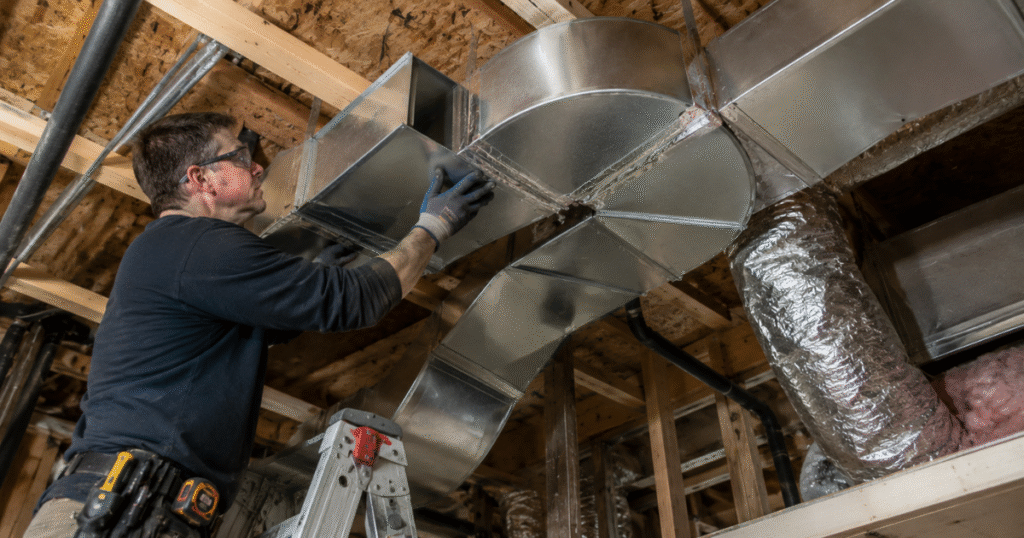
Air Duct Replacement Cost PA: 7 Essential 2026 Price Facts Every Homeowner Should Know
Air duct replacement cost PA runs $3,000 to $6,000 for most homes in 2026. See all 7 essential price facts, cost by home size and material, before you buy.


Air duct replacement cost PA runs $3,000 to $6,000 for most homes in 2026. See all 7 essential price facts, cost by home size and material, before you buy.
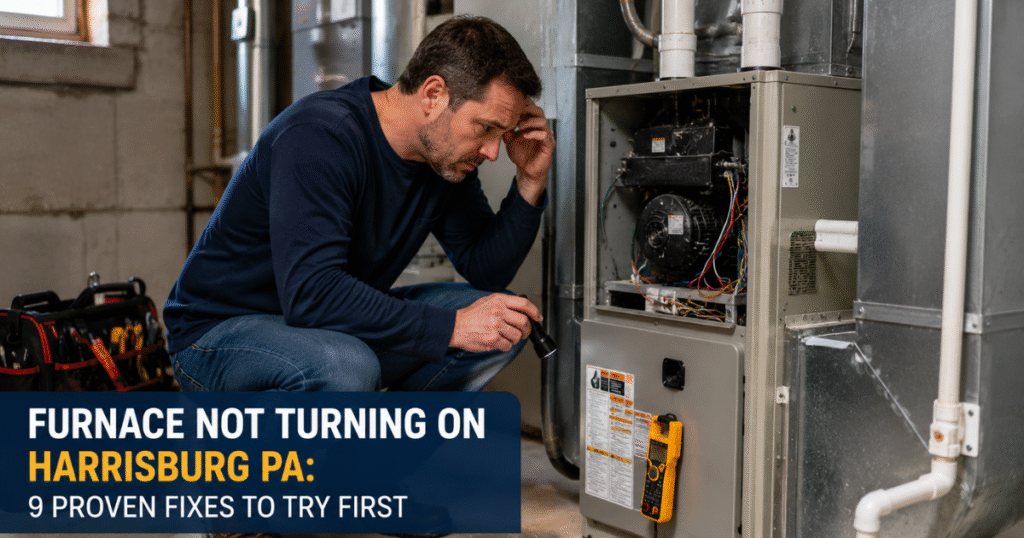
Furnace not turning on Harrisburg PA? Work through 9 proven fixes, from thermostat to flame sensor, plus 2026 repair costs and when to call a pro.
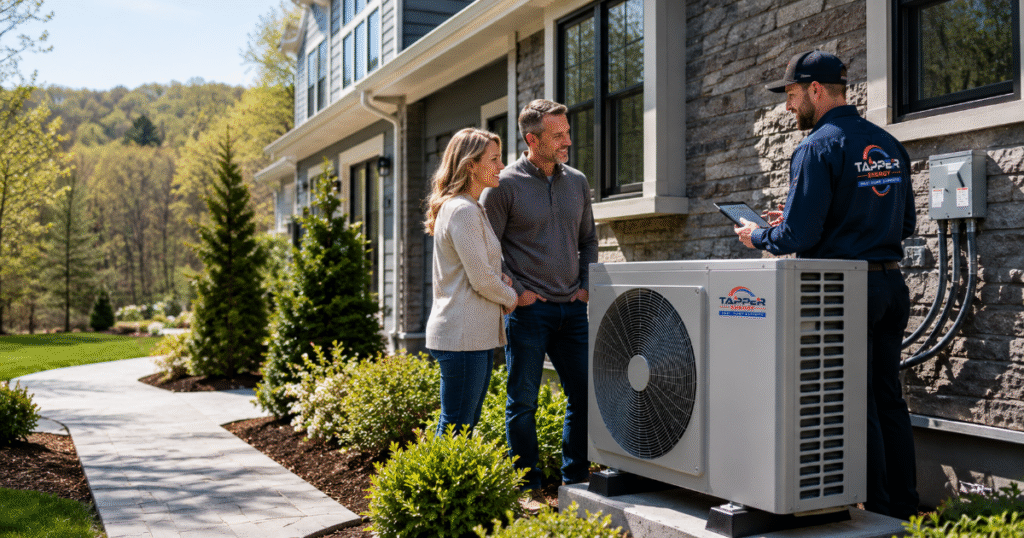
Heat pump installation cost Pennsylvania runs $5,800 to $10,000 for most homes in 2026. See all 7 proven price ranges, from ductless to geothermal, before you buy.
AC repair cost Harrisburg PA homeowners pay in 2026 ranges from about $85 for a basic diagnostic visit to $2,800 for a full compressor replacement, but most everyday repairs land between $150 and $650. The single biggest factor is which part failed: a worn run capacitor is a cheap, same-day fix, while a dead compressor often pushes you toward a whole-system decision. Knowing these numbers before a technician arrives is the easiest way to avoid overpaying or being talked into a replacement you do not need. Need a straight answer on your AC today? Call Tapper Energy at (717) 921-4822 or request a free estimate. Maintenance customers get 24-hour emergency service. Table of Contents How much does AC repair cost in Harrisburg PA? In Harrisburg PA, the average AC repair cost Harrisburg PA homeowners pay in 2026 falls between $150 and $650 for the repairs most homeowners actually face, such as a capacitor, contactor, or refrigerant top-off. Simple electrical fixes sit at the low end, while motor and coil work climbs higher, and a compressor failure can reach $2,800. Almost every reputable local company, including Tapper Energy, charges a diagnostic or service-call fee of roughly $85 to $200, and that fee is typically applied to the repair if you approve the work. Here is a quick reference table of typical Central PA ranges for 2026. These are local market ranges from current cost data, not a Tapper Energy quote. Your exact price depends on your unit, the part, and warranty status. Repair Typical Central PA cost (2026) How common Same-day fix? Diagnostic / service call $85 to $200 Every visit Yes Run capacitor $150 to $400 Very common Usually Contactor $200 to $450 Common Usually Refrigerant recharge $200 to $600 Common Often Refrigerant leak repair $400 to $1,500 Moderate Sometimes Condenser fan motor $200 to $700 Moderate Often Blower motor $450 to $1,200 Moderate Sometimes Evaporator coil $650 to $2,500 Less common No Compressor $1,300 to $2,800 Less common No Use this AC repair cost Harrisburg PA table as a baseline for budgeting, not a final quote, since your unit and warranty status move the number. In our service calls across Harrisburg and the surrounding Susquehanna Valley, the majority of midsummer no-cooling tickets turn out to be one of the first four rows in that table, which is good news for your wallet. AC repair cost Harrisburg PA by part: 7 prices to know The fastest way to understand any AC repair cost Harrisburg PA estimate is to know what each major part costs to fix. Here are the seven you are most likely to hear named on a 2026 service call. 1. Run capacitor: $150 to $400 The capacitor is the most common summer AC failure in Central PA, and it is also one of the cheapest to fix. This small cylinder gives the motor the jolt it needs to start. When it dies, your outdoor fan may hum but not spin. Most technicians carry common capacitors on the truck, so this is usually a same-day repair. 2. Contactor: $200 to $450 The contactor is the electrical switch that tells your outdoor unit to turn on. Ants, corrosion, and PA humidity love to ruin them. A failed contactor often looks like a unit that simply will not start. The part is inexpensive, so most of this cost is the diagnostic visit and labor. 3. Refrigerant recharge or leak repair: $200 to $1,500 A low refrigerant charge means weak cooling and, often, ice on the lines. A simple top-off runs $200 to $600. If you have an actual leak, expect $400 to $1,500 once the technician finds and seals it. Repeated recharges are a red flag that you are paying for the same problem twice. 4. Condenser fan motor: $200 to $700 This is the motor that spins the big fan in your outdoor unit. When it fails, the system overheats and shuts down on hot afternoons, exactly when you need it most. Replacement is straightforward and usually done in one visit. 5. Blower motor: $450 to $1,200 The blower lives in your indoor air handler and pushes cooled air through the ducts. Weak airflow from the vents, even when the outdoor unit runs, often points here. Variable-speed blowers cost more than older single-speed motors. 6. Evaporator coil: $650 to $2,500 The indoor coil absorbs heat from your home. Coils crack and leak with age, and the repair is labor-intensive because the coil sits deep inside the system. On a unit over 10 years old, an evaporator coil repair is a classic moment to weigh repair against replacement. 7. Compressor: $1,300 to $2,800 The compressor is the heart of the system and the most expensive single repair. If it fails on a unit that is more than 10 to 12 years old and out of warranty, replacing the whole system almost always makes more financial sense than the repair alone. Want the replacement side of the math? Our guide to AC replacement cost in Harrisburg PA lays out 2026 system pricing in detail. What drives your AC repair cost in Harrisburg PA? Two identical-looking estimates can differ by hundreds of dollars, and the reasons are usually predictable. Understanding them helps you read your AC repair cost Harrisburg PA quote with confidence. Labor is the first driver of any AC repair cost Harrisburg PA estimate. Central PA HVAC technicians charge roughly $75 to $150 per hour in 2026, so a repair that takes three hours costs far more in labor than a 30-minute capacitor swap. Part availability matters too: common parts are on the truck, while a specialty or proprietary part may require an order and a second trip. Warranty status is the quiet game-changer. If your system is under 10 years old, the manufacturer may cover the part on a coil or compressor, leaving you to pay only labor. Always have your model and serial number handy so the technician can check coverage before quoting. Finally, PA’s hot, humid
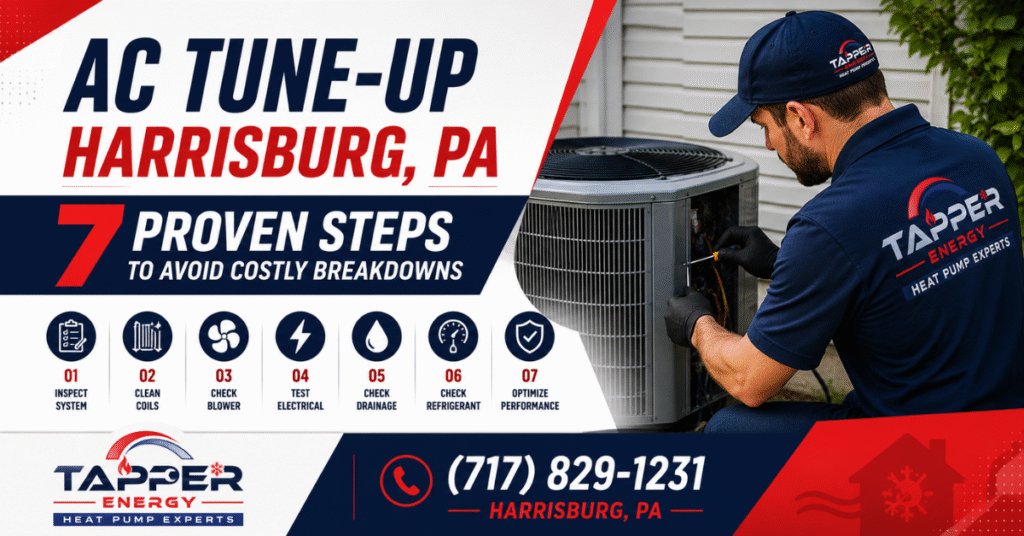
AC tune-up Harrisburg PA is the single most important maintenance task Central PA homeowners can schedule before summer. If you’ve skipped your annual tune-up service for one or two seasons, your system is quietly building toward a costly breakdown. Harrisburg summers regularly push into the 90s, and an unchecked AC unit running under those conditions is the fastest path to a $1,500 emergency call. TL;DR:• A professional AC tune-up Harrisburg PA costs $75–$150 and takes 60–90 minutes• Skipping AC tune-up Harrisburg PA service reduces efficiency by up to 5% per year and cuts lifespan by 3–5 years• If your system is 15+ years old or repairs exceed 50% of replacement cost, replace instead of tuning up Need help now? Call Tapper Energy at (717) 921-4822 or request a free AC tune-up Harrisburg PA estimate. Table of Contents Why AC Tune-Up Harrisburg PA Service Matters Every Spring The National Weather Service reports that Central PA averages 20+ days above 90°F each summer, with humidity pushing heat index values above 100°F. That’s extreme stress for any AC system — and a primary reason why scheduling this annual service every spring isn’t optional, it’s essential. The U.S. Department of Energy estimates a properly maintained AC unit uses 15% less energy than a neglected one. Without annual AC tune-up Harrisburg PA maintenance, here’s what deteriorates: A $100 AC tune-up Harrisburg PA service prevents most of these. Ignoring them leads to $300–$1,800 in repairs within 2–3 seasons. 7 Steps of a Professional AC Tune-Up Harrisburg PA Service Tapper Energy’s NATE-certified technicians spend 60–90 minutes on every AC tune-up Harrisburg PA visit. Here’s exactly what gets done during your AC tune-up Harrisburg PA service: Step 1: Inspect and Replace the Air Filter A clogged filter is the most common cause of AC problems. During your AC tune-up Harrisburg PA service, the technician replaces filters clogged for 60+ days. Dirty filters freeze the evaporator coil — your AC runs but doesn’t cool. DIY or Pro: Replace 1-inch filters yourself every 30–60 days during heavy-use seasons. Step 2: Clean the Condenser Coils A season of cottonwood and debris coats outdoor coils like insulation. Cleaning them can reduce compressor run time by 15–20%, directly lowering your PPL Electric bill. Step 3: Test Refrigerant Level Low refrigerant always means a leak. The technician checks system pressure and uses a leak detector on all connection points. Adding refrigerant without fixing the leak is a temporary fix — a properly sealed system holds its charge for life. Step 4: Test the Capacitor Capacitors are the most failure-prone component in any AC system. The technician tests microfarad ratings — if it’s reading 10–15% below spec, it will fail soon. Catching it in a tune-up costs $150–$300. Waiting for failure means a $500 summer emergency call. Step 5: Clear the Condensate Drain Harrisburg’s humidity means algae grows fast in condensate lines. A blocked drain causes water damage and system shutdown. The tune-up service includes a full flush and drainage confirmation. Step 6: Inspect Electrical Connections Every connection, relay, and control board gets checked during the visit. Loose connections damage compressors and control boards — the most expensive components to replace. Step 7: Measure Supply/Return Temperature Delta A properly functioning AC should produce air 16–22°F cooler than the return. If this delta is outside range after the inspection, the technician diagnoses and quotes the repair with upfront pricing. AC Tune-Up Harrisburg PA Cost Breakdown Service Cost Notes Standard AC tune-up Harrisburg PA $75–$150 60–90 minute visit Capacitor replacement $150–$300 Very common add-on Coil cleaning (heavy buildup) $100–$200 Severe cases only Condensate drain flush Included Part of tune-up Refrigerant top-off $75–$150/lb R-410A; leak fix billed separately Annual maintenance plan $120–$200/yr Priority + 24hr emergency access Read our HVAC Repair vs Replace guide if you’re unsure whether AC tune-up Harrisburg PA service or full replacement is the right call. Get a free this service estimate → DIY vs Professional: What Harrisburg Homeowners Can Handle Task DIY Pro Replace air filter ✅ Every 30–60 days Rinse outdoor unit (low pressure) ✅ Test capacitors ✅ Requires meter Check refrigerant pressure ✅ EPA 608 required Inspect electrical connections ✅ Safety hazard Clean evaporator coil ✅ Requires disassembly The DOE recommends homeowners handle filters and debris — leave the rest to a licensed HVAC technician. Signs Your AC Needs More Than an the service Service These point to compressor failure, major refrigerant leaks, or an aged-out system. See our AC repair Harrisburg PA page for diagnosis details. Case Study: Mechanicsburg Homeowner Saves $890 with AC Tune-Up Problem: A Mechanicsburg homeowner called Tapper Energy for an AC maintenance in late April — two years overdue. System seemed fine. Found: Capacitor at 82% rated value (declining fast), condenser coils coated with two years of cottonwood, condensate drain partially blocked. Solution: Capacitor replaced ($195), coils cleaned, drain flushed. Total visit cost: $315. Result: That capacitor would have failed by mid-July — a $500+ emergency call plus days without AC. Total avoided cost: $890+. FAQ: annual service Schedule Your this maintenance With Tapper Energy The best the tune-up service comes from a company that’s honest about what your system actually needs. Tapper Energy’s NATE-certified technicians deliver a full inspection and upfront pricing — no pressure, no upsells. Serving Harrisburg, Mechanicsburg, Camp Hill, Enola, and all of Central PA. Book your this service today — free estimates on installations →Or call (717) 829-1231 anytime. About the Author Written by the Tapper Energy HVAC team. Our NATE-certified technicians have diagnosed and repaired thousands of AC systems across Harrisburg and Mechanicsburg. Related Articles You May Find Helpful AC Leaking Water? 6 Proven Fixes Before Damage Spreads Emergency AC Repair Harrisburg PA: 6 Critical Steps Air Duct Replacement Cost PA: 7 Essential Price Facts
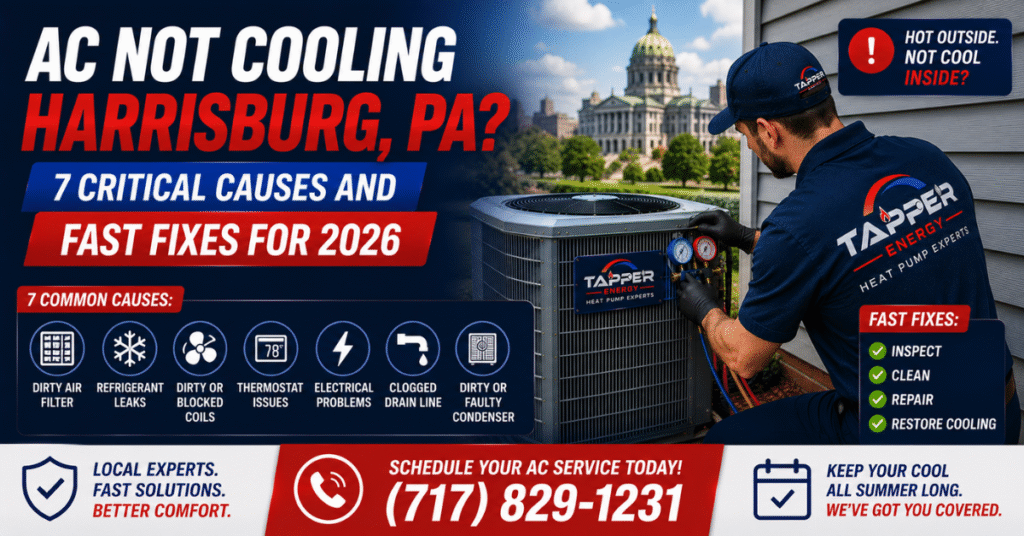
AC not cooling Harrisburg PA homeowners notice it fast: the thermostat says 72 but the house feels like 80, and the air from the vents is warm instead of cold. In almost every case the cause is one of seven things, and the most common is the cheapest to fix. A dirty air filter or a clogged outdoor condenser unit blocks airflow first, followed by thermostat settings, a tripped breaker, low refrigerant from a leak, a failed capacitor, or a frozen evaporator coil. Here in the Greater Harrisburg area, where July highs average 86 degrees and the air turns muggy fast, an AC not cooling Harrisburg PA homeowners report is one of the most common calls our technicians get all summer. TL;DR Need cold air today? Call Tapper Energy at (717) 921-4822 or request a free estimate. Maintenance customers get 24-hour emergency service. Table of Contents AC Not Cooling Harrisburg PA: Why Your System Runs but Will Not Cool Homeowners dealing with an AC not cooling Harrisburg PA summers bring on usually face one core problem. When your air conditioner runs but blows warm air, the system has lost its ability to move heat out of your home. An AC does not make cold air; it removes heat from indoor air and dumps it outside. Anything that blocks that heat transfer, whether it is airflow, refrigerant, or a failed electrical part, leaves you with a fan that hums and air that never gets cold. That lost heat transfer is the root of an AC not cooling Harrisburg PA problem. In our service calls across Harrisburg, Mechanicsburg, and Camp Hill, the cause is restricted airflow more often than any expensive failure. That is good news for your wallet. Before you worry about a new system, work through the seven causes below in order, because they run from most common and cheapest to least common and costly. That order is how we troubleshoot an AC not cooling Harrisburg PA homes deal with every July. The 7 most common causes of an AC not cooling 1. A dirty air filter A clogged filter is the single most common reason an AC stops cooling. When the filter is packed with dust, air cannot move across the evaporator coil, the coil gets too cold, and cooling output drops or stops entirely. During a humid Central PA summer, filters load up fast. Check yours first, every time. 2. A blocked or dirty outdoor condenser unit Your outdoor unit releases the heat pulled from inside. When grass clippings, leaves, cottonwood fluff, or dryer lint coat the condenser fins, the system cannot shed heat and the air indoors stays warm. Harrisburg yards in June and July are notorious for this. The unit needs at least two feet of clear space on all sides. 3. Thermostat settings or a dead thermostat battery It sounds simple, but a thermostat set to “fan on” instead of “auto” blows room-temperature air between cooling cycles, which feels like warm air from the vents. A dead battery, a wrong program, or a thermostat reading the wrong temperature all mimic a broken AC. Confirm it is set to “cool” and at least a few degrees below room temperature. 4. A tripped breaker or lost power to the outdoor unit Many systems have the indoor blower and the outdoor compressor on separate circuits. If only the outdoor unit loses power, the fan inside keeps running and blows warm air while the compressor sits dead. A breaker that trips again right after you reset it is a warning sign of an electrical fault that needs a technician. 5. Low refrigerant from a leak Refrigerant is the fluid that carries heat out of your home. Your AC does not consume it, so if the charge is low, there is a leak. Symptoms include warm air, hissing or bubbling sounds, ice on the lines, and a unit that runs constantly. A leak needs to be found and sealed before recharging, which is a job for a licensed pro under EPA refrigerant rules. 6. A failed run capacitor or contactor The capacitor gives the compressor and fan motors the jolt they need to start. When it fails, you may hear a humming or clicking outdoor unit that will not start, and the air stays warm. A capacitor is an inexpensive, common part that wears out in the Central PA heat, and it is one of the fastest repairs we make. 7. A frozen evaporator coil If the indoor coil ices over, airflow stops and the vents blow warm or weak air. Freezing usually traces back to a dirty filter, low refrigerant, or a blower problem. Turn the system off and let the ice melt before doing anything else. For the full breakdown of why this happens, see our guide on an AC freezing up in Harrisburg PA. DIY checks you can do in 10 minutes For an AC not cooling Harrisburg PA homeowners can often fix it fast. Before you call anyone, run through these safe checks. About a third of the warm-air calls we get are solved by the homeowner with steps like these: What you should never do yourself: add refrigerant, open the sealed system, or bypass an electrical part. Those steps are unsafe, are often illegal without certification, and usually make the repair more expensive. How much does it cost to fix an AC that is not cooling? Wondering what an AC not cooling Harrisburg PA repair runs? Most warm-air problems are far cheaper to fix than homeowners fear. The table below shows typical 2026 ranges for the repairs tied to the seven causes above. These are general Central PA ranges from current industry cost data, not a Tapper Energy quote. Your price depends on the part, the access, and the diagnosis, so we always give a clear estimate before any work. Likely cause What it needs Typical 2026 cost range Dirty air filter New filter (DIY) $10 to $40 Dirty condenser unit Professional coil cleaning
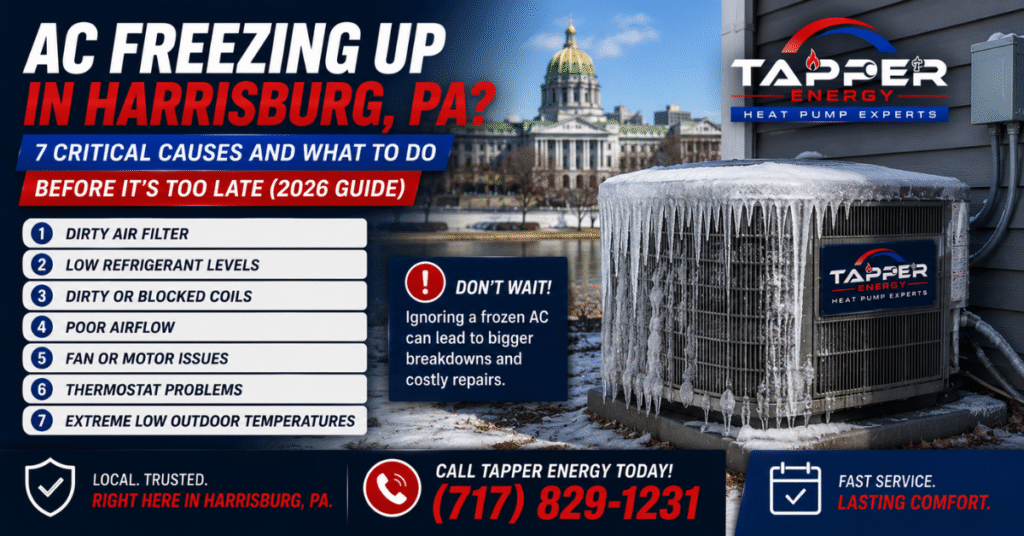
AC freezing up Harrisburg PA is almost always caused by restricted airflow, most often a dirty air filter or a closed vent, followed by a refrigerant leak. The fix starts the same way every time: turn the system off completely, switch the thermostat fan to “on” so warm air can thaw the coil, then check your filter. If ice comes back within a day or two of a fresh filter, you likely have a refrigerant leak or a failing component that needs a licensed technician, not a homeowner fix. 📞 Need help right now? Call Tapper Energy at (717) 921-4822 for fast AC repair in Harrisburg, PA, or request a free estimate online. Table of Contents What Does It Mean When Your AC Freezes Up? AC freezing up Harrisburg PA means ice has formed on the evaporator coil, the indoor coil that absorbs heat from the air in your home, or on the copper refrigerant lines running to your outdoor unit. The coil needs a steady flow of warm indoor air across it to stay above freezing. When that airflow drops, or when refrigerant pressure inside the coil drops, the coil’s surface temperature falls below 32°F and moisture in the air freezes onto it. Once ice builds up, it blocks airflow even further, the problem compounds, and your home stops cooling even though the system keeps running. Why Harrisburg Summers Make This Worse Harrisburg’s summers are a setup for this exact failure. July highs in the Harrisburg area average around 83 to 84°F with humidity near 68%, among the most humid and warm stretches of the year (Climate-Data.org, Harrisburg climate averages). That combination forces most residential AC systems to run for long, nearly continuous stretches rather than cycling on and off. A system running that hard has almost no margin for a partially clogged filter or a slightly low refrigerant charge. What might cause a minor efficiency dip in a milder climate turns into a fully frozen coil within a day or two in a Central PA July. This is exactly why AC freezing up Harrisburg PA spikes every July and August: in our service calls across Harrisburg and Mechanicsburg, long runtimes expose airflow problems that were already there. The 7 Most Common Causes of a Frozen AC, Ranked Common to Rare 1. A Dirty or Clogged Air Filter This is the single most common reason behind AC freezing up Harrisburg PA calls: it causes more frozen coils than every other cause combined. A clogged filter starves the evaporator coil of the warm return air it needs, and the coil’s temperature drops below freezing within hours of restricted airflow. Check your filter first. If you can’t see light through it when held up to a window, replace it. 2. Closed or Blocked Supply and Return Vents Closing vents in unused rooms, or blocking a return vent with furniture, rugs, or curtains, reduces the total air volume moving across the coil even with a clean filter, a setup that quietly triggers AC freezing up Harrisburg PA. Walk your home and confirm every supply and return vent is open and unobstructed, especially the main return near your thermostat or basement. 3. Low Refrigerant From a Leak Central air conditioners do not consume refrigerant during normal operation. If your system is low, refrigerant is escaping somewhere, commonly the evaporator coil, the condenser coil, a line connection, or the compressor itself. Low pressure drops the refrigerant’s temperature enough to freeze the coil even with perfect airflow, one of the most serious causes of AC freezing up Harrisburg PA. This is a licensed-technician repair, both because EPA regulations restrict who can legally handle refrigerant and because finding the leak point takes pressure-testing equipment. 4. A Dirty Evaporator Coil Dust and grime on the coil itself act the same way a dirty filter does: they insulate the coil from the warm air passing over it, another quiet driver of AC freezing up Harrisburg PA. A coil that hasn’t been professionally cleaned in several years is a common, overlooked cause. 5. A Failing Blower Motor or Weak Fan If the indoor blower motor is weak, dying, or running on the wrong speed setting, it can’t move enough air across the coil even with a clean filter and open vents, a setup that often shows up as AC freezing up Harrisburg PA. A blower that sounds labored, runs slower than usual, or cycles oddly is worth a professional inspection before it fails completely. 6. A Thermostat Set Too Low or Malfunctioning Running a central AC below 68°F, especially overnight when outdoor temperatures drop, can push the system into freeze territory. A miscalibrated thermostat that doesn’t shut the system off when the home reaches temperature has the same effect, and it’s a common reason behind AC freezing up Harrisburg PA overnight. 7. An Oversized or Improperly Charged System A system that’s too large for the home, or one that was charged with refrigerant incorrectly during installation, can short cycle and freeze even when every other component is healthy. This is the rarest cause of AC freezing up Harrisburg PA on this list, but it’s also the one most likely to recur repeatedly until a technician corrects the sizing or charge. What to Do the Moment You See Ice on Your AC DIY Checks vs. When It’s Time to Call a Pro for AC Freezing Up Harrisburg PA Symptom DIY Check You Can Do Safely Call a Pro If… Visible ice on indoor coil or lines Replace filter, open all vents, switch fan to “on,” let it thaw Ice returns within 1 to 2 days of a fresh filter Weak or no airflow from vents Check filter, confirm vents are open, listen for blower noise Airflow stays weak after a clean filter and open vents Hissing sound near indoor or outdoor unit None, this is not a homeowner fix Always. Hissing often means a refrigerant leak Oily residue on or near the coil None, this is not a homeowner
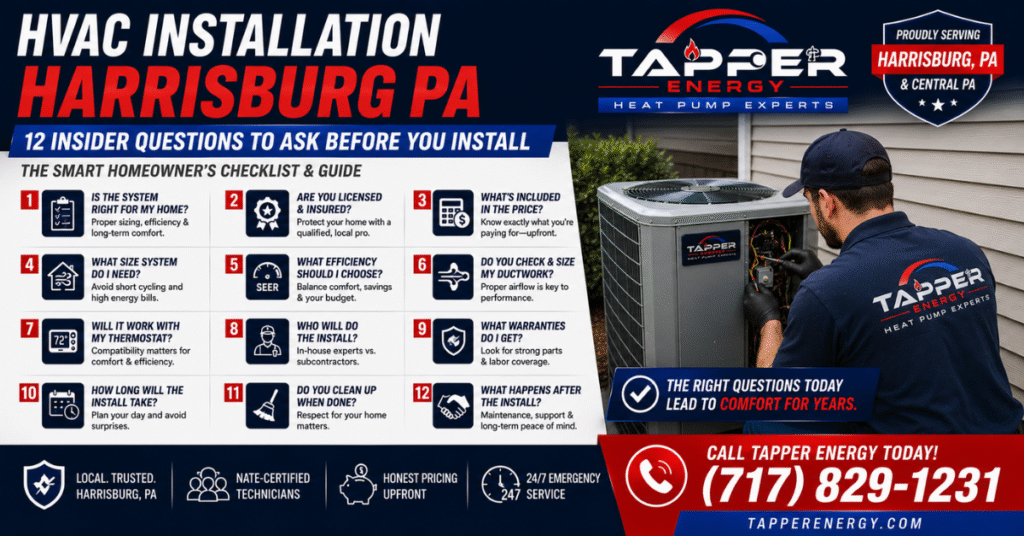
HVAC installation Harrisburg PA homeowners face a brutal reality: you’re spending $5,000–$15,000 on equipment you’ll live with for 15–20 years, and most contractors count on you not knowing the right questions to ask. One vague quote, one skipped permit, one oversized unit — and you’re $3,000+ into a system that underperforms from day one. This guide gives you 12 specific questions that separate honest HVAC installers from contractors who profit from your confusion. Ask all 12. Get the answers in writing. Ready to get started? Get a free HVAC installation Harrisburg PA quote from Tapper Energy → — or call (717) 829-1231. Table of Contents Why the Right Questions Save You Thousands on HVAC Installation Most Harrisburg homeowners get two or three quotes and pick the middle price. That’s the wrong strategy. HVAC installation Harrisburg PA pricing swings $3,000–$5,000 between contractors bidding the same job — because one quote includes permits, a proper Manual J load calculation, and a quality disconnect, while another doesn’t mention any of it. Asking the right questions before you sign forces every contractor to compete on the same terms. It also reveals the honest ones — because contractors who do it right will welcome every single question. How Bad Quotes Cost Harrisburg Homeowners $3,000+ Here’s precisely where the hidden money disappears: Oversized equipment from a skipped load calculation. An oversized AC unit short-cycles — it cools too fast without dehumidifying properly, straining the compressor and wearing it out 5 years ahead of schedule. Early replacement adds $2,000–$4,000. Permit fees quietly excluded. Dauphin County requires a mechanical permit for every HVAC installation in Harrisburg PA. When a contractor doesn’t include it, you pay $150–$400 out of pocket separately — or discover it was never pulled when you list your home for sale. Equipment-only pricing. A quote of $3,200 for a new AC sounds reasonable — until you discover it’s equipment only. Labor, refrigerant, pad, electrical disconnect, and line set add $1,800–$2,500. That “$3,200 quote” is now $5,700 before the install crew packs up. Subcontractor labor. The NATE-certified technician who gave you the estimate may not be the person doing your installation. Warranty callbacks with subcontracted work get complicated — fast. What Most Contractors Hope You Don’t Ask They hope you don’t ask about Manual J — sizing by rule of thumb is faster and most homeowners accept it. They hope you don’t ask about permits because pulling them adds paperwork. And they definitely hope you don’t ask for references from your ZIP code, because those are easy to verify. The 12 questions below change the entire dynamic. 12 Questions to Ask Before Any HVAC Installation in Harrisburg PA Run through every one of these before signing any HVAC installation Harrisburg PA contract. A reputable contractor answers all 12 without hesitation. 1. Did You Perform a Manual J Load Calculation? A Manual J is the ACCA-standard engineering protocol that sizes your heating and cooling equipment to your home’s exact square footage, insulation level, window orientation, ceiling height, air leakage rate, and local climate data. For HVAC installation in Harrisburg PA, this calculation matters: summer temperatures in the Harrisburg area regularly exceed 90°F with high humidity; winter lows drop to single digits. For every HVAC installation Harrisburg PA job, this calculation should be non-negotiable. A contractor who sizes by rule of thumb or by what the last system was is guessing. Require the Manual J before agreeing to any quote. Red flag answer: “I can tell by the square footage.” That is not a Manual J. 2. What SEER2 or AFUE Rating Is This Unit? As of January 2023, the federal minimum SEER2 for new central AC sold in the Northern U.S. region — which includes Pennsylvania — is 15.2. For gas furnaces, Pennsylvania’s minimum AFUE is 80%. But minimums aren’t your goal. SEER2 18+ units and AFUE 97%+ furnaces qualify for Pennsylvania utility rebates in 2026. According to the U.S. Department of Energy, each additional SEER2 rating point reduces cooling costs by approximately 5–8%. Ask for the exact model number so you can verify the efficiency rating independently before signing. 3. Is This Price Installed or Equipment-Only? This is the number one source of sticker shock on HVAC installation Harrisburg PA jobs. Always ask: “Is this the all-in installed price, or equipment only?” A complete installed quote covers equipment, refrigerant, refrigerant line set, electrical disconnect, concrete pad for the outdoor unit, thermostat, labor, permit fees, and old equipment haul-away. If any of these line items are missing from the written quote, ask what they’ll add to the final invoice. The right answer for a legitimate HVAC installation Harrisburg PA quote: “Yes, this is the all-in installed price — here’s each line item.” 4. What Does the Warranty Cover — Parts AND Labor? Most HVAC equipment carries a 10-year parts warranty. That covers parts — not labor. When a compressor fails in year 7, you still pay $400–$800 in labor to install the warranted part. Ask specifically: “Does your company offer a labor warranty on the installation itself?” Reputable Harrisburg-area contractors offer 1–2 year labor warranties. Some manufacturers (Carrier, Trane, Lennox) extend labor coverage when installed by a certified dealer — ask if that applies. 5. Will You Pull Permits for This Installation? In Harrisburg and throughout Dauphin County, HVAC installation requires a mechanical permit under the Pennsylvania Uniform Construction Code. A contractor who says permits aren’t needed is either cutting corners or simply wrong. Permits protect you in three critical ways: they ensure code-compliant installation via an inspector’s review, they protect your manufacturer warranty (most require permitted installation), and they prevent costly disclosure issues when you sell. Per Pennsylvania’s Uniform Construction Code requirements, HVAC replacements require permits in virtually all Pennsylvania municipalities. 6. Are Your Technicians W-2 Employees or Subcontractors? W-2 employees are vetted, trained, insured, and directly managed by the company. Subcontractors may be excellent — or they may be whoever was available that week. Ask directly: “Is the technician doing my installation a full-time
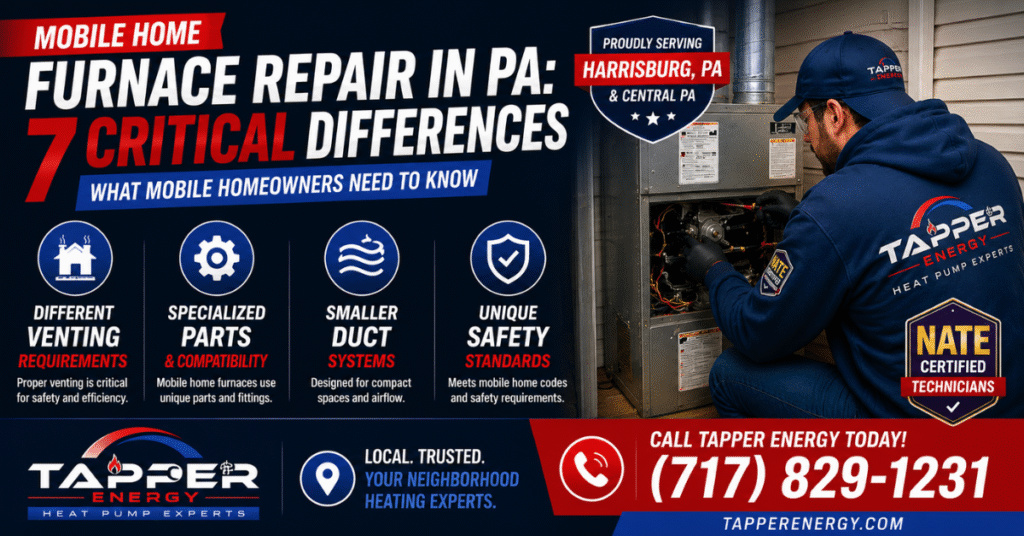
Mobile home furnace repair PA is not the same as standard residential furnace work — and calling the wrong technician can cost you hundreds of dollars or leave you without heat in the middle of a Central Pennsylvania winter. Manufactured and mobile homes fall under a completely separate federal code, use physically different equipment, and present unique installation challenges that most HVAC companies in the Harrisburg area are not trained or equipped to handle. This guide covers all 7 critical differences, the most common problems PA manufactured home owners face, realistic replacement costs for 2026, and the exact questions to ask before any technician shows up at your door. TL;DR: Need help now? Call Tapper Energy at (717) 829-1231 or request a free estimate. Table of Contents Why Mobile Home Furnaces Are Different from Standard Furnaces If you’ve called a standard HVAC company about mobile home furnace repair PA and been told “we don’t service those,” that response is actually correct — and it protects you. Mobile and manufactured homes fall under a completely separate regulatory framework, require different equipment, and present installation challenges that most residential HVAC technicians have never been trained to handle. Knowing why prevents expensive misdiagnoses. HUD Code vs. Residential Building Code Standard homes built on permanent foundations are governed by Pennsylvania’s Uniform Construction Code (UCC). Manufactured homes built after 1976 are regulated by the federal HUD Code — a U.S. Department of Housing and Urban Development standard that covers everything from insulation R-values to appliance certifications. Any furnace installed in a manufactured home must carry a HUD certification label. A standard AHRI-rated residential unit is not a legal substitute. Installing a non-certified unit can void your home’s warranty and create problems with insurance and resale. Review HUD’s manufactured housing standards for full regulatory context. This regulatory gap is one reason mobile home furnace repair PA requires a specialist who knows HUD Code, not just PA UCC standards. Why Most HVAC Companies Won’t Service Mobile Homes Beyond regulatory issues, mobile home HVAC systems use equipment with different physical dimensions, airflow configurations, and electrical specs than site-built homes. A technician trained only on residential systems may not recognize a crossover duct, a downflow burner assembly, or a HUD-certified heat exchanger. The result: wrong diagnosis, non-compliant installs, and real safety hazards — including carbon monoxide risk from improper combustion setups. When it comes to mobile home furnace repair PA, experience with HUD-code equipment isn’t optional; it’s the difference between a $385 repair and a $2,400 unnecessary replacement. 7 Critical Differences in Mobile Home Furnace Repair Understanding these distinctions lets you quickly verify whether the technician you’re hiring actually knows mobile home furnace repair PA — or is about to learn on your dime. 1. Sizing Requirements (Compact Units Only) Mobile home furnaces are physically smaller. Manufactured homes use narrow-body units — typically 14 inches wide — built for tight utility closets or undercounter spaces. Standard residential furnaces run 17.5–21 inches wide and will not fit. BTU capacity is also scaled differently: single-wide manufactured homes typically need 40,000–60,000 BTU furnaces; double-wides may require up to 80,000 BTU. Ordering the wrong unit means a wasted trip and a return fee. Matching these exact specs is the starting point of any mobile home furnace repair PA job — the wrong unit simply will not fit. 2. Downdraft vs. Updraft Airflow Direction Most site-built homes use upflow or horizontal furnaces that push heated air up into supply ducts. Mobile homes typically use downflow (downdraft) configurations — the blower forces warm air downward into the crossover duct beneath the floor. A technician who only works with upflow systems may misread airflow faults or try to install an incompatible unit. Swapping airflow direction is a common mistake in mobile home furnace repair PA work done by technicians trained only on site-built homes. 3. Crossover Duct Configuration Instead of the rigid galvanized steel ductwork inside site-built walls, most manufactured homes distribute heat through a flexible crossover duct that runs beneath the belly board — the insulated underside of the home. This duct connects the furnace’s plenum to floor registers throughout the home. Crossover ducts degrade faster than rigid duct due to moisture, ground contact, and rodent damage — making crossover failure the leading cause of uneven heating in PA manufactured homes. Flex duct condition is always evaluated during a mobile home furnace repair PA inspection, since crushed or torn runs cause major heat loss. 4. Electrical Specifications and Wiring Mobile home furnaces are typically 120V units, often on lower amperage circuits than residential systems. Interior wiring must meet HUD electrical standards, which differ from the National Electrical Code applied in site-built construction. Installing a non-compliant unit or mishandling the wiring can create a fire risk. For federal electrical safety context, see the CPSC’s manufactured housing safety resources. Tapper Energy checks the electrical circuit on every mobile home furnace repair PA service call to confirm the system will run safely. 5. Combustion Air and Clearance Rules HUD-code furnaces must meet specific combustion air requirements. Many mobile home furnaces draw combustion air from the crawl space rather than from the living space — meaning clearances, duct sizing, and venting all follow HUD specs rather than PA residential code. Improper combustion setups create carbon monoxide risk. The CDC’s carbon monoxide safety guidance is essential reading for any manufactured home owner. Proper combustion air is a non-negotiable safety requirement — every mobile home furnace repair PA technician must verify this before lighting the unit. 6. HUD Certification and Code Compliance Every replacement furnace installed in a manufactured home must carry a HUD-compliance certification label from the manufacturer. This is not negotiable. When getting quotes for mobile home furnace repair or replacement in PA, ask every contractor for the HUD label number of the proposed unit. If they can’t provide it, that unit is not legal for your home. Tapper Energy documents HUD compliance on every mobile home furnace repair PA installation and provides homeowners with the certification paperwork.
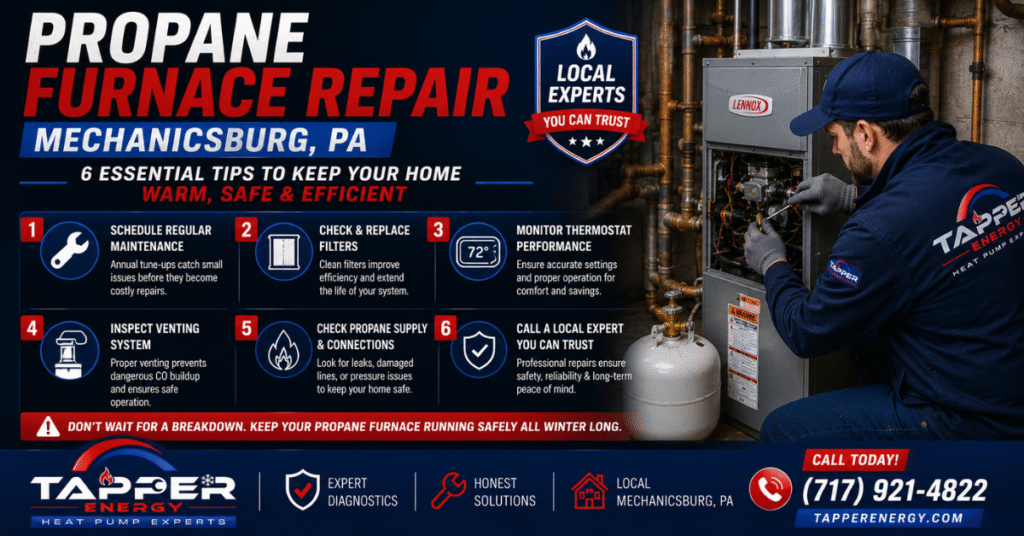
propane furnace repair Mechanicsburg PA becomes an urgent priority the moment temperatures drop below freezing and your heat stops working. Unlike natural gas systems tied to a municipal supply line, propane furnaces depend on a private on-site tank that can run dry, lose pressure, or develop line faults that a utility company would never have to manage. Central PA winters average 25 nights per year below 20°F — a failed propane furnace can drop an unheated home to dangerous temperatures within hours. This guide covers the six maintenance tasks that prevent the majority of emergency breakdowns, the most common propane furnace problems Tapper Energy technicians see across the Mechanicsburg area, and why bundling your fuel delivery and HVAC service under one provider is the smartest decision you can make before winter hits. Need service now? Call Tapper Energy at (717) 829-1231 or request a free estimate. Table of Contents Why Propane Furnaces Need Different Maintenance Than Gas or Oil Most generic HVAC guides lump propane furnaces in with natural gas systems. That’s a costly mistake for Mechanicsburg homeowners. Propane burns at a higher BTU content per cubic foot than natural gas, operates at different supply pressures, and stores fuel on-site in a private tank with no municipal backup. The maintenance failure points are genuinely different — and a technician who doesn’t specialize in propane systems will miss them. Nozzle and Burner Cleaning Differences Propane combustion leaves a different carbon residue profile than natural gas. Propane burners accumulate sooting faster, especially when a system short-cycles or operates at incorrect pressure. The burner nozzle on a propane furnace requires annual cleaning — not every two years like many natural gas systems. A clogged nozzle causes incomplete combustion, a yellow-tipping flame (a warning sign of elevated carbon monoxide output), and accelerated heat exchanger wear. Nozzle cleaning runs $35–$65 in parts; a cracked heat exchanger from neglect runs $800–$1,500. Propane-Specific Safety Considerations Propane is heavier than air. Unlike natural gas, which rises and dissipates toward ceiling vents, propane vapor sinks toward the floor — pooling near baseboards, under cabinets, and in low corners where a wall-mounted CO detector won’t detect it. The U.S. Department of Energy recommends treating propane line and regulator inspection as a safety priority, not just a performance check. Pennsylvania homeowners can also review propane safety requirements through the Pennsylvania Public Utility Commission. 6 Propane Furnace Maintenance Tips for Mechanicsburg PA Homeowners These six tasks address the most common failure points in propane heating systems. Skipping any one of them is how a $165 maintenance call turns into an emergency propane furnace repair Mechanicsburg PA at midnight in January. 1. Annual Nozzle and Burner Cleaning Schedule propane furnace repair and maintenance every September or October — before Central PA heating season begins. A Tapper Energy technician cleans the burner assembly, inspects the heat exchanger for cracks, verifies the flame color is clean blue (never orange or yellow), and measures combustion efficiency with an analyzer. This single service prevents the majority of propane furnace repair Mechanicsburg PA emergency calls each winter. 2. Fuel Filter Replacement Schedule The inline fuel filter traps sediment and moisture before they reach your burner. Replace it every 1–2 years, or immediately if you notice pressure fluctuations or delayed ignition on startup. A clogged filter costs $15–$40 in parts — and is frequently misdiagnosed as a burner problem by technicians who lack propane system experience. 3. Tank-to-Furnace Line Inspection The copper or steel supply line running from your tank to your furnace should be visually inspected every season. Look for corrosion at fittings, cracks near soil contact points, and sections passing through unheated spaces where freezing temperatures can stress the line. Never attempt to repair a propane gas line yourself — always call a licensed technician for propane furnace repair Mechanicsburg PA when line issues are suspected. 4. Propane Pressure Regulator Testing Your tank’s two-stage regulator reduces storage pressure (100–200 PSI) down to the 11 inches of water column your furnace needs to operate correctly. A failing regulator causes low heat output, erratic flame behavior, or a furnace that won’t stay lit. Regulator replacement costs $75–$150 installed and should happen every 10–15 years, or immediately when pressure symptoms appear. 5. Carbon Monoxide Detector Placement for Propane Homes CO detectors in propane homes must be placed low — within 12 inches of the floor — in addition to standard mid-wall placement. Propane sinks rather than rising, and a floor-level detector catches fuel leaks that wall-mounted units miss entirely. The CDC recommends CO detectors in every room where people sleep, tested monthly, and replaced every 5–7 years. 6. Winter Fuel Delivery Scheduling to Prevent Run-Outs Running out of propane mid-winter is the most common and most preventable propane furnace repair Mechanicsburg PA emergency. Schedule delivery before your tank drops below 20% — not 10%. During hard freezes, Central PA delivery times can stretch 24–72 hours as demand spikes across the region. Tapper Energy handles both fuel delivery coordination and HVAC service, so you never manage two separate vendor relationships. Learn more about HVAC and propane service in the Newport PA area. Propane Furnace Maintenance Quick Reference Task Frequency DIY or Pro Estimated Cost Nozzle & burner cleaning Annual Pro only $120–$180 Fuel filter replacement Every 1–2 years DIY or Pro $15–$40 (parts) Tank-to-furnace line inspection Annual Pro only Included in tune-up Pressure regulator testing Every 10–15 years Pro only $75–$150 installed CO detector test & replacement Monthly / every 5–7 yrs DIY $20–$60 per detector Fuel delivery scheduling Before tank hits 20% DIY (scheduling) Varies by plan 🎥 Recommended video: Search YouTube for “propane furnace maintenance tips before winter Pennsylvania” for a helpful visual walkthrough. Common Propane Furnace Problems in Central PA Even well-maintained propane furnaces develop predictable failure patterns. Here are the three issues that generate the most propane furnace repair Mechanicsburg PA service calls to Tapper Energy each heating season. Pilot Light Won’t Stay Lit A pilot that relights but won’t hold usually points to a dirty