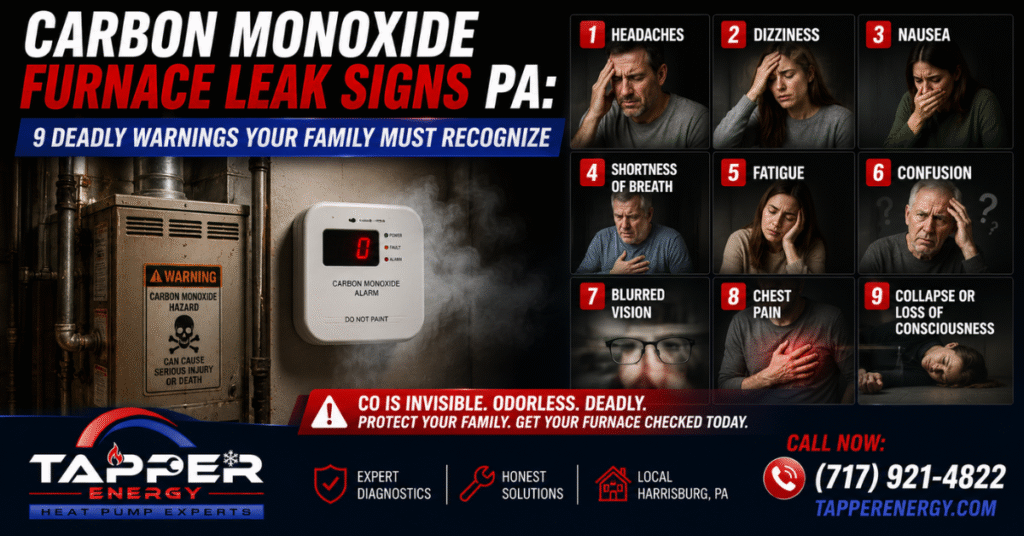
Carbon Monoxide Furnace Leak Signs PA: 9 Deadly Warnings Your Family Must Recognize
Carbon monoxide furnace leak signs PA homeowners can spot early may be the difference between a safe winter and a life-threatening emergency. Carbon monoxide — CO — is colorless, odorless, and produced by every gas-burning furnace. It cannot be smelled or seen, which is what makes it so dangerous. Every heating season in Pennsylvania, families are hospitalized because they missed the warning signs their furnace was giving them. This guide covers all 9 carbon monoxide furnace leak signs PA families need to recognize, what causes CO to escape from a furnace, exactly what to do if you suspect a leak, and how to prevent it entirely with an annual inspection. Need an inspection now? Call Tapper Energy at (717) 829-1231 or request a free furnace safety estimate. What Causes Carbon Monoxide Leaks from Furnaces? Gas furnaces produce carbon monoxide as a normal byproduct of combustion. In a properly functioning system, that CO is channeled through flue pipes and vented outside. When any part of that process fails — even a small crack or blockage — CO can enter your living space in dangerous concentrations. Understanding these causes helps you recognize why the carbon monoxide furnace leak signs PA residents see are often tied to a specific mechanical failure. Cracked Heat Exchangers The heat exchanger is a metal chamber inside your furnace that separates combustion gases (including CO) from the air circulating through your home. Over time — typically after 15–20 years — thermal stress, age, or restricted airflow causes the metal to crack. When it does, combustion gases flow directly into your duct system and into every room of your house. Replacing a cracked heat exchanger costs $500–$1,500 depending on the furnace model and part availability. On older units (15+ years), full furnace replacement is often more economical. Our emergency furnace repair team can evaluate which path makes sense for your home. Blocked Flue Pipes or Venting Flue pipes carry combustion gases from the furnace to the outside. Bird nests, ice buildup, debris, or corrosion can completely block these pathways — causing back-drafting, where CO reverses course and enters the home instead of venting out. This is especially common in Pennsylvania winters when outdoor vent terminations can seal with ice after a freeze-thaw cycle. Incomplete Combustion from Poor Maintenance A furnace that hasn’t been serviced in 12–18 months may have a dirty burner, restricted air filter, or a failing flame sensor — all of which cause incomplete combustion. Fuel that doesn’t burn completely produces dramatically higher CO concentrations. This is why annual HVAC maintenance is a furnace safety issue, not just a comfort issue. 9 Warning Signs of a Carbon Monoxide Leak from Your Furnace Because CO has no color or odor, your furnace itself and your family’s physical symptoms are often the only early indicators. These are the carbon monoxide furnace leak signs PA homeowners should check every heating season. 1. Yellow or Orange Burner Flame (Should Be Blue) Open your furnace’s access panel and observe the burner flame. A properly functioning gas furnace produces a crisp, steady blue flame. A yellow, orange, or flickering flame means incomplete combustion is occurring — your furnace is producing excess CO with each burn cycle. This is one of the most reliable carbon monoxide furnace leak signs PA homeowners can verify themselves in under 60 seconds. 2. Soot or Black Marks Around the Furnace Soot streaks — black or brown residue — around the furnace housing, burner compartment, or flue pipe joints indicate combustion gases are escaping where they should not. If you see fresh soot marks near registers, vents, or the furnace cabinet, treat it as a CO warning. 3. Excessive Moisture on Windows Near the Furnace Condensation forming on windows in rooms near your furnace can indicate that combustion byproducts — water vapor, CO, and other gases — are entering your living space instead of venting outside. In tightly sealed Central PA homes, this moisture buildup is more pronounced and easier to spot. 4. Family Members Experiencing Headaches, Nausea, or Dizziness CO poisoning symptoms closely mimic the flu — but without fever. If multiple household members experience headaches, nausea, dizziness, confusion, or fatigue that improve when they leave the house, treat it as a CO emergency immediately. Pets are often affected first. The CDC notes that CO is responsible for more than 100,000 emergency room visits in the U.S. each year, with a disproportionate number occurring during winter heating season. 5. Stale, Stuffy Air Despite Ventilation A home that feels unusually stuffy or where the air quality seems “off” — even with windows cracked — may be experiencing back-drafting from the furnace. Combustion gases entering the living space instead of venting outside is one of the subtler carbon monoxide furnace leak signs PA residents frequently overlook or attribute to other causes. 6. No Updraft in Chimney or Flue Your furnace flue should create an upward draft that pulls combustion gases out. You can test this by holding a lit match or incense stick near the flue cleanout — smoke should be drawn inward toward the flue. If smoke drifts back into the room or hangs in place, venting has failed and CO may already be accumulating. 7. Rust on Flue Pipes or Vent Connectors Rust, corrosion, or moisture stains on flue pipe joints or vent connectors indicate that condensation from combustion gases is collecting at seams — a sign CO may be escaping before reaching the outdoor vent termination. Pay special attention to rust at elbow joints and where the flue connects to the furnace draft hood. 8. Furnace Cycling On and Off Frequently Short cycling — where the furnace starts, runs for a brief period, and shuts off before completing a full heating cycle — is often caused by a cracked heat exchanger or blocked flue, the same failures that produce CO leaks. If your furnace is short cycling, schedule an emergency furnace inspection without delay. 9. Visible Cracks on the Heat Exchanger During a visual inspection, any