Mobile home furnace repair PA is not the same as standard residential furnace work — and calling the wrong technician can cost you hundreds of dollars or leave you without heat in the middle of a Central Pennsylvania winter. Manufactured and mobile homes fall under a completely separate federal code, use physically different equipment, and present unique installation challenges that most HVAC companies in the Harrisburg area are not trained or equipped to handle. This guide covers all 7 critical differences, the most common problems PA manufactured home owners face, realistic replacement costs for 2026, and the exact questions to ask before any technician shows up at your door.
TL;DR:
- Mobile home furnaces operate under HUD codes — not standard PA residential building codes. Most HVAC companies legally should not install them.
- Crossover duct failure is the #1 cause of uneven heating in PA manufactured homes and typically costs $150–$450 to repair.
- Mobile home furnace replacement in Pennsylvania runs $1,800–$4,200 installed depending on fuel type and BTU capacity.
Need help now? Call Tapper Energy at (717) 829-1231 or request a free estimate.
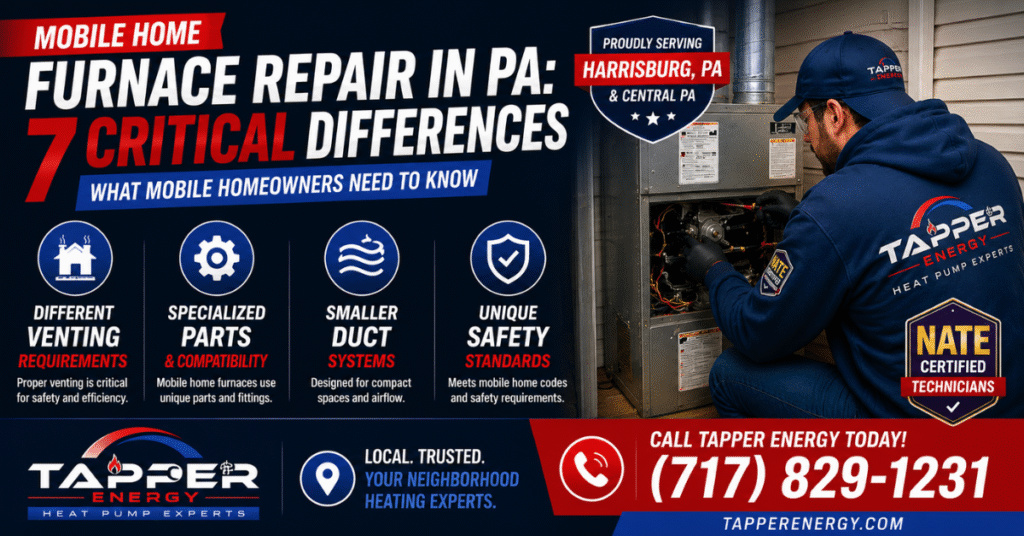
Table of Contents
- Why Mobile Home Furnaces Are Different
- 7 Critical Differences in Mobile Home Furnace Repair
- Common Mobile Home Furnace Problems in Central PA
- Mobile Home Furnace Replacement Cost in Pennsylvania
- Questions to Ask Before Hiring a Technician
- FAQ: Mobile Home Furnace Repair PA
- Call Tapper Energy
Why Mobile Home Furnaces Are Different from Standard Furnaces
If you’ve called a standard HVAC company about mobile home furnace repair PA and been told “we don’t service those,” that response is actually correct — and it protects you. Mobile and manufactured homes fall under a completely separate regulatory framework, require different equipment, and present installation challenges that most residential HVAC technicians have never been trained to handle. Knowing why prevents expensive misdiagnoses.
HUD Code vs. Residential Building Code
Standard homes built on permanent foundations are governed by Pennsylvania’s Uniform Construction Code (UCC). Manufactured homes built after 1976 are regulated by the federal HUD Code — a U.S. Department of Housing and Urban Development standard that covers everything from insulation R-values to appliance certifications. Any furnace installed in a manufactured home must carry a HUD certification label. A standard AHRI-rated residential unit is not a legal substitute. Installing a non-certified unit can void your home’s warranty and create problems with insurance and resale. Review HUD’s manufactured housing standards for full regulatory context. This regulatory gap is one reason mobile home furnace repair PA requires a specialist who knows HUD Code, not just PA UCC standards.
Why Most HVAC Companies Won’t Service Mobile Homes
Beyond regulatory issues, mobile home HVAC systems use equipment with different physical dimensions, airflow configurations, and electrical specs than site-built homes. A technician trained only on residential systems may not recognize a crossover duct, a downflow burner assembly, or a HUD-certified heat exchanger. The result: wrong diagnosis, non-compliant installs, and real safety hazards — including carbon monoxide risk from improper combustion setups. When it comes to mobile home furnace repair PA, experience with HUD-code equipment isn’t optional; it’s the difference between a $385 repair and a $2,400 unnecessary replacement.
7 Critical Differences in Mobile Home Furnace Repair
Understanding these distinctions lets you quickly verify whether the technician you’re hiring actually knows mobile home furnace repair PA — or is about to learn on your dime.
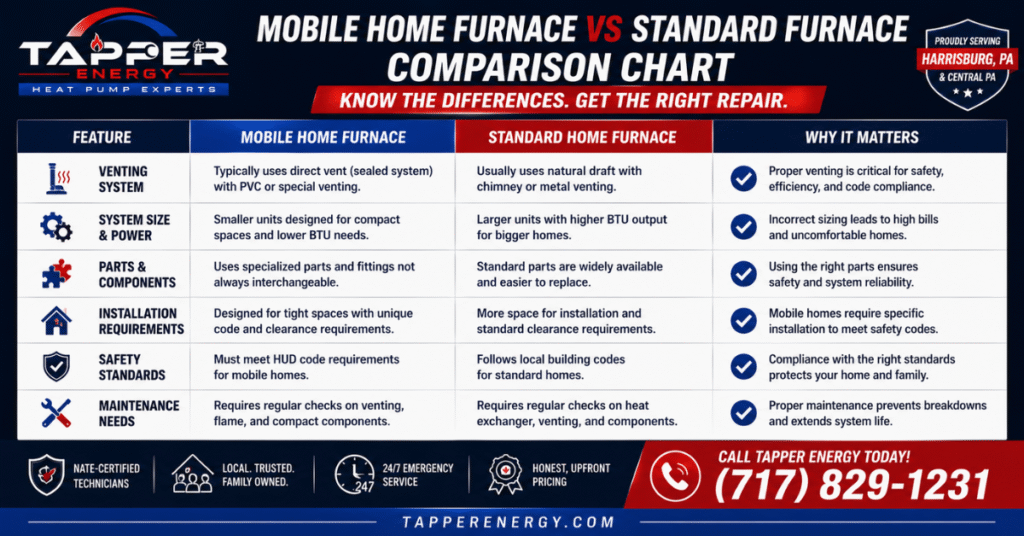
1. Sizing Requirements (Compact Units Only)
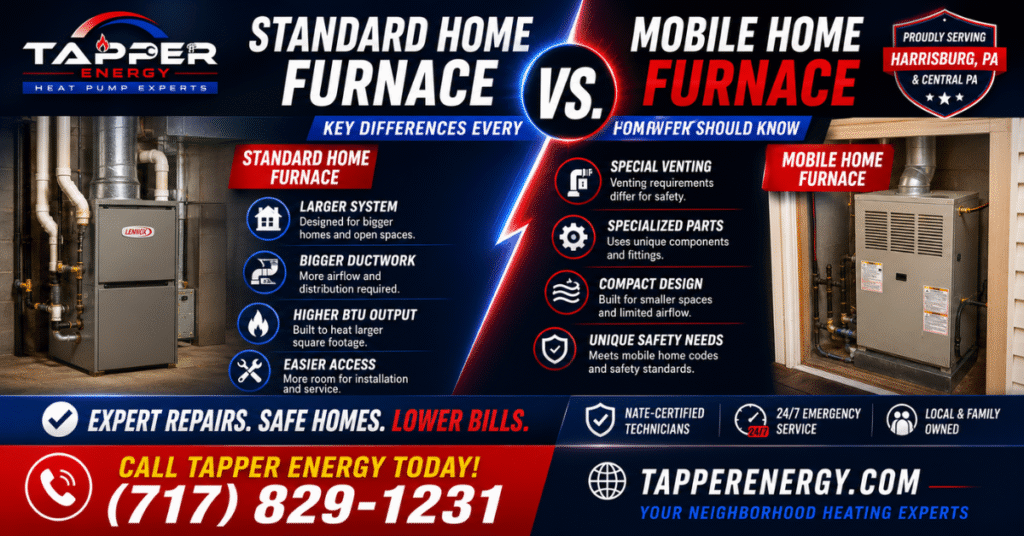
Mobile home furnaces are physically smaller. Manufactured homes use narrow-body units — typically 14 inches wide — built for tight utility closets or undercounter spaces. Standard residential furnaces run 17.5–21 inches wide and will not fit. BTU capacity is also scaled differently: single-wide manufactured homes typically need 40,000–60,000 BTU furnaces; double-wides may require up to 80,000 BTU. Ordering the wrong unit means a wasted trip and a return fee. Matching these exact specs is the starting point of any mobile home furnace repair PA job — the wrong unit simply will not fit.
2. Downdraft vs. Updraft Airflow Direction
Most site-built homes use upflow or horizontal furnaces that push heated air up into supply ducts. Mobile homes typically use downflow (downdraft) configurations — the blower forces warm air downward into the crossover duct beneath the floor. A technician who only works with upflow systems may misread airflow faults or try to install an incompatible unit. Swapping airflow direction is a common mistake in mobile home furnace repair PA work done by technicians trained only on site-built homes.
3. Crossover Duct Configuration
Instead of the rigid galvanized steel ductwork inside site-built walls, most manufactured homes distribute heat through a flexible crossover duct that runs beneath the belly board — the insulated underside of the home. This duct connects the furnace’s plenum to floor registers throughout the home. Crossover ducts degrade faster than rigid duct due to moisture, ground contact, and rodent damage — making crossover failure the leading cause of uneven heating in PA manufactured homes. Flex duct condition is always evaluated during a mobile home furnace repair PA inspection, since crushed or torn runs cause major heat loss.
4. Electrical Specifications and Wiring
Mobile home furnaces are typically 120V units, often on lower amperage circuits than residential systems. Interior wiring must meet HUD electrical standards, which differ from the National Electrical Code applied in site-built construction. Installing a non-compliant unit or mishandling the wiring can create a fire risk. For federal electrical safety context, see the CPSC’s manufactured housing safety resources. Tapper Energy checks the electrical circuit on every mobile home furnace repair PA service call to confirm the system will run safely.
5. Combustion Air and Clearance Rules
HUD-code furnaces must meet specific combustion air requirements. Many mobile home furnaces draw combustion air from the crawl space rather than from the living space — meaning clearances, duct sizing, and venting all follow HUD specs rather than PA residential code. Improper combustion setups create carbon monoxide risk. The CDC’s carbon monoxide safety guidance is essential reading for any manufactured home owner. Proper combustion air is a non-negotiable safety requirement — every mobile home furnace repair PA technician must verify this before lighting the unit.
6. HUD Certification and Code Compliance
Every replacement furnace installed in a manufactured home must carry a HUD-compliance certification label from the manufacturer. This is not negotiable. When getting quotes for mobile home furnace repair or replacement in PA, ask every contractor for the HUD label number of the proposed unit. If they can’t provide it, that unit is not legal for your home. Tapper Energy documents HUD compliance on every mobile home furnace repair PA installation and provides homeowners with the certification paperwork.
7. Warranty Considerations for Manufactured Homes
Manufactured home warranties — from the home builder and appliance manufacturers — typically specify that only HUD-certified components may be used. Installing a standard residential furnace, even if it physically fits, may void your system warranty and potentially your whole-home warranty. This is a risk most homeowners don’t learn about until it’s too late.
| Feature | Standard Home Furnace | Mobile Home Furnace |
|---|---|---|
| Width | 17.5–21 inches | 14 inches (narrow body) |
| Airflow Direction | Upflow, horizontal, or downflow | Typically downflow |
| Duct Type | Rigid galvanized steel | Flexible crossover duct (below floor) |
| Regulatory Code | PA Uniform Construction Code (UCC) | HUD Federal Manufactured Housing Code |
| Certification Required | AHRI rating | HUD compliance label |
| Typical BTU Range | 40,000–120,000 | 30,000–80,000 |
| Combustion Air Source | Indoor or direct vent | Often draws from crawl space |
Common Mobile Home Furnace Problems in Central PA
Manufactured home owners across Perry, Dauphin, and Northumberland counties face the same recurring heating failures. If you’re searching for mobile home furnace repair PA, one of these three issues is almost certainly why.
Crossover Duct Deterioration
The flexible duct beneath your home’s floor is the most vulnerable component in any manufactured home heating system. Ground moisture, freeze-thaw cycles, and rodent gnawing attack the mylar and fiberglass construction over time. When the crossover fails, warm air dumps into the crawl space instead of reaching your floor registers — you’ll feel 72°F in one room and 56°F in the next. Repair cost: $150–$450 depending on duct length and crawl space access. This is the first thing any qualified mobile home furnace technician in PA should inspect. Flex duct issues are among the most common findings during a mobile home furnace repair PA diagnostic visit.
Tapper Energy serves manufactured home communities in Newport, Duncannon, Halifax, and Millersburg — areas with large manufactured housing populations in Perry and Northumberland County. Tapper Energy provides mobile home furnace repair PA service across Perry, Dauphin, and Northumberland counties with same-day availability.
Thermostat Compatibility Issues
Many manufactured homes use 2-wire thermostat wiring that is incompatible with modern smart thermostats — Nest, Ecobee, and most Wi-Fi models — without an add-a-wire adapter. A technician unfamiliar with mobile home HVAC systems in PA may install the wrong thermostat, causing the furnace to short-cycle or fail entirely. Before purchasing any smart thermostat for a manufactured home, have your wiring inspected by a specialist.
Draft and Insulation Problems
Manufactured homes built before 1990 typically carry lower insulation R-values than current HUD standards require. Combined with single-pane windows and belly board gaps from shifting, these homes lose heat faster than the furnace can replace it — especially in Central PA winters when overnight temperatures drop below 20°F. Sealing skirting gaps and insulating the belly board can reduce heating demand by 15–25%, according to energy.gov weatherization data. Before spending money on a new furnace, rule out insulation problems first.
Not sure whether you need repair or replacement? See our full guide →
Not sure what’s wrong? Request a free diagnosis from a mobile home furnace specialist →
Mobile Home Furnace Replacement Cost in Pennsylvania
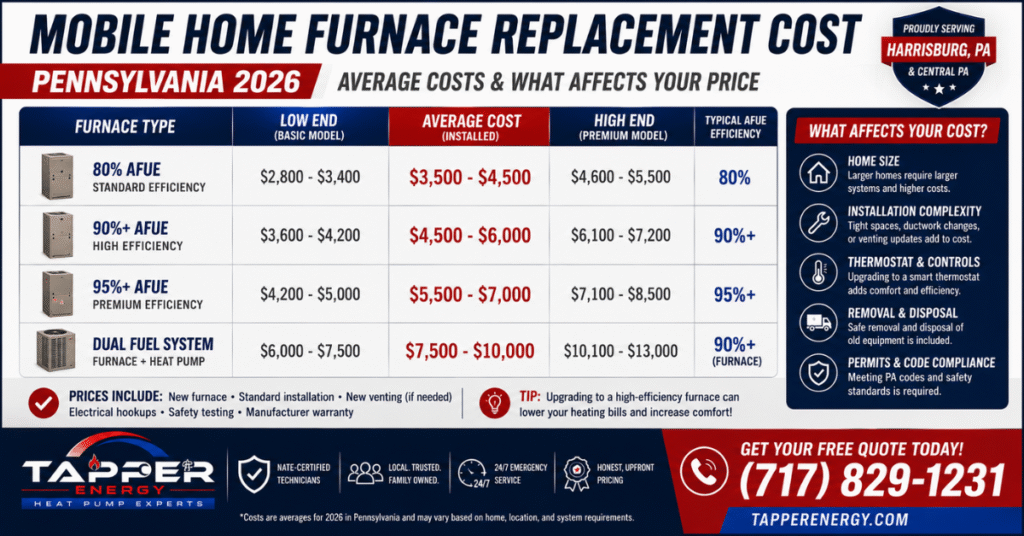
The table below shows realistic 2026 installed costs for mobile home furnace replacement in PA. Propane units are common in rural Perry and Dauphin County areas where natural gas lines don’t reach. For a deeper look at propane heating systems, visit our furnace repair page. These are the realistic 2026 installed prices homeowners across PA should expect when requesting a mobile home furnace repair PA estimate.
| Furnace Type | Cost Range (Installed) | Installation Time | Typical Lifespan |
|---|---|---|---|
| Natural Gas (HUD-certified) | $1,800–$2,800 | 4–6 hours | 15–20 years |
| Propane LP (HUD-certified) | $2,000–$3,200 | 4–6 hours | 15–20 years |
| Electric (mobile home rated) | $1,400–$2,200 | 3–5 hours | 20–25 years |
| Heat Pump + Air Handler (manufactured home) | $3,200–$4,200 | 6–8 hours | 15–20 years |
Costs include equipment and standard labor. Emergency dispatch, crossover duct replacement, or electrical panel work may add $200–$600. Propane prices in Central PA vary — confirm rates with your supplier.
Pennsylvania homeowners may qualify for heating assistance or efficiency rebates through LIHEAP (pa.gov) and the ENERGY STAR rebate finder. Check before you replace — the savings can be significant. PA homeowners can often reduce the out-of-pocket cost of mobile home furnace repair PA through LIHEAP or ENERGY STAR rebate programs.
Questions to Ask Before Hiring a Mobile Home HVAC Technician
The fastest way to screen out unqualified contractors before scheduling mobile home furnace repair PA:
- “Are you familiar with HUD-code manufactured home furnaces?” — A vague answer means no.
- “Will the replacement unit carry a HUD compliance certification label?” — Required by law for any installed unit.
- “Do you inspect the crossover duct as part of a furnace diagnosis?” — Standard procedure for specialists; if they skip it, find someone else.
- “Do you service downflow furnace configurations?” — Many contractors only know upflow.
- “Are you licensed in Pennsylvania for HVAC work?” — PA requires HVAC contractors to hold a Home Improvement Contractor (HIC) registration; verify at the PA Attorney General’s consumer portal.
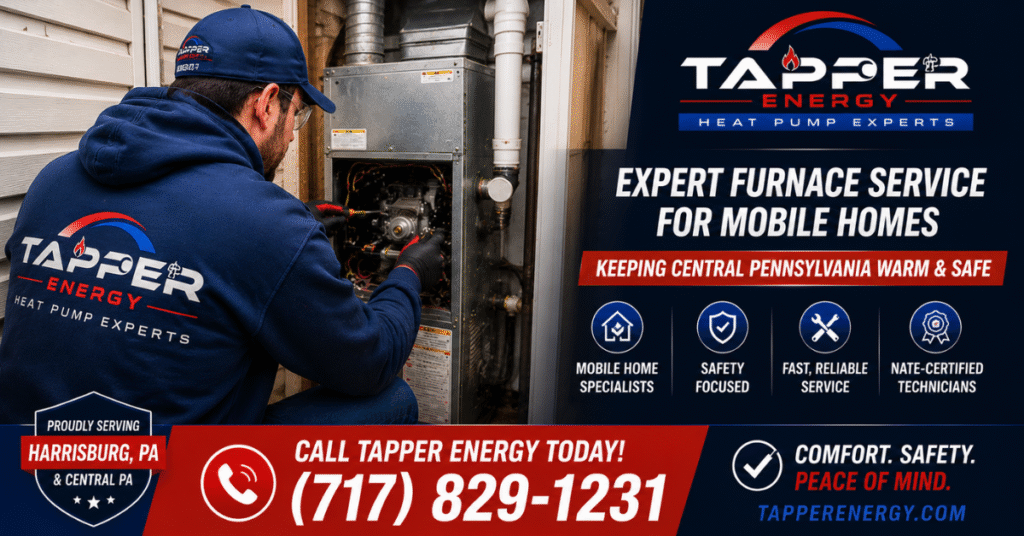
Tapper Energy’s NATE-certified technicians are specifically trained in mobile home furnace repair throughout PA and carry HUD-certified replacement equipment. We cover manufactured home communities in Newport, Duncannon, Halifax, Millersburg, and all of Greater Harrisburg. Scheduling annual tune-ups is the most cost-effective way to reduce emergency mobile home furnace repair PA calls during winter.
Case Study: Double-Wide in Newport, PA — $385 Repair vs. $2,400 Replacement Quote
Problem: A Newport homeowner contacted Tapper Energy after two other HVAC companies refused to service her double-wide manufactured home. One bedroom measured 72°F; the adjacent room was 56°F. A previous contractor had installed a smart thermostat incompatible with her 2-wire wiring, causing the furnace to short-cycle for months. She had been quoted $2,400 for a full furnace replacement.
Solution: Our technician performed a crossover duct inspection immediately — finding an 18-foot section of collapsed flexible duct in the belly board beneath the colder bedroom. We replaced the damaged duct section, installed a 2-wire compatible programmable thermostat, and cleaned the flame sensor that had been triggering the safety shutoff due to short-cycling stress.
Result: Both rooms stabilized within 90 minutes. The total bill: $385. The homeowner saved $2,015 compared to the unnecessary replacement quote. She’s now on our annual mobile home HVAC maintenance plan in PA and hasn’t had a heating issue since.
For urgent heating failures, see our emergency furnace repair service → and our emergency services in Duncannon →
FAQ: Mobile Home Furnace Repair PA — What Central PA Owners Ask
Can a standard residential furnace be installed in a mobile home in Pennsylvania?
No. Federal HUD standards require that any furnace installed in a manufactured home carry a HUD compliance certification. Standard residential furnaces are also physically wider (17.5+ inches versus the 14-inch maximum for mobile home units). Installing a non-certified unit voids your warranty and may violate your homeowner’s insurance policy.
How much does mobile home furnace repair PA typically cost?
Most mobile home furnace repair jobs in PA run $150–$600 for common issues — crossover duct repairs, thermostat replacement, flame sensor cleaning, or igniter replacement. Full furnace replacement in a Pennsylvania manufactured home costs $1,800–$4,200 installed, depending on fuel type. Always get a written estimate before any work begins.
Why is my manufactured home heating unevenly in winter?
Uneven heating in a Pennsylvania manufactured home is almost always a crossover duct problem. The flexible duct beneath your floor can tear, disconnect, or collapse — forcing warm air into the crawl space instead of your rooms. A qualified technician can diagnose this in under an hour. Don’t let a contractor replace your furnace before inspecting the crossover.
Do most HVAC companies in Central PA service mobile homes?
No. The majority of HVAC contractors in Harrisburg, Mechanicsburg, and surrounding areas are trained exclusively on site-built residential systems and do not stock HUD-certified equipment. When scheduling mobile home furnace repair PA, always confirm the company has specific manufactured home experience before booking.
How long do mobile home furnaces last in Pennsylvania?
A properly maintained manufactured home furnace in PA typically lasts 15–20 years for gas and propane units, and up to 25 years for electric models. Annual maintenance — including flame sensor cleaning, crossover duct inspection, and heat exchanger check — can add 3–5 years to service life. See our HVAC maintenance checklist for what to inspect each fall.
Can I use a Nest or smart thermostat in my manufactured home?
Many manufactured homes use 2-wire thermostat wiring that is incompatible with Nest, Ecobee, and most Wi-Fi thermostats without an add-a-wire adapter. Before purchasing a smart thermostat for a mobile home heating system in PA, have a technician verify your wiring. Some Honeywell T6 and Emerson models support 2-wire configurations without an adapter.
Ready to Fix Your Mobile Home Furnace? Call Tapper Energy
Mobile home furnace repair PA requires a technician who knows HUD codes, downflow configurations, crossover ducts, and HUD-certified replacement equipment — not just a residential HVAC license. The wrong technician means non-compliant installs, missed diagnoses, and bills that are 4–6 times higher than necessary.
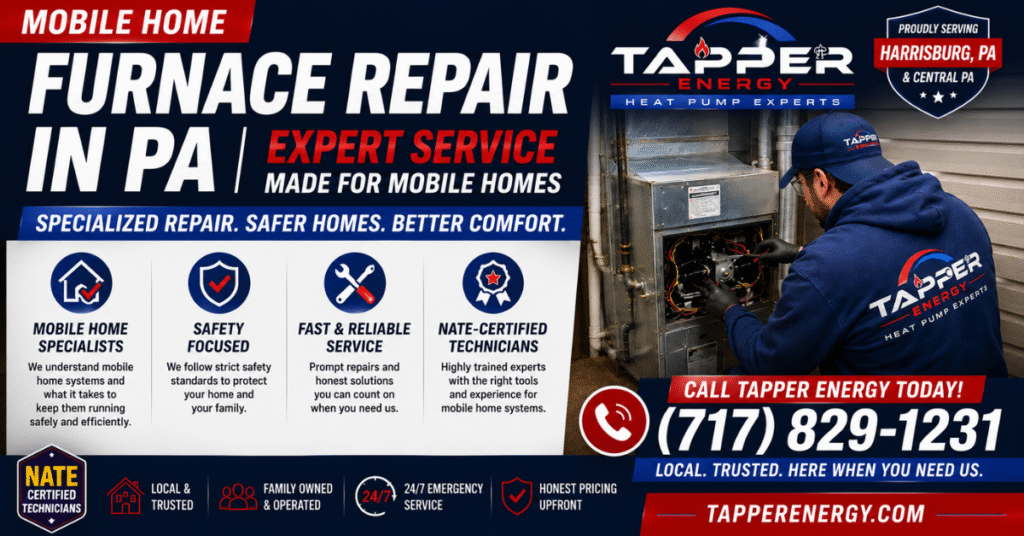
Tapper Energy specializes in mobile home furnace repair across Central PA, serving manufactured home communities in Newport, Duncannon, Halifax, Millersburg, and Greater Harrisburg with honest diagnostics and upfront pricing before any work begins.
Book your mobile home furnace service with Tapper Energy — free estimates on replacements →
Or call (717) 829-1231 anytime.
About the Author
Written by the Tapper Energy HVAC team. Our NATE-certified technicians have diagnosed and repaired thousands of furnaces, heat pumps, and manufactured home HVAC systems across the Harrisburg and Mechanicsburg area, specializing in fast, honest, no-upsell mobile home furnace repair throughout Central PA.