The propane vs electric heat pump PA decision comes down to two numbers: what you pay for a gallon of propane and what you pay for a kilowatt-hour of electricity. At late-November 2026 prices, an electric heat pump usually costs less to run over a Central PA winter. A propane furnace still earns its place as backup on the coldest nights, especially in a dual fuel setup.
Tapper Energy delivers propane and installs heat pumps, so we have no reason to push one fuel over the other. Here is the honest propane vs electric heat pump PA math for Harrisburg, Mechanicsburg, and the rest of Central PA.
TL;DR
- Today’s prices: Pennsylvania residential propane averaged $3.30 a gallon in the week of November 23, 2026 (EIA), and PPL’s residential supply rate rises to about 14.43 cents per kWh on December 1, 2026, roughly 20 cents all-in.
- Running cost: at those prices, a heat pump delivers heat for about $20 to $24 per million BTU, compared with about $38 for a 95% efficient propane furnace.
- Best of both: dual fuel runs the heat pump most of the winter and switches to propane on the coldest nights, which avoids electric backup strips that cost about $59 per million BTU.
Weighing a new system? Call Tapper Energy at (717) 921-4822 or request a free estimate online.
Table of Contents
- How Each System Heats Your Home
- Annual Heating Cost Comparison
- The Break-Even Electricity Rate
- 7 Facts That Decide the Winner
- Dual Fuel: Heat Pump Plus Propane Furnace
- Propane vs Electric Heat Pump PA FAQ
- Get a Free Comparison
Propane vs Electric Heat Pump PA: How Does Each One Heat Your Home?
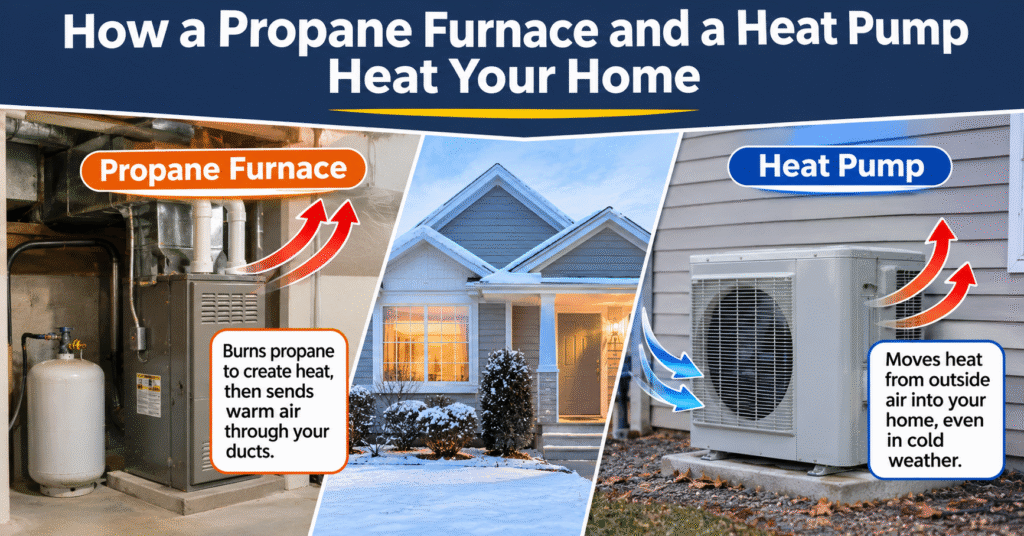
A propane furnace burns fuel to make heat. A blower then pushes that heat through your ducts. Efficiency is measured as AFUE: an older 80% furnace turns 80 cents of every fuel dollar into heat, while a high-efficiency condensing model reaches 95% or more.
An electric heat pump does not make heat. It moves heat from the outdoor air into your home, even when it feels cold outside. Because moving heat takes less energy than creating it, a heat pump often delivers 2 to 3 units of heat for every unit of electricity it uses. That ratio is called the coefficient of performance (COP), and it drives every propane vs electric heat pump PA comparison.
The catch is temperature. As the outdoor air gets colder, a heat pump has less heat to collect, so its COP and output drop. To earn the ENERGY STAR cold climate designation, a heat pump must still reach a COP of at least 1.75 at 5°F.
Propane vs Electric Heat Pump PA: What Does Each Cost to Run Per Winter?
To run a fair propane vs electric heat pump PA comparison, we price the same amount of delivered heat. Our example is an 1,800 square foot Central PA home that needs about 52 million BTU of heat per year. That equals roughly 600 gallons of propane in a 95% furnace.
That is in line with the U.S. Energy Information Administration’s forecast that a propane-heated Northeast home will use about 515 gallons from November through March this winter. The prices below use EIA’s Pennsylvania propane price of $3.30 a gallon and an all-in electric rate of about 20 cents per kWh.
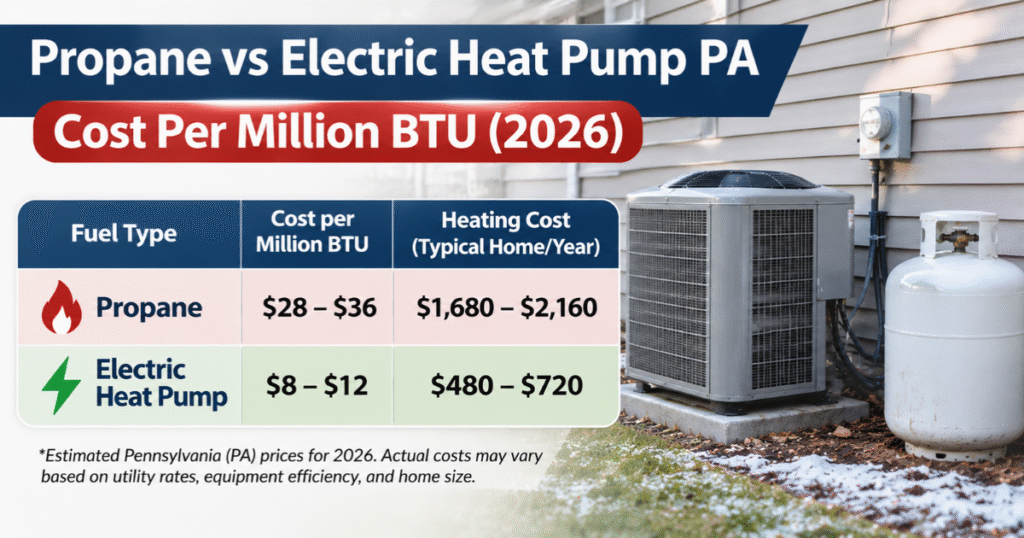
| System | Fuel Price | Efficiency | Cost Per Million BTU | Annual Cost (Example Home) |
|---|---|---|---|---|
| Propane furnace, older | $3.30 per gallon | 80% AFUE | $45 | About $2,350 (712 gallons) |
| Propane furnace, high efficiency | $3.30 per gallon | 95% AFUE | $38 | About $1,980 (600 gallons) |
| Standard heat pump | 20 cents per kWh | Seasonal COP 2.5 | $23 | About $1,220 (6,114 kWh) |
| Cold-climate heat pump | 20 cents per kWh | Seasonal COP 3.0 | $20 | About $1,020 (5,095 kWh) |
| Electric backup strips only | 20 cents per kWh | COP 1.0 | $59 | About $3,060 (15,286 kWh) |
These propane vs electric heat pump PA figures are estimates, not a quote. Real bills depend on insulation, thermostat habits, the exact equipment, and how many hours the heat pump leans on backup heat. Propane prices exclude taxes and delivery fees vary by supplier.
The Break-Even Electricity Rate
The fastest way to settle the propane vs electric heat pump PA question for your own home is to find the electric rate where both cost the same. If your all-in rate is below the number in the table, the heat pump is cheaper to run.
| Propane Price Per Gallon | Heat Pump Wins Below (Season Average, COP 2.5) | Heat Pump Wins Below (5°F, COP 1.75) |
|---|---|---|
| $2.50 | 24.5 cents per kWh | 17.2 cents per kWh |
| $3.00 | 29.4 cents per kWh | 20.6 cents per kWh |
| $3.30 | 32.4 cents per kWh | 22.7 cents per kWh |
| $3.50 | 34.3 cents per kWh | 24.0 cents per kWh |
| $4.00 | 39.3 cents per kWh | 27.5 cents per kWh |
Compared against a 95% propane furnace. Use your own propane price and add your delivery charges to your supply rate to get your all-in cents per kWh.
Want your own propane vs electric heat pump PA numbers? Send us a recent propane receipt and electric bill, and we will run this comparison for your home. Call (717) 921-4822.
7 Facts That Decide Propane vs Electric Heat Pump PA
1. Upfront Installation Cost
Upfront cost is where propane leads the propane vs electric heat pump PA matchup. National 2026 data from Fixr puts propane furnace installation at $3,700 to $14,200, and HomeAdvisor lists a typical average near $4,500. A ducted heat pump typically runs $5,800 to $10,000, and a cold-climate model $8,000 to $13,000, as covered in our heat pump installation cost guide for Pennsylvania. Remember that a heat pump also replaces your central AC.
2. Cold-Weather Performance Below 20°F
A propane furnace puts out the same heat at 0°F as it does at 40°F. A heat pump loses capacity as it gets colder, and older models may need electric backup strips. Cold-climate models hold up far better, which is why sizing for your home’s design temperature matters.
3. Comfort at the Vents
Propane furnace air feels hotter and comes in strong bursts. A heat pump runs longer at a lower, steadier temperature. Some people love the even warmth, while others miss the blast of hot air.
4. Power Outages and Generators
Both systems need electricity. A propane furnace only needs power for its blower and controls, so a small generator can keep it running. A heat pump needs a much larger generator to run during an outage.
5. Rebates: Heat Pumps Qualify, Propane Furnaces Mostly Do Not
Rebates tilt the propane vs electric heat pump PA math toward the heat pump. Under PPL’s Act 129 program, running June 1, 2026 through May 31, 2031, an ENERGY STAR air-source heat pump earns up to a $325 rebate, or $350 to $475 for income-qualified households. The federal 25C heat pump tax credit ended December 31, 2025, and Pennsylvania’s Penn Energy Savers rebates were still awaiting final federal approval as of September 2026.
6. Maintenance and Lifespan
Both need a yearly tune-up. A heat pump heats in winter and cools in summer, so it runs more hours than a furnace and tends to wear out sooner. A propane furnace also needs its venting and burners checked for safety every year.
7. Tank Ownership vs Leasing
With a leased propane tank, you usually must buy from the company that owns it. Owning your tank lets you shop for price. Either way, reliable propane delivery in Harrisburg and Mechanicsburg keeps a propane furnace running all winter.
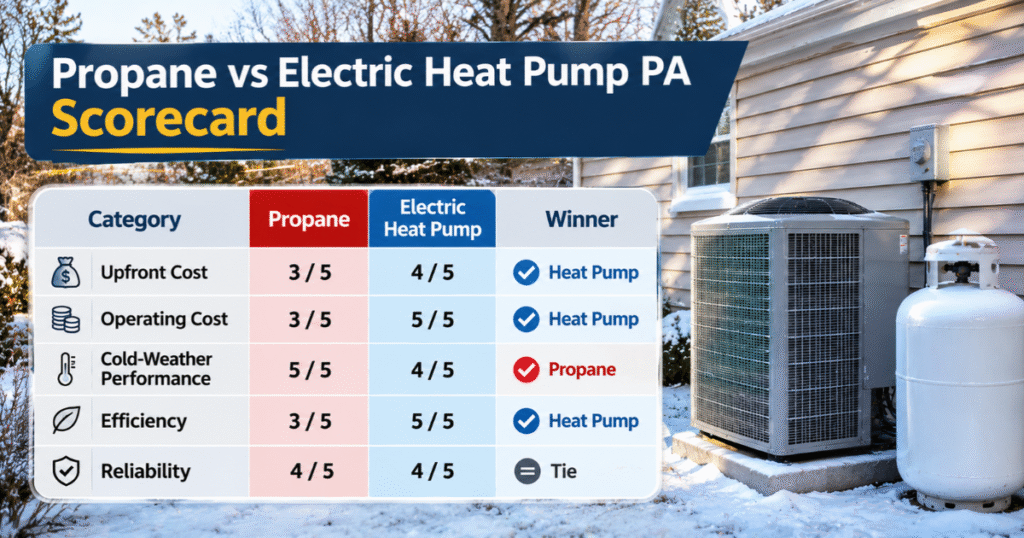
Here is the propane vs electric heat pump PA scorecard at a glance.
| Factor | Propane Furnace | Electric Heat Pump | Edge |
|---|---|---|---|
| Installed cost | $3,700 to $14,200 | $5,800 to $13,000 | Propane |
| Running cost (2026 prices) | About $38 per million BTU | About $20 to $24 per million BTU | Heat pump |
| Coldest nights | Full output | Reduced output | Propane |
| Air conditioning | Needs a separate AC | Built in | Heat pump |
| Rebates | Rare | Up to $325 (PPL), more if income-qualified | Heat pump |
| Generator needs | Small | Large | Propane |
Propane vs Electric Heat Pump PA: Is Dual Fuel the Best of Both?
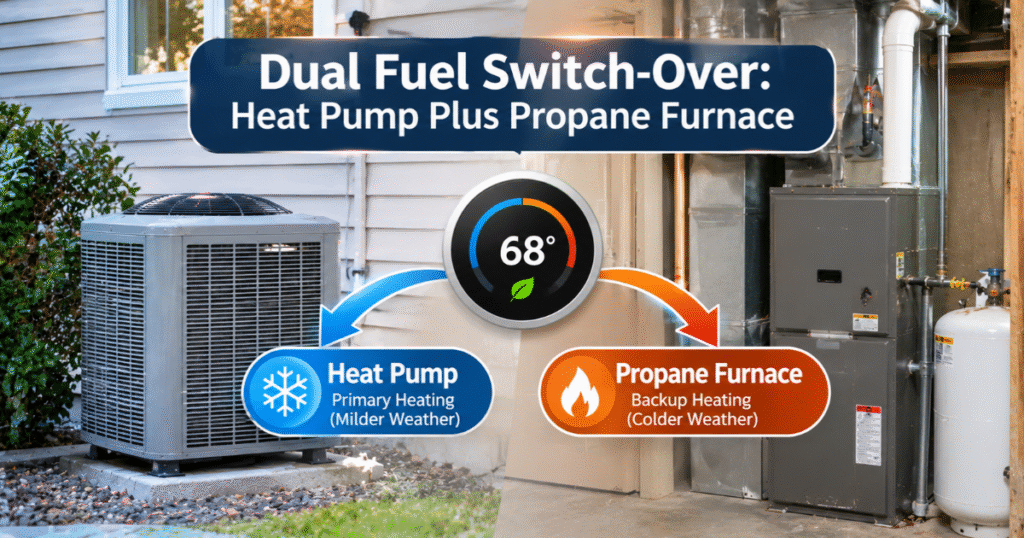
A dual fuel system pairs an electric heat pump with a propane furnace. The heat pump handles mild and moderately cold days. When it gets very cold, the system switches to propane instead of costly electric strips. For many homes, this settles the propane vs electric heat pump PA debate by using each fuel where it is strongest.
How the Switch-Over Temperature Works
In a dual fuel propane vs electric heat pump PA setup, your thermostat or control board switches to propane below a set outdoor temperature. With today’s prices, a heat pump at a COP of 1.75 still costs about $34 per million BTU, slightly less than a 95% propane furnace. That means a cold-climate heat pump stays cheaper into the single digits, so the switch-over is often set for comfort and capacity rather than cost.
Who Should Choose Dual Fuel
- Homes that already have a working propane furnace and need a new AC
- Older or drafty homes with a high heat load
- Families who want backup heat during a heat pump repair
- Homeowners who want to hedge against swings in propane or electric prices
For a broader look at fuels, see our guide to heat pump vs furnace in Central PA.
Propane vs Electric Heat Pump PA FAQ
Propane vs electric heat pump PA: which is cheaper to run?
At late-November 2026 prices, the heat pump usually wins. With Pennsylvania propane near $3.30 a gallon and electricity near 20 cents per kWh all-in, a heat pump delivers heat for about $20 to $24 per million BTU. A 95% propane furnace costs about $38. Propane only wins if electric rates climb above roughly 32 cents per kWh at that propane price.
Is a propane furnace better than a heat pump in cold weather?
In a propane vs electric heat pump PA cold-weather matchup, a propane furnace delivers full output no matter how cold it gets, while a heat pump loses capacity as temperatures fall. Cold-climate heat pumps must reach a COP of at least 1.75 at 5°F to earn the ENERGY STAR cold climate designation, so they keep heating efficiently in Central PA winters. A dual fuel setup covers the coldest nights with propane.
Can I add a heat pump to my propane furnace?
Yes. This is called a dual fuel system. The heat pump replaces your central AC outdoor unit and shares the furnace blower and ductwork. The furnace stays in place as backup heat. It is often the most cost-effective upgrade when your AC needs replacing and your propane furnace still has years of life left.
How much propane does a house use per winter in PA?
The U.S. Energy Information Administration forecasts that a propane-heated home in the Northeast will use about 515 gallons from November through March this winter, at an expected cost of about $1,687. Larger or older homes, and homes that also use propane for water heating or cooking, often use more over a full heating season.
Do heat pumps qualify for rebates in Pennsylvania?
Yes. PPL’s Act 129 program offers up to $325 on an ENERGY STAR air-source heat pump, or $350 to $475 for income-qualified households, through May 31, 2031. The federal 25C tax credit ended December 31, 2025. Pennsylvania’s Penn Energy Savers program was still awaiting final federal approval as of September 2026.
Does Tapper Energy install both propane furnaces and heat pumps?
Yes. Tapper Energy delivers propane, installs and services propane furnaces, and installs heat pumps and dual fuel systems across Harrisburg, Mechanicsburg, Camp Hill, and Central PA. Because we work with both fuels every day, we can run an honest side-by-side comparison for your home and offer a free estimate on new equipment.
Not Sure Which Is Cheaper for Your Home? Get a Free Comparison from Tapper Energy
The right answer to propane vs electric heat pump PA depends on your home, your fuel prices, and how long you plan to stay. Our family-owned, local team will look at your current system, your propane and electric bills, and your comfort goals, then show you the numbers side by side.
Call (717) 921-4822 or request a free estimate online. Maintenance plan customers also get 24-hour emergency service.
About the Author
Written by the Tapper Energy HVAC team. Our technicians diagnose and repair furnaces, AC systems, boilers, and heat pumps across Harrisburg, Mechanicsburg, and Central PA.