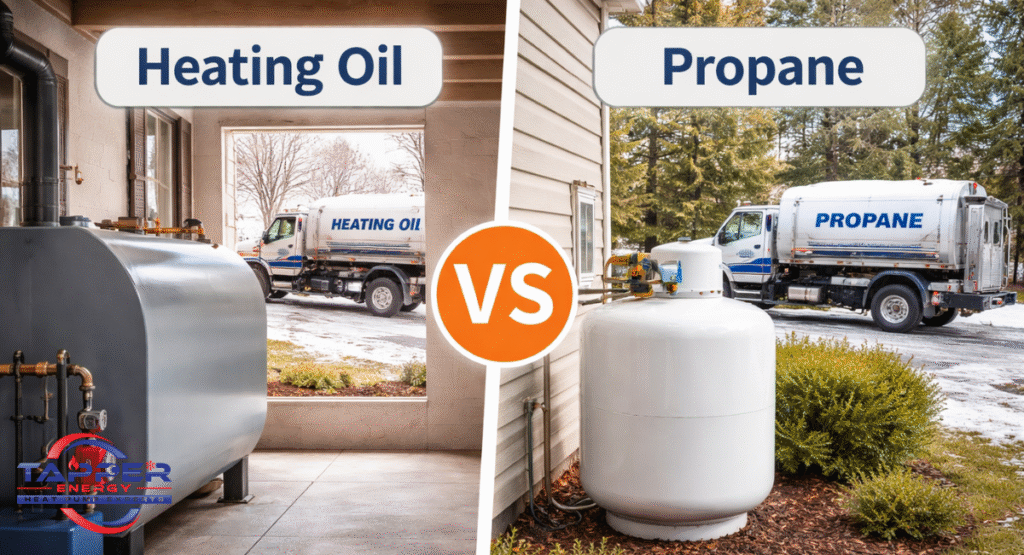
Your complete 2026 resource for comparing heating oil vs propane cost PA homeowners actually face — covering efficiency, safety, delivery, and long-term value across the Susquehanna Valley.
When heating oil vs propane cost PA homeowners pay every winter becomes the defining question of your annual energy budget, the answer matters enormously. Families across the Midstate — from the West Shore suburbs of Mechanicsburg to the rural Perry County routes near Newport and Duncannon — face this exact decision every single year. Some stick with Heating Oil #2 out of pure habit. Others are discovering that LP Gas delivers better efficiency, cleaner combustion, and more predictable pricing across a full Central PA winter season. This 2026 guide breaks down every factor that genuinely matters — cost per gallon, AFUE rating comparisons, equipment lifespan, delivery reliability, environmental impact, and real conversion costs — so you can make a fully informed energy decision for your specific Capital City region home before next heating season begins. Whether you live in Lower Paxton Township, Cumberland County suburbs, or along the Route 15 and I-81 corridors, this guide was built specifically for you.
The Big Debate: Analyzing Heating Oil vs Propane Cost PA for Homeowners
The heating oil vs propane cost PA debate isn’t settled by a single price-per-gallon comparison — it never has been. True cost analysis requires examining fuel efficiency, system performance, delivery reliability, price volatility patterns, and long-term equipment costs simultaneously. Homeowners across the Midstate who switch fuel sources based purely on today’s advertised gallon price frequently discover they missed critical cost factors that show up on their bills three months later without warning. The Capital City region energy market moves fast — and understanding all cost dimensions before committing to either fuel protects your household budget far more effectively than chasing the lowest quoted price available this week.
According to the U.S. Energy Information Administration’s residential heating fuel data, both heating oil and propane prices fluctuate significantly with crude oil markets, seasonal demand cycles, and regional supply chain pressures. Central PA homeowners in Dauphin County and Cumberland County experience these fluctuations acutely every winter — making advance price protection strategies not merely convenient but genuinely financially critical for any household managing a fixed monthly budget through a Susquehanna Valley heating season.
Comparing Price Per Gallon: Propane vs. Heating Oil in the Midstate
Raw price-per-gallon comparisons between propane and Heating Oil #2 require important context to be genuinely meaningful for Midstate homeowners. Propane typically contains approximately 91,500 BTU per gallon. Heating Oil #2 delivers approximately 138,500 BTU per gallon — a higher raw energy content per unit volume. However, that BTU advantage doesn’t automatically translate into lower operating costs when system efficiency differences are factored into the real-world calculation. A modern high-efficiency propane condensing furnace running at 96% AFUE rating frequently delivers more usable heat per dollar spent than an older oil burner operating at 78–82% efficiency — even when oil’s raw price per gallon appears lower on the surface.
The Pennsylvania Public Utility Commission’s energy comparison resources help Central PA homeowners evaluate fuel costs using equivalent heat unit calculations rather than misleading raw gallon price comparisons alone. Current heating oil prices in Harrisburg PA and surrounding Dauphin County communities fluctuate between $3.20 and $4.80 per gallon depending on market conditions and delivery timing. Propane prices across Mechanicsburg Borough and Cumberland County suburbs typically range between $2.50 and $3.90 per gallon through the same seasonal windows. The meaningful comparison requires converting both fuels to cost-per-million-BTU delivered to your living space — not cost per gallon sitting in your tank.
| Fuel Type | BTU Per Gallon | Typical PA Price Range | Cost Per Million BTU (Est.) |
|---|---|---|---|
| Propane LP Gas | 91,500 BTU | $2.50–$3.90/gal | $27–$43 |
| Heating Oil #2 | 138,500 BTU | $3.20–$4.80/gal | $23–$35 |
| Natural Gas | 100,000 BTU/therm | $1.10–$1.80/therm | $11–$18 |
| Electric Resistance | 3,412 BTU/kWh | $0.14–$0.22/kWh | $41–$64 |
How BTU Efficiency Affects Your Total Energy Bill
Raw BTU comparison numbers tell only half the story that Central PA homeowners genuinely need to understand. The other half lives in your heating system’s AFUE rating — the percentage of fuel energy actually converted into usable household heat versus lost through exhaust and system inefficiency. An oil burner carrying a 78% AFUE rating loses 22 cents of every fuel dollar straight up the flue pipe as wasted exhaust heat. A modern propane condensing furnace operating at 96% AFUE rating loses only 4 cents per dollar — delivering 92 cents of usable warmth from every dollar of LP Gas consumed throughout the heating season.
For a typical 2,000 square foot home in Lower Paxton Township or Susquehanna Township consuming 800 gallons of heating fuel annually, that efficiency gap translates into hundreds of real dollars saved per heating season — not theoretical savings on a marketing brochure but actual money remaining in your household budget every February. The U.S. Department of Energy’s heating system efficiency guidance recommends that Central PA homeowners evaluate new heating equipment using AFUE ratings as the primary comparison metric rather than fuel type or equipment price alone — because long-term operating efficiency consistently outweighs upfront equipment cost differences over any realistic ownership timeline.
Price Protection: Locking in Rates to Avoid Winter Spikes
Both propane and heating oil prices spike predictably during Central PA winter demand peaks — but the available price protection mechanisms differ meaningfully between the two fuels. Propane suppliers like Tapper Energy offer Price Cap Programs that set a firm per-gallon ceiling regardless of market movement above that ceiling — while still allowing customers to benefit automatically from any market price drops below the cap level. Budget Billing Plans spread estimated annual fuel costs across 12 equal monthly payments — eliminating the January billing shock that catches unprepared Susquehanna Valley families every single year without exception.
Heating oil price protection programs exist but vary dramatically in structure, availability, and terms between suppliers across Dauphin County and Cumberland County. Fixed-price oil contracts lock your rate completely — eliminating downside market benefit entirely. Oil budget plans function similarly to propane budget billing but are tied to more volatile crude oil pricing benchmarks that historically show greater seasonal price swings than propane markets across the same Pennsylvania winter periods. According to EIA residential propane price tracking data, Northeast propane prices have shown 15–20% less seasonal volatility than Heating Oil #2 prices over the past five consecutive heating seasons — a meaningful financial stability advantage for budget-conscious Midstate homeowners planning annual energy expenses.
Why Many Harrisburg Residents Are Making the Switch to Propane

Across Harrisburg PA neighborhoods — from established East Shore communities in Lower Paxton Township to West Shore developments near Mechanicsburg Borough — a clear and accelerating shift away from Heating Oil #2 toward LP Gas has been building momentum steadily since 2020. The reasons driving this transition are practical, financial, and environmental simultaneously. Older oil heating systems installed in Harrisburg homes during the 1970s and 1980s are reaching the natural end of their operational lifespan — and homeowners facing mandatory system replacement are overwhelmingly choosing modern propane condensing furnaces over equivalent oil system replacements when presented with honest side-by-side comparisons of long-term operating costs and system capabilities.
The infrastructure reality of Harrisburg PA neighborhoods reinforces this shift powerfully. Many East Shore and West Shore properties sit beyond natural gas pipeline reach — making propane the only realistic path to modern, high-efficiency condensing furnace performance without grid connection. Underground oil tank liability concerns have also accelerated switching decisions significantly across Dauphin County. The Pennsylvania DEP’s storage tank program documents hundreds of residential oil tank leak incidents across Central PA annually — each representing significant environmental remediation costs and property value complications that propane tank systems simply don’t carry. Heating oil vs propane cost PA analysis increasingly favors propane when tank liability, system efficiency, and long-term price stability are all evaluated together honestly.
Energy Efficiency: Which Fuel Heats Your Mechanicsburg Home Better?
Energy efficiency in residential heating isn’t an abstract environmental concept — it’s a direct and measurable determinant of how much money leaves your Mechanicsburg Borough household every month between October and March. The fuel that heats your home most efficiently is the fuel that delivers the most usable warmth per dollar spent under real Central PA winter operating conditions — not theoretical laboratory conditions or marketing materials designed to favor one fuel type over another. Heating oil vs propane cost PA efficiency comparisons must account for real-world system performance, local climate degree day monitoring data, and your specific home’s insulation and thermal characteristics to be genuinely actionable.
Modern propane heating technology has advanced dramatically over the past decade. Today’s propane condensing furnaces achieve AFUE ratings of 95–98% — performance levels that oil heating technology simply cannot match with currently available residential equipment regardless of price point. The American Council for an Energy-Efficient Economy independently validates these efficiency comparisons and provides Central PA homeowners with unbiased heating system evaluation frameworks built on verified laboratory and field performance data rather than manufacturer marketing claims.
Comparing AFUE Ratings: Propane Furnaces vs. Oil Burners
The AFUE rating gap between modern propane systems and current oil heating equipment represents the single most important efficiency factor in any honest heating oil vs propane cost PA comparison for Mechanicsburg and broader Cumberland County homeowners. Modern propane condensing furnaces achieve 95–98% AFUE ratings consistently across major equipment manufacturers. The best available residential oil burners currently reach 86–87% AFUE under optimal operating conditions — a 9–11 percentage point efficiency gap that compounds significantly over a full heating season of continuous daily operation.
For a Mechanicsburg Borough home spending $2,400 annually on heating fuel, that efficiency gap represents $216–$264 in direct annual savings at current fuel prices — savings that accumulate year after year across the full operational lifespan of the installed system. Over a 15-year equipment lifecycle, that efficiency advantage produces $3,240–$3,960 in cumulative fuel savings from efficiency alone — before accounting for any fuel price differential between propane and Heating Oil #2 over that same period. The U.S. Department of Energy’s AFUE standards documentation establishes minimum federal efficiency requirements and helps Pennsylvania homeowners identify qualifying high-efficiency equipment for available rebate programs.
| System Type | Typical AFUE Rating | Annual Fuel Waste | Est. Annual Savings vs 78% System |
|---|---|---|---|
| Propane Condensing Furnace | 95–98% | 2–5% | $180–$264 |
| High-Efficiency Oil Burner | 85–87% | 13–15% | $60–$84 |
| Standard Oil Burner | 78–82% | 18–22% | Baseline |
| Electric Heat Pump | 175–300%* | N/A | Varies significantly |
*Heat pumps move existing heat rather than generating it — efficiency expressed as COP ratio
Beyond the Furnace: Powering Water Heaters and Stoves with Propane
Propane’s efficiency advantage extends meaningfully beyond central heating into every fuel-consuming appliance in your Central PA home. A propane tankless water heater delivers hot water on demand at 94–96% thermal efficiency — outperforming both electric resistance water heaters and oil-fired hot water systems by significant measurable margins. Mechanicsburg Borough and Cumberland County suburbs homeowners who convert their entire home to propane — heating, water heating, cooking, and clothes drying simultaneously — typically report total annual energy bill reductions of 18–25% compared to equivalent whole-home oil and electric system combinations.
Propane cooking delivers the precise, instant temperature control that professional chefs and serious home cooks specifically seek — a meaningful lifestyle quality factor that Capital City region homeowners increasingly cite as a secondary conversion motivation beyond pure economics. Propane clothes dryers reduce drying cycle times by approximately 25% compared to electric alternatives while consuming less energy per load — a practical daily efficiency benefit that accumulates meaningfully across hundreds of annual drying cycles. These multi-appliance efficiency advantages compound the central heating BTU comparison benefits — making whole-home propane conversion an increasingly compelling financial proposition for Susquehanna Valley families evaluating total annual energy expenditure comprehensively.
Equipment Maintenance and Longevity in Central PA Climates
Equipment maintenance costs and system operational lifespan represent two frequently overlooked factors in heating oil vs propane cost PA total cost of ownership comparisons. Central PA winters — with their characteristic temperature swings, humidity cycles, and extended cold periods across Dauphin County and Cumberland County — stress heating equipment differently than milder climate regions. Understanding how propane and oil systems age under real Susquehanna Valley operating conditions helps homeowners make equipment investment decisions based on verified long-term performance data rather than optimistic manufacturer warranty language.
Propane burns considerably cleaner than Heating Oil #2 at the combustion chemistry level — producing significantly less carbon buildup, soot accumulation, and combustion byproduct residue inside burner assemblies, heat exchangers, and flue systems. That cleaner combustion profile directly translates into reduced maintenance frequency requirements, lower annual service costs, and measurably longer operational lifespans for propane heating equipment compared to equivalent oil systems operating under identical Central PA climate conditions and usage patterns.
The Lifespan of Propane Systems vs. Oil Heating Units
A properly installed and regularly maintained propane furnace or boiler in Central PA climate conditions realistically operates for 20–25 years before requiring major component replacement or full system retirement. Well-maintained oil heating systems in equivalent Susquehanna Valley climate conditions typically reach 15–20 years of reliable operation before heat exchanger degradation, burner wear, or combustion efficiency decline necessitates significant repair investment or complete system replacement. That 5-year average lifespan advantage for propane systems — spread across a 25-year homeownership period — effectively means Mechanicsburg and Harrisburg homeowners with propane systems purchase one fewer complete heating system replacement during typical long-term property ownership compared to equivalent oil system owners.
The financial implication of that single avoided system replacement is substantial. A complete oil heating system replacement in Cumberland County or Dauphin County currently costs $4,500–$8,500 including equipment, labor, and disposal — depending on system size and installation complexity. Avoiding one full replacement cycle over a 25-year ownership period represents genuine long-term savings that rarely appear in short-term heating oil vs propane cost PA cost comparisons but materially affect total lifetime energy infrastructure investment for Central PA homeowners evaluating fuel conversion decisions with long-term ownership horizons.
Keeping Your System Running: Annual Tune-Up Requirements in the Susquehanna Valley
Both propane and oil heating systems require annual professional maintenance inspections to operate safely, efficiently, and within manufacturer warranty terms throughout their operational lifespan. However, the scope, duration, and cost of those annual tune-ups differ meaningfully between fuel types — creating a maintenance cost differential that accumulates significantly across Susquehanna Valley heating seasons. Annual propane system tune-ups typically involve burner inspection and cleaning, pressure test and safety inspection of gas connections and the propane regulator, heat exchanger examination, flue inspection, and thermostat calibration verification — a service call typically completed in 60–90 minutes by a certified technician.
Oil system annual tune-ups require all equivalent inspections plus mandatory nozzle replacement, fuel filter changes, oil pump pressure testing, combustion chamber cleaning, and flue system soot removal — procedures that extend service time to 2–3 hours and carry higher parts costs than comparable propane maintenance visits. The Pennsylvania Department of Environmental Protection recommends annual professional inspections for all residential heating systems operating across Central PA — and their guidance specifically notes that oil systems accumulate combustion deposits at rates requiring more intensive annual service intervention than equivalent propane or natural gas systems operating under identical climate conditions.
Storage and Safety: Comparing Oil Tanks and Propane Tanks
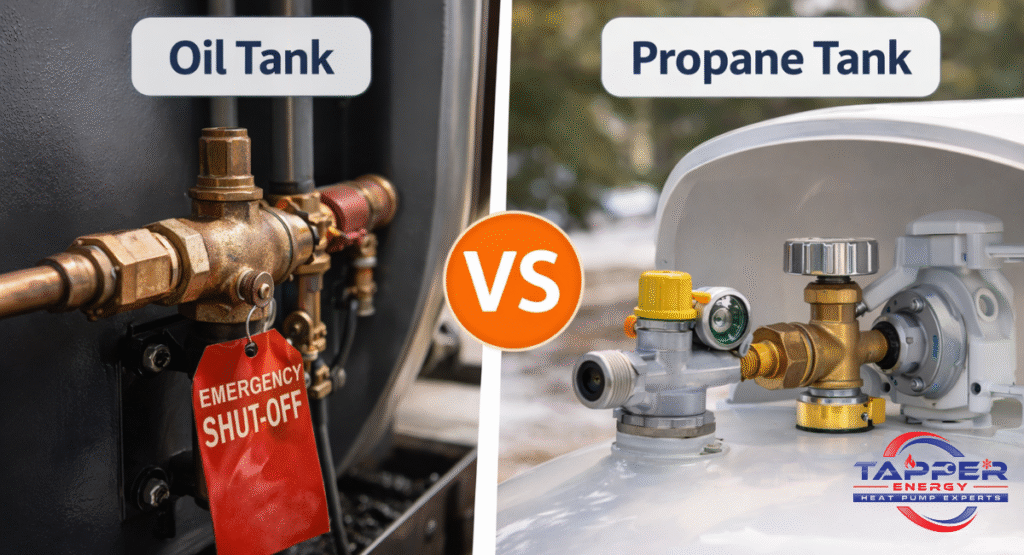
Fuel storage represents a critical safety, environmental, and financial consideration that heating oil vs propane cost PA comparisons must address honestly and completely. Both Heating Oil #2 and LP Gas require on-site storage tanks — but the regulatory requirements, environmental liability profiles, insurance implications, and long-term maintenance obligations associated with each tank type differ substantially in ways that directly affect Central PA homeowners across Dauphin, Cumberland, and Perry Counties.
Heating oil underground storage tanks — particularly older steel tanks installed before modern corrosion-resistant coating requirements — represent a documented environmental liability risk that Pennsylvania regulators, insurance underwriters, and real estate professionals all treat with increasing seriousness. The Pennsylvania DEP Underground Storage Tank program maintains active remediation records for thousands of residential oil tank leak incidents across Central PA — each representing cleanup costs ranging from $15,000 to over $100,000 depending on contamination extent and soil conditions. Propane tanks — whether above-ground or underground — don’t carry equivalent soil contamination risk because LP Gas dissipates safely as a vapor in the unlikely event of a leak rather than saturating surrounding soil with liquid petroleum contamination.
Underground vs. Above-Ground: Space-Saving Solutions for Smaller Lots in Camp Hill
Camp Hill Borough and surrounding West Shore communities present a specific storage challenge that many Cumberland County suburbs homeowners navigate annually — smaller residential lots with limited outdoor space, active HOA architectural review requirements, and neighbors close enough to notice every equipment installation decision. Above-ground 500-gallon residential tanks provide the most cost-effective propane storage solution at $300–$800 installed — but their visible presence requires careful placement planning relative to HOA guidelines, municipal setback ordinances, and practical bobtail delivery truck access requirements.
Underground propane tank installation eliminates all surface visibility concerns completely — making it the preferred solution for Camp Hill Borough and Mechanicsburg Borough properties where HOA restrictions or aesthetic priorities make above-ground tanks impractical or prohibited. Underground installations require professional soil composition testing, engineered compacted backfill, mandatory cathodic protection anode systems to prevent electrochemical corrosion, and correctly positioned access lids meeting both safety codes and delivery access needs. Pennsylvania’s 36-inch frost line depth requirement across Dauphin and Cumberland Counties adds installation cost compared to warmer-climate states — but the resulting underground installation performs reliably and safely across decades of Susquehanna Valley temperature cycling without surface visibility impact on your property.
| Storage Factor | Above-Ground Propane | Underground Propane | Heating Oil Tank |
|---|---|---|---|
| Installation Cost | $300–$800 | $1,500–$3,000+ | $800–$2,500 |
| Visibility Impact | Visible | Invisible | Visible or buried |
| Soil Contamination Risk | None | None | Significant if leaking |
| HOA Compatibility | Sometimes restricted | Generally approved | Varies |
| Cathodic Protection Required | No | Yes | N/A |
| PA Frost Line Compliance | N/A | 36″ minimum depth | N/A |
| Insurance Liability | Minimal | Minimal | Elevated for older tanks |
| Regulatory Oversight | Standard | DEP registration | DEP registration required |
Environmental Impact: Why Propane is the “Green” Choice for Dauphin County
Environmental performance increasingly influences residential fuel decisions across Dauphin County and Cumberland County — driven by growing homeowner environmental awareness, evolving municipal sustainability initiatives, and practical concerns about long-term property value in communities where environmental compliance is increasingly scrutinized during real estate transactions. Propane burns significantly cleaner than Heating Oil #2 across every meaningful emissions category — producing approximately 43% less carbon dioxide per BTU delivered, virtually zero sulfur dioxide emissions, dramatically reduced particulate matter output, and no risk of soil or groundwater contamination from storage or delivery operations.
The U.S. Environmental Protection Agency’s clean energy resources provide Central PA homeowners with verified emissions comparison data showing propane’s measurable carbon footprint reduction advantage over petroleum-based heating fuels under real residential operating conditions. LP Gas is specifically classified as an approved clean fuel under the federal Clean Air Act — a regulatory designation that Heating Oil #2 does not hold and cannot qualify for under current emissions standards. For Dauphin County homeowners evaluating fuel choices with genuine environmental consciousness alongside economic considerations, propane’s clean combustion profile, zero soil contamination risk, and established clean fuel regulatory status represent meaningful and verifiable advantages that extend well beyond marketing language into documented environmental science.
Delivery Reliability: Never Running Out in Newport and Duncannon
For rural Perry County communities like Newport and Duncannon — where LP Gas serves as the only realistic residential heating fuel option available beyond electric resistance heating — delivery reliability isn’t a customer service preference. It’s a fundamental household safety requirement that determines whether families stay warm through the most severe Susquehanna Valley winter weather events. Route 15 and I-81 corridors present distinct seasonal delivery logistics challenges that only locally experienced propane suppliers with genuine Perry County route knowledge can navigate reliably when conditions deteriorate.
Tapper Energy’s delivery operations across Perry County rural routes account specifically for seasonal road weight restrictions near creek crossings, steep grade limitations affecting heavy bobtail delivery truck passage, and remote properties where GPS navigation provides inaccurate or completely impossible routing directions. Automatic delivery customers in Newport, Duncannon, and surrounding Perry County communities receive priority scheduling that accounts for these access realities proactively — ensuring tanks never approach critically low levels during precisely the severe weather periods when emergency delivery scheduling becomes most logistically difficult and time-sensitive.
The Convenience of Automatic Delivery Services
Automatic fuel replenishment using degree day monitoring represents the most reliable and genuinely stress-free propane delivery model available to Central PA homeowners — particularly those in rural Perry County and outlying Cumberland County communities where weather-related road access complications make last-minute emergency delivery orders logistically challenging. Degree day monitoring systems track cumulative outdoor temperature data continuously and calculate each customer’s projected fuel consumption based on their specific home’s verified usage history — scheduling proactive deliveries before tanks approach 20–25% remaining capacity under any foreseeable weather scenario.
For Newport and Duncannon homeowners managing larger 500-gallon residential tanks to accommodate extended delivery intervals between Perry County rural route service visits, automatic delivery provides an additional critical layer of supply security. The system accounts for extended cold periods, back-to-back storm events, and unusual consumption spikes during severe cold snaps — scheduling adjusted delivery timing proactively rather than reactively after tank levels have already dropped to concerning levels. According to the National Propane Gas Association’s consumer safety resources, automatic delivery customers experience significantly fewer dangerous low-tank emergency situations than equivalent will-call customers — a safety outcome with particular importance for elderly Perry County residents managing fixed daily routines through Susquehanna Valley winters.
Monitoring Your Usage: Smart Tank Technology for PA Homeowners
Smart tank gauge and monitoring technology has transformed residential propane management for Central PA homeowners over the past five years — moving fuel level awareness from periodic manual gauge checks to continuous real-time digital monitoring accessible from any smartphone regardless of location. Wireless tank monitors attach directly to your 500-gallon residential tank‘s existing gauge assembly and transmit continuous level readings to your supplier’s dispatch system and simultaneously to your personal smartphone app — providing always-current fuel level visibility without requiring physical access to your tank location.
For Mechanicsburg Borough and Cumberland County suburbs homeowners managing properties with underground tanks where manual gauge checking requires outdoor access in winter weather, smart monitoring technology delivers particular practical value. The system alerts both you and your supplier automatically when tank levels approach pre-set threshold percentages — triggering proactive delivery scheduling before any shortage risk develops. Degree day monitoring integrated with smart tank data creates a dual-verification supply management system that virtually eliminates run-out risk for any Central PA homeowner enrolled in automatic delivery service regardless of their geographic location within the Dauphin, Cumberland, or Perry County service territory.
The Logistics of Switching: How to Convert from Oil to Propane in Central PA
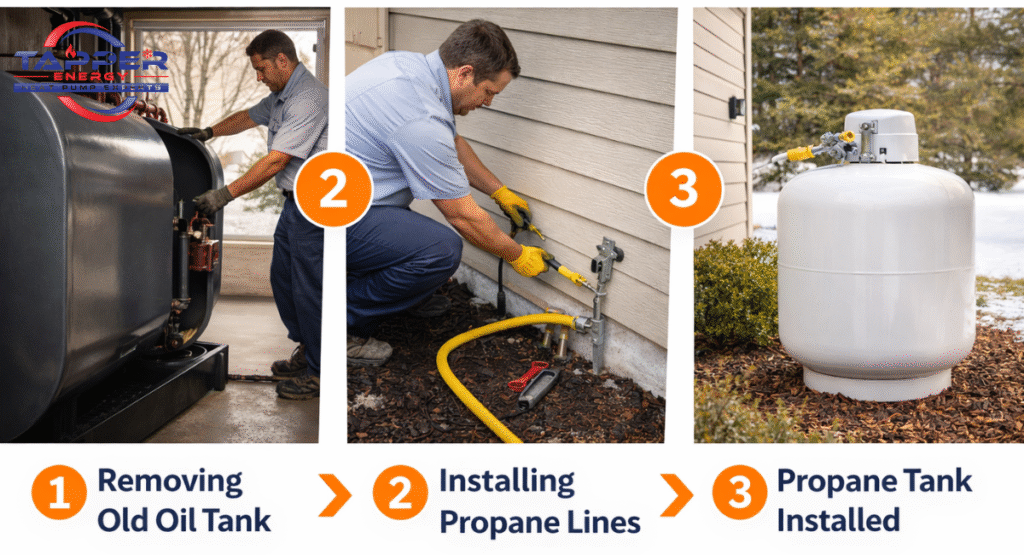
Converting from Heating Oil #2 to LP Gas in Central PA involves a defined sequence of professional steps — each manageable and clearly structured when guided by experienced local propane professionals who understand Pennsylvania’s specific regulatory requirements and local installation standards. The heating oil vs propane cost PA calculation shifts decisively in propane’s favor once homeowners understand that conversion costs are frequently offset by available energy efficiency rebates and long-term operating savings realized within three to five years of successful conversion completion.
The complete conversion process involves four primary phases: safe removal and disposal of your existing oil storage tank, soil testing if an underground tank was present, new propane system installation including tank placement and appliance connections, and final pressure test and safety inspection certification before first fuel delivery. Tapper Energy manages every phase of this process for Dauphin County, Cumberland County, and Perry County homeowners — coordinating contractors, permits, inspections, and equipment installation under single-point accountability so you’re never left coordinating multiple independent vendors through an unfamiliar technical process without professional guidance.
Safely Removing Your Old Heating Oil Tank
Old heating oil tank removal — particularly for underground steel tanks installed before modern corrosion-resistant coating requirements — requires certified professional handling that follows both Pennsylvania DEP protocols and local municipal requirements across Cumberland County and Dauphin County jurisdictions. Above-ground oil tanks are decommissioned by certified technicians who purge remaining fuel, clean internal tank surfaces, disconnect all piping safely, and arrange compliant disposal through licensed petroleum waste handling contractors. The process typically completes within one business day for standard residential above-ground tank sizes.
Underground oil tank removal requires soil excavation, professional tank extraction, and mandatory tank removal and soil testing conducted by a Pennsylvania-certified environmental professional who collects soil samples from multiple excavation points and submits them for laboratory analysis. If soil contamination from historical tank seepage is detected — a situation the Pennsylvania DEP’s land recycling program addresses through established remediation pathways — your environmental professional coordinates appropriate cleanup procedures and required DEP notification filings. Most Central PA underground tank removals complete without significant contamination findings — but professional soil testing is legally required regardless of visible contamination evidence and should never be omitted to reduce upfront conversion costs.
No-Hassle Installation and New Equipment Rebates
Following successful tank removal and soil clearance confirmation, propane system installation proceeds through a structured sequence that experienced Central PA propane professionals complete efficiently and with minimal household disruption. New propane tank placement — either above-ground or underground based on your property specifications and preferences — is followed by regulator installation, service line connection, appliance conversion or replacement, and comprehensive system pressure test and safety inspection before any fuel is introduced to the new system for the first time.
Energy efficiency rebates available through Pennsylvania programs and federal tax incentives meaningfully offset conversion costs for Central PA homeowners choosing high-efficiency propane equipment. The Pennsylvania Department of Environmental Protection’s energy programs and ENERGY STAR federal rebate programs provide qualifying Dauphin County and Cumberland County homeowners with rebates of $300–$2,000 for certified high-efficiency propane condensing furnace installations — rebates that reduce effective conversion costs substantially when claimed correctly through the application process. Off-peak delivery rates available through Tapper Energy during non-peak installation periods further reduce first-year propane costs for newly converted Central PA customers establishing initial 500-gallon residential tank fills during spring or summer months.
Navigating Local Zoning and Safety Regulations in Cumberland County
Cumberland County municipalities — including Mechanicsburg Borough, Silver Spring Township, Upper Allen Township, and Camp Hill Borough — each maintain specific local zoning ordinances governing propane tank placement distances from property lines, structures, and public rights-of-way. These local setback requirements overlay Pennsylvania’s statewide DEP regulations and must be researched and satisfied independently for each specific installation address before tank placement begins. Navigating these overlapping regulatory layers without experienced professional guidance creates unnecessary delays, permit rejections, and potential installation cost increases that experienced local propane professionals help you avoid entirely.
Tapper Energy’s installation team maintains current working knowledge of Cumberland County municipal zoning requirements and actively coordinates permit applications, inspection scheduling, and regulatory compliance documentation as a standard component of every new customer installation project — not as an optional add-on service available at additional cost. The Pennsylvania Propane Gas Association provides statewide regulatory guidance and certified installer directories that Central PA homeowners can reference when evaluating any propane contractor’s credentials and compliance knowledge before engaging their installation services. Proper regulatory navigation from the first permit application prevents costly post-installation correction requirements that delay your conversion completion and first fuel delivery.
Resale Value: Does Upgrading to Propane Increase Your Home’s Worth?
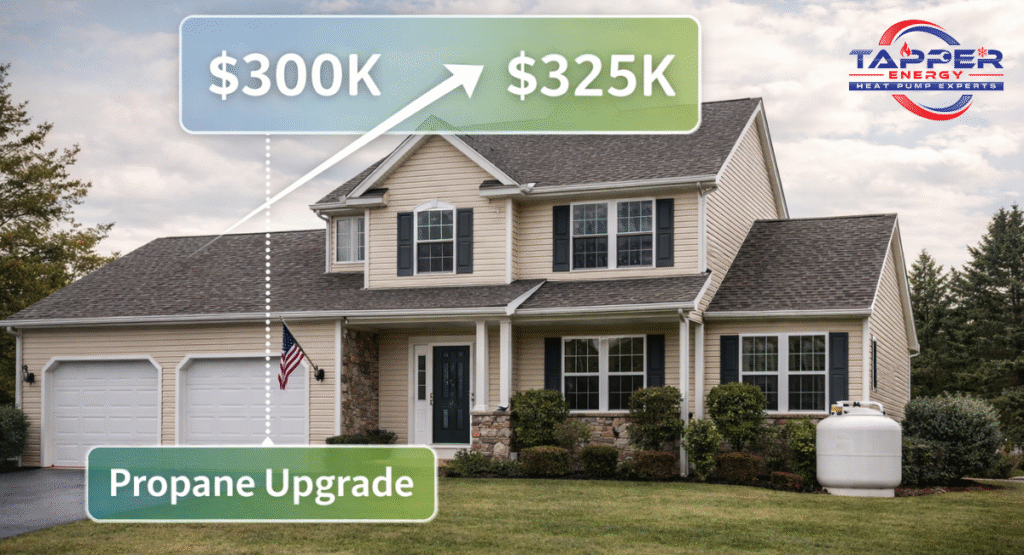
The competitive Mechanicsburg Borough and broader Cumberland County real estate market increasingly reflects buyer preference for modern, high-efficiency propane heating systems over aging oil heating infrastructure — a market reality that makes fuel conversion decisions relevant not just to current monthly energy costs but to long-term property value and marketability. Real estate professionals operating across the Midstate consistently report that properties featuring modern propane condensing furnace systems, propane water heaters, and propane cooking appliances generate stronger buyer interest and more competitive offer pricing than equivalent properties with aging oil heating systems requiring near-term replacement investment.
The financial logic driving this buyer preference is straightforward and rational. A prospective buyer evaluating a Mechanicsburg property with a 12-year-old oil burner at 80% AFUE rating mentally prices in a near-term $5,000–$8,000 system replacement cost — reducing their effective offer price accordingly. The same buyer evaluating an equivalent property with a recently installed 97% AFUE rating propane condensing furnace sees a modern, efficient, low-maintenance system with 15+ years of remaining reliable operational life — and prices their offer without the mental deduction for imminent capital expenditure. According to National Association of Realtors research on home features, energy-efficient heating systems consistently rank among the top features influencing buyer purchasing decisions in competitive suburban real estate markets — precisely the market conditions defining Mechanicsburg Borough and surrounding Cumberland County suburbs in 2026.
Switching to propane for better home resale value in Central PA isn’t a marketing claim — it’s a documented market reality that experienced local real estate professionals across Dauphin County and Cumberland County observe consistently in active transaction data. Modern propane systems signal overall property maintenance quality, energy consciousness, and reduced near-term capital expenditure requirements — all factors that sophisticated buyers in competitive Midstate markets actively evaluate and price into their offer decisions.
Beyond Heating: The Year-Round Benefits of Propane for Midstate Families
LP Gas delivers genuine household value across every calendar month — not just during the November-through-March heating season that dominates most homeowner conversations about propane. Midstate families who leverage propane’s full year-round application range extract substantially more value from their existing tank infrastructure and supplier relationship than those who treat propane exclusively as a winter heating fuel. Year-round propane usage also strengthens your supplier relationship — creating the account familiarity and usage history that supports better automatic delivery scheduling, more accurate annual consumption projections, and faster emergency response prioritization when severe Susquehanna Valley weather creates competing service demands.
The year-round propane lifestyle particularly resonates with Central PA homeowners who invest in their properties as multi-season living environments rather than purely functional winter shelters. Propane fireplaces extend comfortable living seasons into outdoor spaces. Propane generators protect household continuity through storm seasons. Propane cooking appliances deliver daily quality-of-life benefits that compound across hundreds of annual meal preparation sessions. Together these applications transform propane from a single-purpose winter heating fuel into a comprehensive household energy infrastructure investment with measurable year-round returns.
Propane Fireplaces for Cozy Harrisburg Winters
A propane fireplace in a Harrisburg PA home delivers genuine supplemental heating capability alongside the atmospheric warmth and visual ambiance that homeowners across the East Shore and West Shore increasingly seek as primary living space features rather than decorative afterthoughts. Unlike wood-burning fireplaces requiring cord wood storage, regular chimney cleaning, and ash disposal management, propane fireplaces start instantly with a switch or remote control — delivering immediate radiant warmth and adjustable flame output without any combustion byproduct accumulation in your living space.
Modern propane fireplace inserts installed in existing Harrisburg home fireplaces achieve thermal efficiencies of 70–85% — dramatically outperforming traditional wood-burning fireplaces that lose 80–90% of combustion heat through the chimney. As zone heating tools, propane fireplaces allow Dauphin County homeowners to lower central thermostat settings by 3–5 degrees in unoccupied areas of the home while maintaining comfortable temperatures in actively used living spaces — a targeted efficiency strategy that reduces overall LP Gas consumption meaningfully across a full Central PA heating season without sacrificing household comfort in occupied areas.
Reliable Cooking and Back-up Power During Storms
Susquehanna Valley storm seasons — spanning late-summer microbursts through winter nor’easters along the Route 15 and I-81 corridors — regularly disrupt grid power for Dauphin County and Cumberland County households for hours or occasionally multiple consecutive days. A propane whole-home standby generator connected to your existing 500-gallon residential tank activates automatically within seconds of grid failure detection — keeping your furnace, refrigerator, sump pump, medical equipment, and essential lighting operating continuously without any manual intervention required from you or your family members.
Propane cooking appliances provide an additional storm resilience layer that electric cooking entirely lacks — propane ranges and cooktops function completely independently of grid power, allowing Harrisburg and Mechanicsburg families to prepare hot meals normally throughout extended power outages that leave neighbors with electric cooking appliances dependent on cold food and emergency restaurant alternatives. According to FEMA’s household emergency preparedness guidelines, homes with fuel-independent cooking and backup power generation capabilities recover from extended grid outages with significantly less disruption and financial impact than unprepared households — making propane’s storm resilience capability a genuine household emergency preparedness asset beyond its primary heating and comfort applications.
Conclusion: Making the Right Choice for Your Central PA Property
The heating oil vs propane cost PA analysis presented throughout this guide points consistently toward propane as the superior long-term energy choice for the majority of Central PA homeowners across Dauphin, Cumberland, and Perry Counties — particularly those managing properties beyond natural gas pipeline reach, facing near-term oil system replacement decisions, or evaluating energy infrastructure investments with genuine long-term property value consciousness. Propane’s higher AFUE rating ceiling, cleaner combustion profile, lower environmental liability exposure, superior delivery reliability through automatic fuel replenishment technology, and growing real estate market preference advantage combine into a compelling multi-dimensional case that extends well beyond any single per-gallon price comparison.
That said, the genuinely right answer for your specific Central PA property depends on your current system age, your property’s specific geographic location and tank access characteristics, your household’s annual fuel consumption patterns, and your personal financial planning preferences around fixed vs. variable energy costs. Heating oil vs propane cost PA calculations are most meaningful when performed with your specific consumption data, your local delivery pricing, and your system’s current AFUE rating as inputs — not as generic statewide averages applied to all Susquehanna Valley homes uniformly. Tapper Energy provides custom energy consultations that perform this specific analysis for your individual property — giving you a genuine apples-to-apples comparison grounded in your actual usage and local market pricing rather than regional averages that may not reflect your specific situation accurately.
Ready to Compare? Get Your Custom Energy Consultation from Tapper Energy
Every Central PA homeowner across Harrisburg, Mechanicsburg, and the surrounding Susquehanna Valley deserves a fuel decision based on honest, complete, property-specific analysis — not generic advertising claims from suppliers with obvious financial interests in your choice. Tapper Energy’s energy consultation process provides exactly that honest analysis — comparing your current heating oil vs propane cost PA reality against projected propane operating costs using your verified consumption data, your local delivery pricing, your system’s current efficiency rating, and available energy efficiency rebates that reduce your effective conversion investment.
The consultation is completely free, entirely pressure-free, and specifically designed to give you the information you genuinely need to make the right long-term energy decision for your Central PA property — whether that decision ultimately favors propane conversion or confirms that your current oil system remains your best near-term option. Don’t make a multi-decade energy infrastructure decision based on incomplete information or single-metric price comparisons that ignore the efficiency, reliability, environmental, and resale value factors that determine true long-term energy costs for Dauphin County, Cumberland County, and Perry County homeowners.
Make the call today — your custom energy consultation is one conversation away.
👉 Schedule Your Free Energy Consultation — Contact Tapper Energy
📞 Call directly for immediate consultation scheduling across Dauphin, Cumberland, and Perry Counties
🔗 Learn more about Propane Delivery in Harrisburg PA
🔗 Explore Propane Services in Mechanicsburg PA
Frequently Asked Questions: Heating Oil vs Propane Cost PA
Is propane cheaper than oil in Pennsylvania in 2026? On a raw per-gallon basis, propane and Heating Oil #2 prices fluctuate relative to each other throughout the year based on crude oil markets and seasonal demand. However, when BTU comparison analysis converts both fuels to cost-per-million-BTU-delivered using real system AFUE ratings, modern high-efficiency propane systems frequently deliver lower effective heating costs per unit of usable warmth — particularly when compared against older oil systems operating at 78–82% efficiency in Dauphin County and Cumberland County homes.
What does converting from oil to propane cost in 2026 in Central PA? Complete oil-to-propane conversion in Central PA typically costs $3,500–$8,500 depending on system size, tank type selection, existing oil tank removal requirements, and soil testing needs for underground tank sites. Available energy efficiency rebates through Pennsylvania DEP programs and federal ENERGY STAR incentives can reduce effective conversion costs by $300–$2,000 for qualifying high-efficiency equipment installations — making the net conversion investment considerably more manageable than gross cost figures suggest for most Susquehanna Valley homeowners.
How does degree day monitoring improve propane delivery reliability? Degree day monitoring tracks cumulative outdoor temperature data and calculates projected fuel consumption based on your home’s verified usage history — allowing your propane supplier to schedule proactive deliveries before your 500-gallon residential tank approaches critically low levels. This system virtually eliminates run-out risk for automatic fuel replenishment customers across Perry County rural routes, Cumberland County suburbs, and Dauphin County neighborhoods regardless of how severe the current weather event affecting delivery scheduling may be.
Does switching to propane increase home resale value in Mechanicsburg PA? Yes — Mechanicsburg Borough and broader Cumberland County real estate market data consistently shows that modern high-efficiency propane systems generate stronger buyer interest and more competitive offer pricing than aging oil heating infrastructure. Buyers factor near-term oil system replacement costs into their offer calculations — making recently installed propane condensing furnaces a genuine property value asset in the competitive Central PA real estate market of 2026.
What propane safety steps should Central PA homeowners follow? The Consumer Product Safety Commission’s propane safety guidelines recommend annual professional system inspections, pressure test and safety inspection of all connections and regulators, carbon monoxide detector installation near all propane appliances, and immediate evacuation followed by outdoor emergency service calls if any gas odor is detected. Never attempt to adjust your propane regulator or investigate gas leaks personally — always evacuate immediately and call emergency services from a safe outdoor location before any investigation occurs.
Tapper Energy proudly serves homeowners across the Susquehanna Valley — providing reliable LP Gas delivery, expert propane tank installation, and honest energy consultation services throughout Dauphin County, Cumberland County, and Perry County. From propane delivery in Harrisburg PA to comprehensive propane services in Mechanicsburg PA — local knowledge, transparent pricing, and genuine community commitment every season.